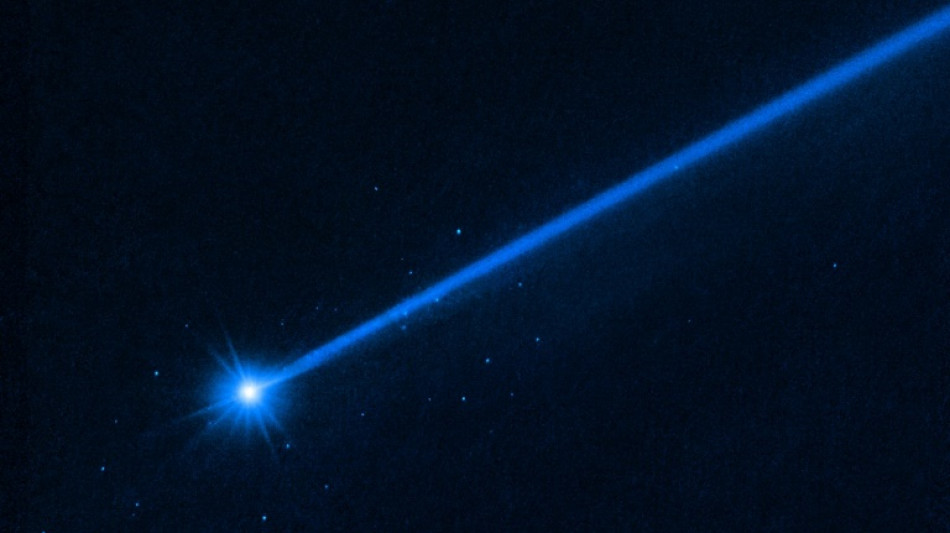
Asteroid-smashing NASA probe sent boulders into space / Photo: © Space Telescope Science Institute/AFP

 Dodgers return to Trump White House despite fan anger

 Lyles, Richardson ease into 100m semis at US athletics championships

 Salman Rushdie testifies at knife attacker's US terror trial

 World Bank confirms plan to phase out China lending by 2031

 US panel backs trendy peptides despite safety concerns

 Justice Dept withdraws NY Times subpoenas over Trump plane report

 Barcelona's De Jong returns from World Cup with torn ligament
 Albania police teargas protesters against Trump-linked resort
 US panel says to loosen restrictions on popular peptide despite safety concerns

 Verstappen swerves around future questions

 EU renews online child sex abuse detection powers

 Airbus, Boeing fly in different directions at Farnborough

 Bab al-Mandeb Strait: another key oil shipping route under threat
 Deadly wildfires in Europe force thousands to flee

 NATO to overhaul European fuel pipeline network

 US trade envoy to make tariff announcement as 10% duty soon expires

 Trump stuns Saudis by pinning nuclear deal to Israel ties

 Tough day for Ubisoft stock topped with weaker revenues

 Swelling jet fuel costs hit American Airlines outlook
 Carapaz climbs unopposed to Tour de France 18th stage win

 Sooryavanshi hits maiden 50 as India thump Zimbabwe in T20

 ECB opens door to September rate-hike as Iran war flares up

 World Bank estimates Venezuela quakes caused $19.6 bn in damage

 Italy's far-right line up to defend jeweller who killed robbers

 AI-led boom in IPOs raises concerns about a bust

When a NASA spacecraft successfully knocked an asteroid off course last year it sent dozens of boulders skittering into space, images from the Hubble telescope showed on Thursday.
NASA's fridge-sized DART probe smashed into the pyramid-sized, rugby ball-shaped asteroid Dimorphos roughly 11 million kilometres (6.8 million miles) from Earth in September last year.
The spacecraft knocked the asteroid significantly off course in the first-ever such test of Earth's planetary defences.
New images taken by the Hubble Space Telescope show that the collision also sent 37 boulders -- ranging from one metre (three feet) to seven metres (22 feet) across -- floating into the cosmos.
They represent around two percent of the boulders that were already scattered across the surface of the loosely-held-together asteroid, scientists estimated in a new study.
The finding suggests that possible future missions to divert life-threatening asteroids heading towards Earth could also spray off boulders in our direction.
But these particular rocks do not pose any threat to Earth -- indeed they have barely gone anywhere.
They are drifting away from Dimorphos at around a kilometre (half a mile) per hour -- roughly the speed a giant tortoise walks, Hubble said in a statement.
The boulders are moving so slowly that the European Space Agency's Hera mission -- which is due to arrive at the asteroid in late 2026 to inspect the damage -- will even be able to take a look at them.
"The boulder cloud will still be dispersing when Hera arrives," said David Jewitt, a planetary scientist at the University of California at Los Angeles and lead author of the new study.
"It's like a very slowly expanding swarm of bees," he said.
The "spectacular observation" by Hubble "tells us for the first time what happens when you hit an asteroid and see material coming out," he added.
"The boulders are some of the faintest things ever imaged inside our solar system."
The dispersal of the boulders indicates that DART left a crater roughly 50 metres (160 feet) wide on Dimorphos, according to Jewitt. The whole asteroid is 170 metres across.
The scientists plan to continue following the boulders to work out their trajectory and determine how exactly they launched off the surface.
The study was published in the Astrophysical Journal Letters.
J.Fankhauser--BTB