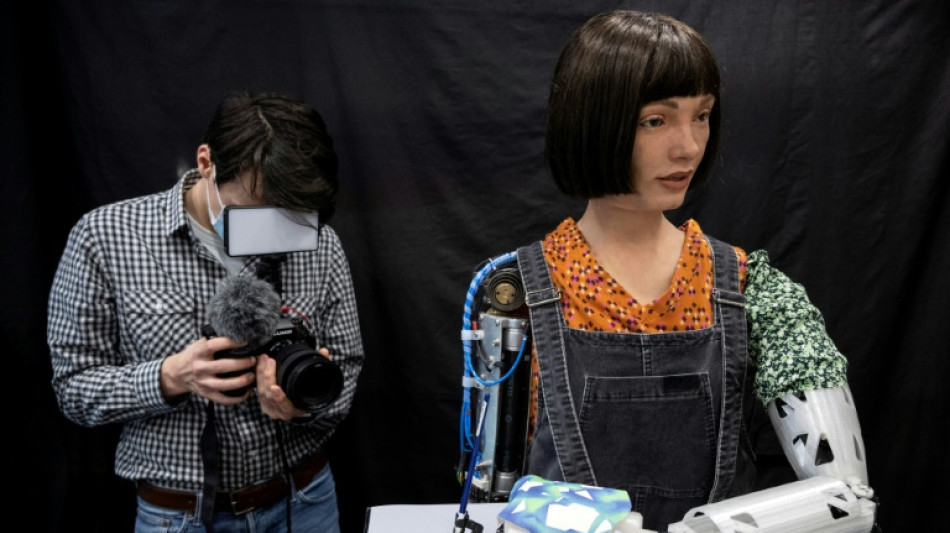
UN talks aim to harness AI power and potential / Photo: © AFP/File

 Six candidates to lead UN take stage for televised debate
 King Charles opens slimmed down Commonwealth Games in Glasgow
 US unveils new tariffs on 60 partners as Trump rebuilds trade agenda

 WNBA viral star Cunningham wades into trans athletes row
 Hearn dismisses Fury talk of Joshua no-show for super fight

 'Like a war zone': France evacuates 20,000 due to wildfires

 Ships avoid Ukrainian grain ports after Russian attacks

 Oil passes $100 a barrel again: why it's more serious this time

 Who are the six candidates vying to lead the UN?
 Hamilton proud of recovery after hitting rock bottom a year ago

 Carapaz eyes polkadot mountains jersey after stage win
 Fields medal awarded to four young mathematicians
 Carapaz claims Tour de France stage as Pogacar loses key team-mate

 Alonso welcomes Aston Martin upgrade, warns against unreal expectations
 Anderson declares Man City 'kings of Manchester' after £116 mn move
 Relieved Russell says Mercedes have solved his power problems mystery

 Oil soars above $100 as Middle East fears grow

 Venezuelans turn to scrap collecting in quake-hit beach 'paradise'

 Heptathlon champion Johnson-Thompson joins list of Commonwealth Games absentees

 Nigeria's Dangote raises $2.5bn to expand Africa's largest refinery

 Oil soars to $100 on fresh Mideast attacks
 Coal-fired power generation rising globally on Mideast war: IEA
 Premier League champions Arsenal sign Greece winger Tzolis from Brugge

 French Jewish DJ sues after activists disrupt gig: lawyer
 Venice film festival promises Pattinson, Oasis and Musk doc

The United Nations is convening this week a global gathering to try to map out the frontiers of artificial intelligence and to harness its potential for empowering humanity.
The UN hopes to lay out a clear blueprint on the way forward for handling AI, as development of the technology races ahead the capacity to set its boundaries.
The "AI for Good Global Summit", being held in Geneva on Thursday and Friday, will bring together around 3,000 experts from companies like Microsoft and Amazon as well as from universities and international organisations to try to sculpt frameworks for handling AI.
"This technology is moving fast," said Doreen Bogdan-Martin, head of the International Telecommunication Union, the UN's information and communications technology agency that convened the summit.
"It's a real opportunity for the world's leading voices on AI to come together on the global stage and to address governance issues," she told reporters.
"Doing nothing is not an option. Humanity is dependent upon it. So we have to engage and try and ensure a responsible future with AI."
She said the summit would examine possible frameworks and guardrails to support safe AI use.
Listed participants include Amazon's chief technology officer Werner Vogels, Google DeepMind chief operating officer Lila Ibrahim and former Spain football captain Iker Casillas -- who suffered a heart attack in 2019 and now advocates for AI use in heart attack prevention.
They will be joined by dozens of robots, including several humanoids like Ai-Da, the first ultra-realistic robot artist; Ameca, the world's most advanced life-like robot; the humanoid rock singer Desdemona; and Grace, the most advanced healthcare robot.
- Benefiting humanity? -
The Geneva-based ITU feels it can bring its experience to bear on AI governance.
Founded in 1865, the ITU is the oldest agency in the UN fold. It established "SOS" as the Morse code international maritime distress call in 1906, and coordinates everything from radio frequencies to satellites and 5G.
The summit wants to identify ways of using AI to advance the UN's lagging sustainable development goals on issues such as health, the climate, poverty, hunger and clean water.
Bogdan-Martin said AI must not exacerbate social inequalities or introduce biases on race, gender, politics, culture, religion or wealth.
"This summit can help ensure that AI charts the course that benefits humanity," UN chief Antonio Guterres said.
However, while AI proponents hail the technology for how it can transform society, including work, healthcare and creative pursuits, others are worried by its potential to undermine democracy.
- 'Perfect storm' -
"We're kind of in a perfect storm of suddenly having this powerful new technology -- I don't think it's super-intelligent -- being spread very widely and empowered in our lives, and we're really not prepared," said serial AI entrepreneur Gary Marcus.
"We're at a critical moment in history when we can either get this right and build the global governance we need, or get it wrong and not succeed and wind up in a bad place where a few companies control the fates of many, many people without sufficient forethought," he said.
Last month, EU lawmakers pushed the bloc closer to passing one of the world's first laws regulating systems like OpenAI's ChatGPT chatbot. There is also growing clamour to regulate AI in the United States.
ChatGPT has become a global sensation since it was launched late last year for its ability to produce human-like content, including essays, poems and conversations from simple prompts.
It has sparked a mushrooming of generative AI content, leaving lawmakers scrambling to try to figure out how to regulate such bots.
Juan Lavista Ferres, chief data scientist of the Microsoft AI For Good Lab, gave an example of how AI could be used "to make our world a better place".
He compared the more than 400 million people diagnosed with diabetes, a major cause of blindness, with the small number of ophthalmologists.
"It's physically impossible to diagnose every patient. Yet we and others have built AI models that today can take this condition with an accuracy that matches a very good ophthalmologist. This is something can even be done from a smartphone.
"Here AI is not just a solution, but it's the only solution."
K.Brown--BTB