Sustainability at centre of British polar science strategy / Photo: © AFP

 Six candidates to lead UN take stage for televised debate

 King Charles opens slimmed down Commonwealth Games in Glasgow
 US unveils new tariffs on 60 partners as Trump rebuilds trade agenda

 WNBA viral star Cunningham wades into trans athletes row

 Hearn dismisses Fury talk of Joshua no-show for super fight

 'Like a war zone': France evacuates 20,000 due to wildfires

 Ships avoid Ukrainian grain ports after Russian attacks

 Oil passes $100 a barrel again: why it's more serious this time

 Who are the six candidates vying to lead the UN?
 Hamilton proud of recovery after hitting rock bottom a year ago

 Carapaz eyes polkadot mountains jersey after stage win
 Fields medal awarded to four young mathematicians
 Carapaz claims Tour de France stage as Pogacar loses key team-mate
 Alonso welcomes Aston Martin upgrade, warns against unreal expectations

 Anderson declares Man City 'kings of Manchester' after £116 mn move

 Relieved Russell says Mercedes have solved his power problems mystery

 Oil soars above $100 as Middle East fears grow

 Venezuelans turn to scrap collecting in quake-hit beach 'paradise'

 Heptathlon champion Johnson-Thompson joins list of Commonwealth Games absentees

 Nigeria's Dangote raises $2.5bn to expand Africa's largest refinery

 Oil soars to $100 on fresh Mideast attacks

 Coal-fired power generation rising globally on Mideast war: IEA

 Premier League champions Arsenal sign Greece winger Tzolis from Brugge

 French Jewish DJ sues after activists disrupt gig: lawyer

 Venice film festival promises Pattinson, Oasis and Musk doc

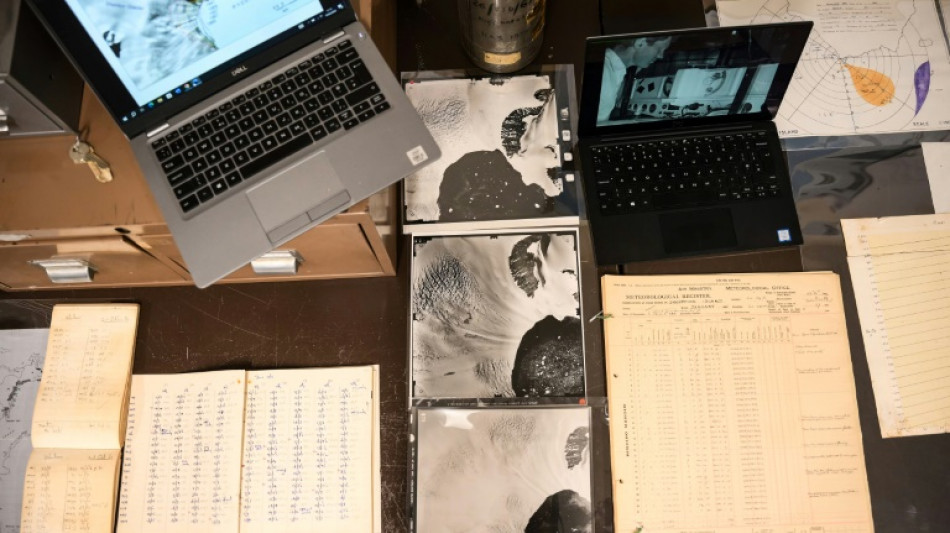
With research stations shifting to renewable energy and artificial intelligence mapping out fuel-efficient marine routes, the British Antarctic Survey is putting sustainability at the heart of its new 10-year plan.
"The main target for our strategy is really focused on climate change because the polar regions are the regions on Earth which are changing most drastically," BAS director Jane Francis said, adding that these changes are "affecting the whole planet".
"What we're trying to do is plan the future of our science more now than we used to, because I think it's really so urgent that we can understand how our climate is changing. We need to support the relevant people in making good decisions about renewable energy, about how to save carbon, and how to live in better balance with our planet," she told AFP.
At the BAS headquarters in Cambridge, eastern England, AFP saw some of the cutting-edge technology used by scientists studying the polar regions.
Autonomous underwater vehicles are used to collect data from deep within the icy waters of the Southern Ocean, which encircles the Antarctic and acts as a carbon sink, absorbing heat and carbon from the atmosphere.
From the sky, drones and satellite technology help monitor and count animal populations in remote or inaccessible parts of the polar regions.
- Ice core study -
To gather information about atmospheric conditions in the past, scientists are drilling into ice sheets and glaciers to retrieve ice cores, some containing ice that is hundreds of thousands of years old.
The ice is cut inside a special cold room at the BAS labs where the temperature is kept at -25 degrees Celsius (-13 degrees Fahrenheit).
The air bubbles trapped inside are extracted to measure the concentration of greenhouse gases, such as carbon dioxide and methane.
In the field, the BAS currently operates five research stations in the Antarctic, one of them only during the southern hemisphere summer.
The stations are serviced by a fleet of vehicles, ranging from snowmobiles to Sno-Cats and tractors, that make their way through the workshops at BAS headquarters before being deployed.
The kit is modified to ensure it's "fit for purpose when it lands on the ice", for example by installing pre-heating systems that will help the engines start in freezing temperatures, BAS head of vehicles engineering Ben Norrish said.
Some snowmobiles are equipped with vehicle-tracking devices that have a distress button to request assistance from the station but also keep a record of refuelling stops and other activity while out in the field.
It gives BAS "some kind of carbon accounting to see where we've gone during any given season," Norrish added.
- Net-zero targets -
Reducing carbon emissions is part of the BAS's wider sustainability strategy with the aim to be fully decarbonised across its operations by 2040, said Net Zero transition lead Nopi Exizidou.
"For our research stations, we are investing a lot in renewable energy technology," Exizidou said, adding that BAS aims to decarbonise its polar stations within the next seven years.
The Bird Island station, off the northwest tip of South Georgia, west of the Falklands, is using a solar energy system and battery storage that is expected to reduce fuel use by 50 percent.
King Edward Point station, midway on South Georgia, has a hydropower plant, which meets 80 percent of energy demand in heating and electricity.
At Rothera, the largest British Antarctic research station located on Adelaide Island off the west coast of Antarctica, the new two-storey energy-efficient Discovery Building is set to replace several old buildings.
BAS also has a team of engineers developing an artificial intelligence and machine learning toolkit that will help plan marine routes and run research ships, such as the £200 million RRS Sir David Attenborough, more efficiently.
"They are developing tools that will sit alongside the master of the ship and will help him take more informed decisions on how to go from A to B," said Exizidou.
"We are developing, as we say, the Google maps of the Southern Ocean."
BAS director Francis said the changing technology that researchers will be using in the coming years is "really revolutionary now".
"We don't need to take the ship so far, we don't need to take the aircraft using fuel, we can send out our drones, we can send out our marine robots.
"And it means that we can collect data, so much more data, faster and do much better science."
Y.Bouchard--BTB