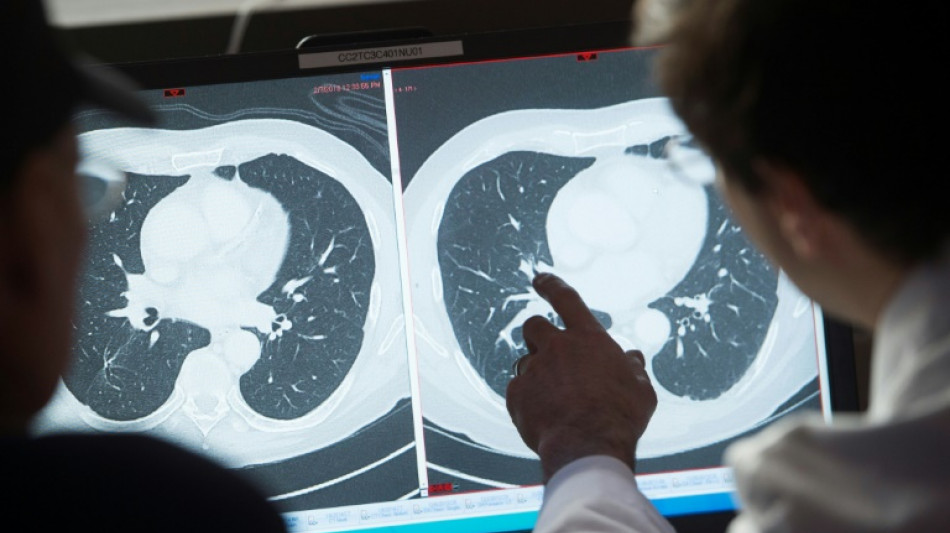
'Ray of hope': New advances in fighting a range of cancers / Photo: © AFP/File

 Six candidates to lead UN take stage for televised debate

 King Charles opens slimmed down Commonwealth Games in Glasgow

 US unveils new tariffs on 60 partners as Trump rebuilds trade agenda

 WNBA viral star Cunningham wades into trans athletes row

 Hearn dismisses Fury talk of Joshua no-show for super fight

 'Like a war zone': France evacuates 20,000 due to wildfires

 Ships avoid Ukrainian grain ports after Russian attacks

 Oil passes $100 a barrel again: why it's more serious this time

 Who are the six candidates vying to lead the UN?

 Hamilton proud of recovery after hitting rock bottom a year ago

 Carapaz eyes polkadot mountains jersey after stage win

 Fields medal awarded to four young mathematicians

 Carapaz claims Tour de France stage as Pogacar loses key team-mate

 Alonso welcomes Aston Martin upgrade, warns against unreal expectations

 Anderson declares Man City 'kings of Manchester' after £116 mn move

 Relieved Russell says Mercedes have solved his power problems mystery

 Oil soars above $100 as Middle East fears grow

 Venezuelans turn to scrap collecting in quake-hit beach 'paradise'

 Heptathlon champion Johnson-Thompson joins list of Commonwealth Games absentees

 Nigeria's Dangote raises $2.5bn to expand Africa's largest refinery

 Oil soars to $100 on fresh Mideast attacks

 Coal-fired power generation rising globally on Mideast war: IEA

 Premier League champions Arsenal sign Greece winger Tzolis from Brugge

 French Jewish DJ sues after activists disrupt gig: lawyer

 Venice film festival promises Pattinson, Oasis and Musk doc

New advances in the fight against a range of cancers have been revealed at the annual meeting of the American Society of Clinical Oncology (ASCO), which wraps up in Chicago on Tuesday.
Here are some of the announcements that have most excited experts.
- Lung cancer -
One of the trial results that caused a stir in Chicago has raised hopes for a new weapon against lung cancer, the deadliest of all cancers.
The treatment osimertinib was shown to halve the risk of death from a certain type of lung cancer when taken daily after surgery to remove the tumour.
Developed by the pharmaceutical group AstraZeneca, the daily pill targets patients with non-small cell cancer -- by far the most common type -- as well as a mutation of their epidermal growth factor receptor, or EGFR.
Iris Pauporte, head of research at France's League Against Cancer, told AFP the advance was a "big ray of hope" for this type of cancer, for which progress has been slow.
Muriel Dahan, head of research at Unicancer, said that if the results are confirmed, it "should change" common practice in treating this kind of lung cancer.
Systematic testing for the EGFR mutation would also become necessary for lung cancer patients, she added.
- Brain cancer -
Another treatment, called vorasidenib, was found to significantly prolong the progression-free survival of patients with brain tumour glioma, according to clinical trial results.
The daily pill, developed by French pharma firm Servier, aims to block an enzyme responsible for the progression of some brain cancers, which have been particularly difficult to treat.
Patrick Therasse, Servier's vice-president of oncology research, told AFP that there "have been few therapeutic advances for brain tumours over the last 20 years".
"Thanks to our targeted treatment, patients avoided cancer progression for 27.7 months, compared to 11.1 months" for those taking a placebo, he added.
Fabrice Andre, head of research at France's Gustave Roussy cancer centre, said "precision medicine opens a door for a disease for which there was nothing until now".
"It means that science can unblock situations that were catastrophic," he told AFP.
Unicancer's Dahan said it was important to "remain cautious" but added that "this could become the new therapeutic standard -- depending on further trials".
- Breast cancer -
Preliminary trial results also released in Chicago indicated the drug ribociclib reduced the risk of breast cancer recurring by 25 percent for a large group of early-stage survivors.
The drug, developed by Swiss pharmaceutical maker Novartis, is already widely approved around the world. It was tested in combination with hormonal therapy.
ASCO expert Rita Nanda said it was a "very important and practice-changing clinical trial".
- Cervical cancer -
There was also good news for patients with early-stage cervical cancer with a low risk of progression.
There was no greater risk of the cancer returning for patients who get a simple hysterectomy, in which the uterus and cervix are removed, than a radical hysterectomy, in which the uppermost part of the vagina is also removed, according to phase three trials.
League Against Cancer's Pauporte said this was "good news," adding that "it shows that it's not just progress involving drugs that was important".
- Ovarian cancer -
A trial also presented at ASCO showed that taking the antibody treatment mirvetuximab soravtansine significantly improved the survival rate of patients with ovarian cancer, a particularly deadly form of cancer.
ASCO expert Merry Jennifer Markham said the treatment "demonstrates progress and offers hope for these patients".
- Rectal cancer -
Study results released in Chicago indicated that patients with locally advanced rectal cancer could receive chemotherapy without getting radiation therapy before undergoing surgery.
This would spare patients from the brutal side effects of radiation.
- Vaccines -
Vaccines that treat existing cancer have long been a goal of the medical community.
Preliminary studies announced at the ASCO meeting involved vaccines targeting lung cancer, head and neck cancers, brain tumour glioblastoma and the cancer-causing HPV virus.
Christophe Le Tourneau, an oncologist at France's Curie Institute which presented a study about a vaccine for a certain form of HPV, said there has been "significant technological progress" in the area recently.
"Therapeutic vaccines, we talk about them more and more, and there are more and more trials in progress," he said.
A.Gasser--BTB