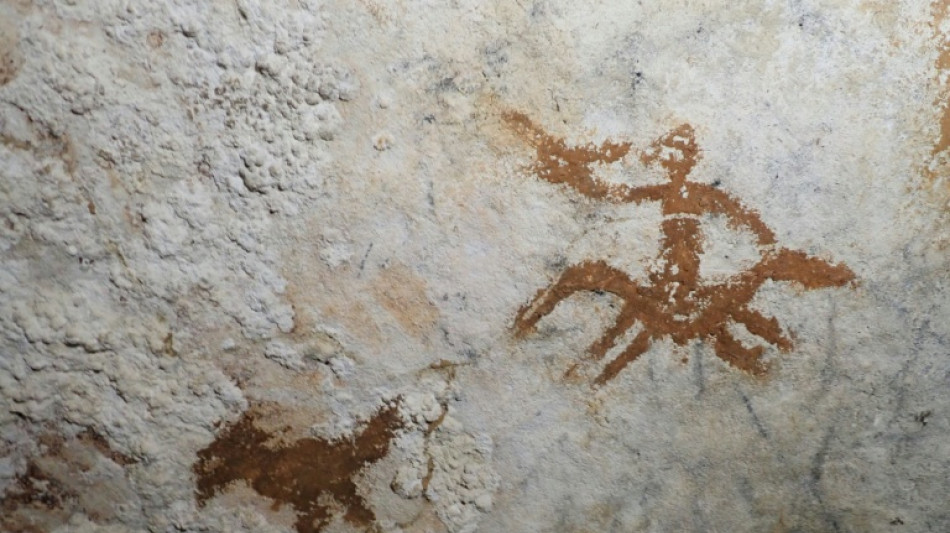
World's oldest cave art discovered in Indonesia / Photo: © GRIFFITH UNIVERSITY/AFP

 Stocks rise on AI buzz, oil prices cool

 India narrowly survive huge scare against minnows Japan

 Missing F-35 fighter parts 'not sensitive', says Australia minister

 Cambodia showcases scams crackdown with global conference

 Afghan cyclist who disguised herself as man wins Asian Games silver

 Typhoon Dujuan leaves four dead in Japan, 45,000 houses without power

 G7 leaders condemn Houthi strikes on Saudi Arabia

 Google data centre sparks protests in Austria

 Shin Ohashi: Junk food-loving teen and Japan's next big swimming hope

 Stocks rise on AI buzz, drop in oil prices

 China's robot dancers limber up for America's Got Talent final

 Despite military might, Saudi struggles to crush the Houthis

 Trump to tout deals, defend Iran war in UN speech

 Sri Lanka to issue verdict in landmark Easter attack trial

 Macron says talks with Trump on Red Sea, Ukraine 'constructive'

 Green policies just good politics, says UK minister

 Bardot auction in Paris fetches nearly one million euros

 No timeline on Daniels injury return, says Commanders coach

 British Columbia sues OpenAI in US court over Canada school shooting

 French star Batum retires after 18-year NBA career

 Zidane leads first France training session
 Man shot by ICE agent in Texas detained with bullet inside him: lawyer

 California declares state of emergency ahead of El Nino

 South Africa arrests three more suspects, after nine women murdered

 Carse needs time away from England, says captain Brook

A red stencil of a hand pressed against the wall of an Indonesian cave is the oldest rock art ever discovered, scientists said Wednesday, and sheds light on how humans first migrated to Australia.
The cave art dates back at least 67,800 years, according to research published in the journal Nature by a team of Indonesian and Australian archaeologists.
"We have been working in Indonesia for a long time," study co-author Maxime Aubert of Australia's Griffith University told AFP.
This time they ventured to caves on the island of Muna in the Sulawesi province on the advice of Indonesian archaeologist Adhi Agus Oktaviana, the study's lead author.
There they found "handprints in negative, stencilled, probably using red ochre," Aubert said.
The fingers of one of the hands were "retouched to become pointed like claws -- a style of painting only seen in Sulawesi," the Canadian archaeologist added.
To determine the art's age, the team took five-millimetre samples from "cave popcorn", which are small clusters of calcite that form on the walls of limestone caves.
Then they zapped the layers of rock with a laser to measure how the uranium decayed over time, compared to a more stable radioactive element called thorium.
This "very precise" technique gave the scientists a clear minimum age for the painting, Aubert explained.
At 67,800 years old, the Indonesian stencil is more than a thousand years older than other hand stencils found in a Spanish cave which has been attributed to Neanderthals. However the dating of that cave art "has been controversial," the study cautioned.
The new discovery is also more than 15,000 years older than previous art found in the Sulawesi region by the same team.
The scientists also established that the Muna caves had been used for rock art many times over a long period.
Some of the ancient art was even painted over up to 35,000 later, Aubert said.
- A fork in the road -
Beyond setting a new record, the art also offers clues for a long-running historical mystery.
Scientists have been divided about how Homo sapiens first journeyed from Asia to Australia.
They could have taken the northern route, travelling by boat through Indonesia islands including Sulawesi to Papua New Guinea.
These ancient humans could then have walked the rest of the way -- at the time, Papua New Guinea and Australia were both part of a supercontinent called Sahul.
Or the migrants could have taken the southern route, travelling through the islands of Sumatra, Java and Bali before heading for Timor. Then a boat ride was required to finally make it to Australia.
"These paintings provide the first evidence that modern humans were on these Indonesian islands at that time," Aubert said.
The discovery also "reinforces the idea that people arrived in Australia via Papua, perhaps around 65,000 years ago", he said.
But it could not be ruled that other people were also making their way to Australia via the southern route at the same time, he added.
The researchers also said that the paintings were very likely created by people closely linked to the ancestors of Indigenous Australians.
D.Schaer--VB