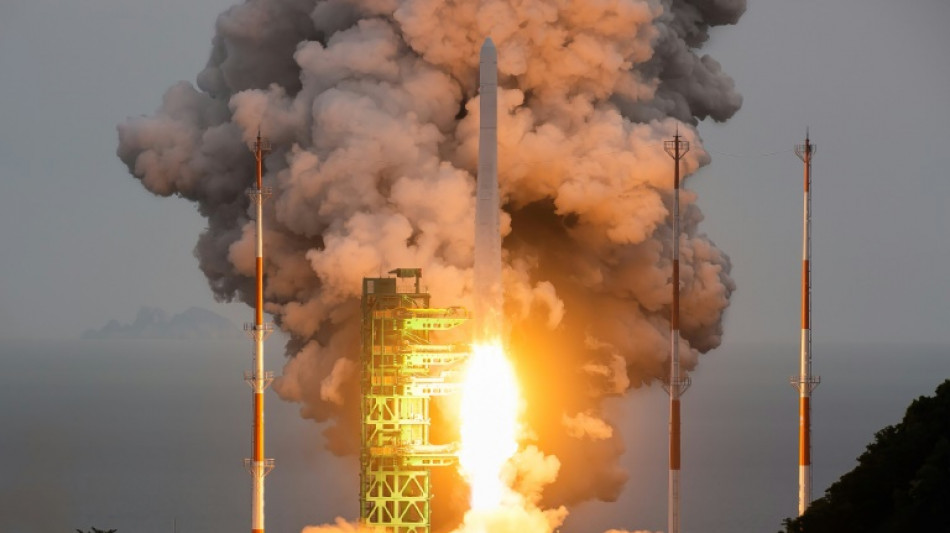
South Korea hails successful launch of homegrown rocket / Photo: © Korea Aerospace Research Institute (KARI)/AFP

 Brewers beat Rays 4-1 to capture first World Series title

 Philippine island fights rising seas with nature, not concrete

 Bangladesh presses India before Ganges water treaty expires

 Trump accuses Alaska Democrats of fraud over same-name scandal
 Spain mourns after latest train tragedy kills 68

 Trump's border: quiet, but few people are happy

 Australian defence chief says China military buildup creating 'pressure' in SE Asia

 No penalty practice? No problem for Man City in shoot-out win

 Microsoft beats expectations fueled by Azure cloud business

 Chelsea win as Bayern draw with Madrid in Women's Champions League

 Kane watches as Bayern cruise into German Cup last 16

 Bayern boss Kompany out of hospital after meningeal irritation

 Shares in Google owner Alphabet sink on profit miss, ad slowdown
 Chelsea win as Bayern and Madrid draw in Women's Champions League

 Made with munitions from the Falklands War, a 'Chalice of Peace' for the pope

 Pioneering US labor leader Dolores Huerta dies at 96

 Italian PM slams 'shameful' release of alleged protest organiser
 Hollywood producer Kennedy to head LA28 Olympic ceremony plans

 Djokovic wins Basel opener to boost ATP Finals bid

 US Fed holds interest rates steady despite surging inflation

 Chiefs sign ex-Ravens kicker suspended over sex allegations

 Inglis and Carey put Australia in command of South Africa decider

 92-year-old US judge handling Maduro case dies

 Perez extends Cadillac deal to 2029

 Arab Israelis proud of high election turnout, uncertain for future
South Korea said Thursday it had successfully launched its homegrown Nuri rocket and placed working satellites into orbit, hailing a key step forward for the country's burgeoning space programme.
It was the third launch of the Nuri, which successfully put test satellites into orbit last year after a failed 2021 attempt saw the rocket's third-stage engine burn out too early.
The three-stage rocket, more than 47 metres (155 feet) long and weighing 200 tonnes, soared into the sky at 6:24 pm (0924 GMT) from the Naro Space Center in South Korea's southern coastal region, leaving a huge trail of white smoke.
"We report to the public that the third launch of Nuri, which was independently developed to secure domestic space transportation capacity, has been successfully completed," said Lee Jong-ho, minister of science and technology.
The main satellite made communication with South Korea's King Sejong Station in Antarctica, he said, adding that the launch confirmed "our potential for launch services for various satellite operations and space exploration".
South Korea will carry out three more launches of Nuri by 2027, Lee added.
South Korean President Yoon Suk Yeol hailed Nuri's launch, saying it will give the country a competitive edge in the global space race.
"The success of Nuri's third launch is a splendid achievement that declares South Korea has joined the G7 space powers," he said in a statement.
The launch came a day after initial plans were called off over a computer communication error which was resolved by Thursday.
In previous tests, the rocket carried payloads mainly designed for verifying the performance of the launch vehicle.
This time, the rocket was topped with eight working satellites, including a "commercial-grade satellite", according to the science ministry.
More than 200,000 viewers were watching the livestream of the launch on YouTube, with one commenting: "Fly high Nuri! Let's go to space!"
- Space race -
South Korea has laid out ambitious plans for outer space, including landing spacecraft on the Moon by 2032 and Mars by 2045.
In Asia, China, Japan and India all have advanced space programmes, and the South's nuclear-armed neighbour North Korea was the most recent entrant to the club of countries with their own satellite launch capability.
Ballistic missiles and space rockets use similar technology and Pyongyang claimed to have put a 300-kilogram satellite into orbit in 2012 in what Washington condemned as a disguised missile test.
The South Korean space programme has a mixed record -- its first two launches in 2009 and 2010, which in part used Russian technology, both ended in failure.
The second one exploded two minutes into the flight, with Seoul and Moscow blaming each other.
Eventually, a 2013 launch succeeded, but still relied on a Russian-developed engine for its first stage.
Last June, South Korea became the seventh nation to have successfully launched a one-tonne payload on their own rockets.
The three-stage Nuri rocket has been a decade in development at a cost of two trillion won ($1.5 billion).
J.Bergmann--BTB