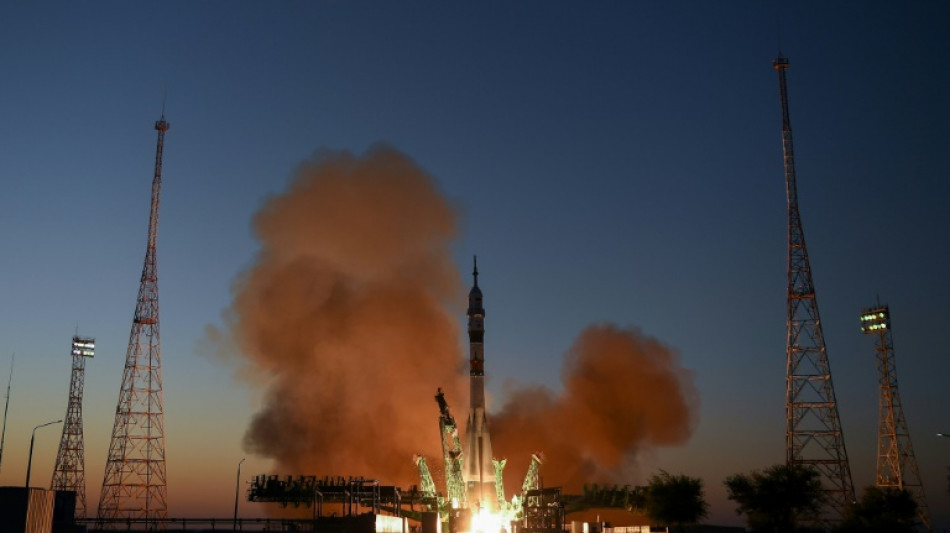
Russia to send spacecraft to ISS to bring home crew of damaged capsule / Photo: © AFP/File

 Chelsea win as Bayern draw with Madrid in Women's Champions League

 Kane watches as Bayern cruise into German Cup last 16

 Bayern boss Kompany out of hospital after meningeal irritation

 Shares in Google owner Alphabet sink on profit miss, ad slowdown

 Chelsea win as Bayern and Madrid draw in Women's Champions League

 Made with munitions from the Falklands War, a 'Chalice of Peace' for the pope

 Pioneering US labor leader Dolores Huerta dies at 96

 Italian PM slams 'shameful' release of alleged protest organiser

 Hollywood producer Kennedy to head LA28 Olympic ceremony plans

 Djokovic wins Basel opener to boost ATP Finals bid

 US Fed holds interest rates steady despite surging inflation

 Chiefs sign ex-Ravens kicker suspended over sex allegations

 Inglis and Carey put Australia in command of South Africa decider

 92-year-old US judge handling Maduro case dies

 Perez extends Cadillac deal to 2029

 Arab Israelis proud of high election turnout, uncertain for future
 Inglis, Carey put Australia in command of South Africa decider
 French firm Safran helps build aircraft wings of the future in UK factory

 Ceasefire in Russia-occupied Ukrainian city holds for second day

 Canada hikes rates to contain oil price surge caused by Iran war

 World Bank warns of worsening food insecurity as commodity prices soar

 Mona Lisa scrubbed from Syrian textbooks as critics slam conservative drift

 Bolsonaro flees Brazil for US after election defeat: AFP

 Brazil's Bolsonaros: between power, prison, and exile

 Israel president urges against new vote despite inconclusive result

Russia said Wednesday that it will send an empty spacecraft to the International Space Station (ISS) next month to bring home three astronauts whose planned return vehicle was damaged by a strike from a tiny meteorite.
The Russian space agency, Roscosmos, made the announcement after examining the flight worthiness of the Soyuz MS-22 crew capsule docked with the ISS that sprang a radiator coolant leak in December.
Roscosmos and NASA officials said at a joint press briefing that an uncrewed Soyuz spacecraft, MS-23, would be sent to the ISS on February 20 to bring Russian cosmonauts Dmitry Petelin and Sergei Prokopyev and NASA astronaut Frank Rubio back to Earth.
"We're not calling it a rescue Soyuz," said Joel Montalbano, the ISS program manager at NASA's Johnson Space Center in Houston. "I'm calling it a replacement Soyuz.
"Right now the crew is safe onboard the space station."
MS-22 flew Petelin, Prokopyev and Rubio to the ISS in September. They were scheduled to return home in the same spacecraft in mid-March.
But MS-22 began leaking coolant on December 14 after being hit by what US and Russian space officials said they believe was a micrometeorite.
"Everything does point to a micrometeorite," Montalbano said.
Sergei Krikalev, executive director of Human Space Flight Programs at Roscosmos, said the "current theory is that this damage was caused by a small particle about one millimetre in diameter".
Krikalev said the decision to use MS-23 to fly the crew home was made because of concern over high temperatures in MS-22 during re-entry.
"The main problem to land the current Soyuz with crew would be thermal conditions because we lost heat rejection capability," he said.
"We may have a high temperature situation on Soyuz in the equipment compartment and in the crew compartment."
- SpaceX Crew Dragon -
Montalbano said discussions were also underway with SpaceX officials about potentially returning one or more crew members on the SpaceX Crew Dragon capsule currently docked with the ISS.
Four astronauts were flown to the ISS by a SpaceX rocket in October for a mission expected to last about six months.
"We could safely secure the crew members in the area that the cargo normally returns on the Dragon," Montalbano said.
"All that is only for an emergency, only if we have to evacuate ISS," he stressed. "That's not the nominal plan or anything like that."
Krikalev said MS-22 would return to Earth after the two cosmonauts and the NASA astronaut leave on MS-23. It would bring back equipment and experiments that are not "temperature sensitive", he said.
Soyuz MS-23 had been initially scheduled to fly Russian cosmonauts Oleg Kononenko and Nikolai Chub and NASA's Loral O'Hara to the ISS on March 16.
Space has remained a rare venue of cooperation between Moscow and Washington since the start of the Russian offensive in Ukraine and ensuing Western sanctions on Russia.
The ISS was launched in 1998 at a time of increased US-Russia cooperation following the Cold War "Space Race".
Russia has been using the ageing but reliable Soyuz capsules to ferry astronauts into space since the 1960s.
W.Lapointe--BTB