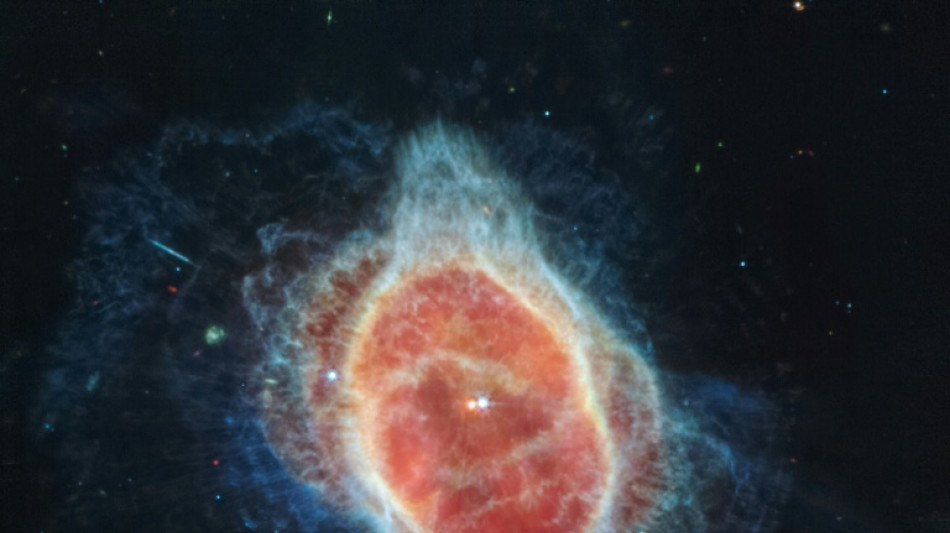
Webb telescope spies hidden stars in stellar graveyard / Photo: © NASA/AFP/File

 ASEAN calls for open straits as US-Iran war casts shadow

 Ford and Geely to form joint venture at struggling Spain plant

 Russia warns US against Ukraine arms sales in Manila meeting

 New UK PM announces tax cut for struggling pubs

 Supporters flood India's 'cockroach' protesters with food

 Modi vows punishment for exam leaks fuelling India protests

 Norway set to make formal complaint to FIFA over Balogun red card saga
 Floods in northeast India kill at least 41

 Nestle siphons off bottled water business into joint venture

 Hundreds hospitalised in Japan heatwave 'disaster'

 Renault says sales stalled in first half

 EasyJet says profits nosedive on Mideast war

 Modi vows punishment for exam fraud fuelling India protests

 Six candidates in race to lead UN set for televised debate

 Comic-Con kicks off with Marvel's return

 Dutch riders dreaming of crazy party corner of Alpe d'Huez
 Houthis target Red Sea shipping as US hits Iran
 Record-equalling Red Sox streak halted at 15 wins

 Messi-less Miami beat Fire 3-2 to spoil Lewandowski's MLS debut

 Mercedes expect Hungary challenge from Hamilton and Ferrari
 In Ghana, one man's race to save critically endangered fish
 Wilson captain, Slipper absent in Kiss's first Wallabies squad
 New Mideast fighting puts eurozone rate-setters on alert

 Venezuelans search for animal companions lost in the quakes
 Argentine Football Association says US did not detain its president
It was one of the first famous images revealed by the James Webb Space Telescope earlier this year: a stunning shroud of gas and dust illuminated by a dying star at its heart.
Now researchers analysing the data from history's most powerful telescope have found evidence of at least two previously unknown stars hiding in the stellar graveyard.
The Southern Ring Nebula, which is in the Milky Way around 2,000 light years from Earth, had previously been thought to contain two stars.
One, nestled in the nebula's centre, is a white dwarf star which in its death throes has been casting off torrents of gas and dust for thousands of years that in turn formed the surrounding cloud.
Sapped of its brightness, the extremely hot white dwarf is the less visible of the two stars seen in Webb images released in July.
The white dwarf has offered astronomers a view of how our own Sun may die one day -- billions of years from now.
Unlike our lonely Sun, it has a companion, the brighter of the two stars in Webb's images.
However this binary system, which is common across the Milky Way, does not explain the nebula's "atypical" structure, Philippe Amram, an astrophysicist at France's Marseille Astrophysics Laboratory, told AFP.
Amram is one of the co-authors of a study published in the journal Nature Astronomy on Thursday that has used Webb's observations to uncover more of the nebula's secrets.
Since the nebula was discovered by English astronomer John Herschel in 1835, astronomers have wondered why it has "such a bizarre shape, not really spherical," Amram said.
By analysing the data from Webb's infrared cameras, the researchers said they found evidence of at least two other stars inside the nebula, which has a diameter equivalent 1,500 times the distance from the Sun to Pluto.
While the new pair are slightly farther away from the white dwarf and its companion, all four stars -- or possibly even five -- are located in the centre of the nebula.
They are close enough to interact with each other, and their "exchanges of energy" create the nebula's strange shape, Amram said.
The Webb telescope, which has been operational since July, has already unleashed a raft of unprecedented data and scientists are hopeful it will herald a new era of discovery.
N.Fournier--BTB