Olympic legends: from Jesse Owens to Bob Beamon - Part 2 / Photo: © AFP

 'Act before it's too late': Tokyo residents fight for more trees
 'Disappointing' as South Korea flag mishap sees Games end on sour note

 Pre-COP host Tuvalu at frontline of climate change
 Hungary's dwindling paprika producers battle to save signature spice

 Cornell president vows review in wake of alleged student gang rape
 Latvian partial election results suggest pro-European choice

 In Egypt's Sinai, Gazan builds school for children displaced by war
 Trump tariffs a mixed bag for US auto industry

 Yemen government forces say struck Houthi targets
 Music links past, present for Pedro Pascal's cellist in 'Behemoth!'

 ALEX BODI ȘI AMBASADORUL REPUBLICII SUDANUL DE SUD, GUM DOMINIC MATIOK, DISCUTĂ LA BERLIN DESPRE POSIBILITATEA ÎNFIINȚĂRII UNUI CONSULAT ONORIFIC LA BUCUREȘTI

 Dodgers step up World Series three-peat bid with 5-3 win over Braves

 Spain break down Czechs as England outclass Croatia in Nations League
 Yamal on target as Spain hold off Czech Republic
 Latvian exit polls suggest pro-European choice

 Lula, Bolsonaro wrap up campaigns ahead of knife-edge election

 Tuchel hails 'complete' England after Croatia demolition

 Fury to invite Trump to lead ring walk before Joshua showdown
 Fashion industry in 'precarious moment', says Vivienne Westwood supremo
 Seventh heaven for England in Nations League rout of Croatia
 Storms, flooding cause chaos on Greek holiday island of Crete
 #IAmJaneDoe: online support campaign in US university rape case
 Brazil shine on Selecao's first visit to India

 Zverev sets up Djokovic quarter-final at China Open, Rybakina out

 Happier at home, Bordeaux hammer Lyon in Top 14

AFP continues its look back at the history of the Olympics to pick out some of the legends that have lit up the Games.
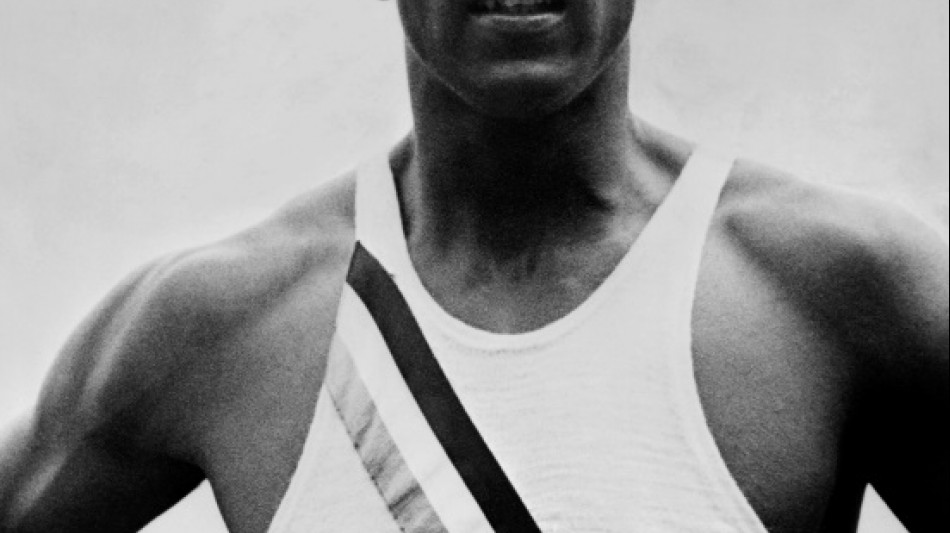
- Jesse Owens: infuriating the Fuehrer -
Owens, an African-American, exploded the Nazi-propagated myth of racial superiority at the age of 22, when he won four athletics gold medals at the 1936 Berlin Olympics under the nose of Adolf Hitler.
He won the 100m, 200m, 4x100m relay and long jump, setting three world records and reportedly prompting Hitler to storm out, though the "Buckeye Bullet" later said the Fuehrer had waved to him.
The grandson of slaves, Owens was snubbed by his own president when Franklin D. Roosevelt failed to greet him, a customary honour for returning Olympic champions.
"When I came back to my native country, after all the stories about Hitler, I couldn't ride in the front of the bus," Owens said of the racial segregation that existed in the US at the time. "I couldn't live where I wanted."
- Fanny Blankers-Koen: athlete of the century -
Blankers-Koen blazed a trail for women's sport when she swept to four athletics golds at the 1948 Olympics as a 30-year-old mother of two.
The Dutchwoman made her Games debut in Berlin in 1936 but it was at the first post-war Games, in London in 1948, that she really shone.
She won every event she entered -- the 100m, 200m, 80m hurdles and 4x100m relay.
"One newspaperman wrote that I was too old to run, that I should stay at home and take care of my children," she told the New York Times in 1982.
"When I got to London, I pointed my finger at him and I said: 'I show you'."
Blankers-Koen was named female athlete of the century in 1999.
- Abebe Bikila: barefoot marathon runner -
In a feat that has become part of Olympic lore, Ethiopia's Abebe Bikila became the first black African to win gold, running the marathon barefoot at the Rome Games in 1960.
Bikila set a world record of 2hr 15min 16sec barefoot, having discarded ill-fitting running shoes.
Four years later in Tokyo, he bettered the record, running all the way in shoes this time but barely a month after undergoing an emergency appendectomy, trimming a few minutes off his time.
In doing so, the soldier became the first man to win an Olympic marathon twice.
At home Bikila, a soldier in the Imperial Guard, was hailed a national hero, promoted in rank by Emperor Haile Selassie and presented with a Volkswagen Beetle car.
In a cruel twist, the car ended his Olympics career after he had a serious accident in 1969 that left him paralysed from the waist down.
- Bob Beamon: historic leap -
New York native Bob Beamon found perfection as he defied gravity with a record-smashing long jump at the 1968 Mexico City Olympics.
The leap shattered the previous world record by 55.88 centimetres (nearly 22 inches). His lead of 8.90 metres beat the old mark by 6.6 percent and lasted 23 years. It remains the second longest jump not assisted by wind.
He almost missed the final after overstepping on his first two qualifying jumps.
The final, Beamon remembered, was an "extraordinary day".
Beamon was the first of the favourites to jump and won the competition with his opening leap.
"Everything was perfect for me. The wind was perfect. The weather when I jumped was perfect," he recalls. "It rained right after I jumped."
When team-mate Ralph Boston translated the metric distance on the scoreboard into feet and inches for him, Beamon collapsed, in what he later called a "cataplectic seizure" brought on by "emotional excitement".
"To my surprise, it was not only a jump, but it was an incredible moment in history," Beamon said.
After retiring, he coached and promoted sport participation, as well as working as a graphic artist and pursuing his childhood passion of drumming.
F.Wagner--VB