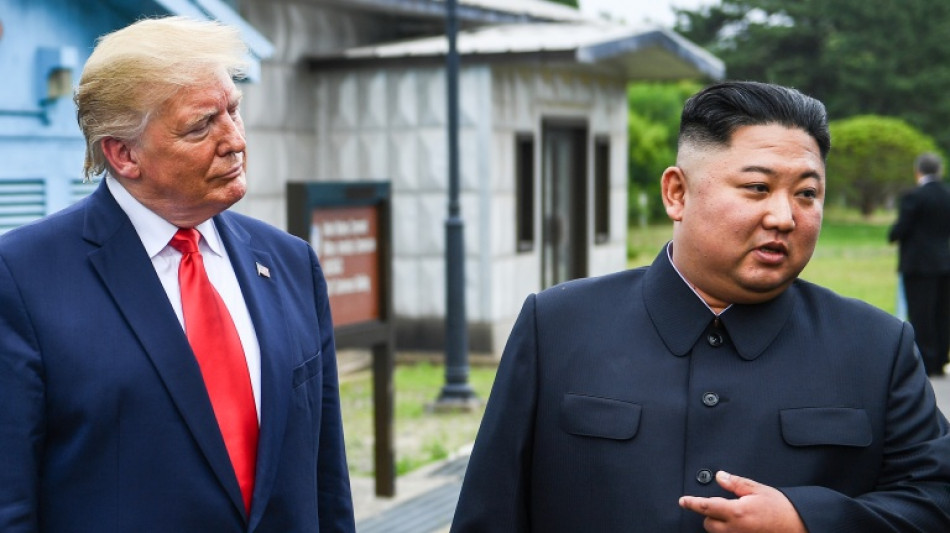
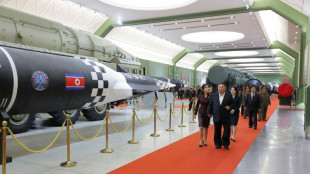
Ahead of APEC summit, Trump comes knocking on Kim's door / Photo: © AFP/File

 Ukraine's young figure skaters twizzle on despite Russian threat

 Asian football endorses Infantino re-election as FIFA president
 Complete Kane hopes for 'special night' as Ballon d'Or rumours swirl

 Rooney calls United squad 'selfish babies' after Fernandes criticism

 Teddy Wilson, son of World Cup-winner David, gets Wallabies call-up

 New Zealand military chief resigns over 'inappropriate relationship'

 Man Utd's Carrick on borrowed time, free-scoring Brighton face Liverpool

 Asian stocks head into weekend on a low as tech extends losses

 'Generational rage': Young Europeans fight to be heard

 Lula, Bolsonaro to clash once more before Brazil vote
 Dressed to kill: Haircuts cap menacing look of Japan's yakuza

 Napa Valley's wineries feel Trump's tariff squeeze
 Venezuela protests demand return of Nobel winning leader Machado

 Marquez tops incident-packed opening practice for Australian MotoGP

 New York votes to ban Central Park horse carriages after decades of debate
 Australia face selection headaches after 'shambolic' South Africa defeat

 Around 150,000 rally in Belgrade as Serbia heads to pivotal poll

 Hamilton sets sights on racing in African grand prix

 Bournemouth hammer 10-man Milan, Juventus denied at the death
 Judge orders Trump to give deposition in BBC lawsuit by Dec 11
 'Fake' pollsters hit US midterms
 Global markets retreat as tech mood sours, oil prices jump

 Juventus denied at the death, Sunderland make point in Poland in Europa League

 Tens of thousands rally as Serbia heads to pivotal poll
 Monet's 'Iris' fetches 50 mn euros at Paris auction

As world leaders prepare to gather in Shenzhen for November's APEC summit, speculation is mounting over a possible meeting between Donald Trump and Kim Jong Un -- a prospect experts say remains remote.
In 2019, North Korea's Kim made the 60-hour train journey home from Hanoi empty-handed after his summit with the US president collapsed.
Now, the dynamic has reversed: Trump is making repeated overtures, only to be met with silence from Pyongyang.
Trump said again last week that he "may" meet with Kim during his Asian tour next month and that it "would be exciting".
But on Monday, he said: "I don't know... I'm not sure that anybody's asking for a meeting," adding that his "relationship with Kim Jong Un is very good."
Any meeting between the leaders would trigger a media frenzy, but Pyongyang's deepening ties with Russia and China could complicate Trump's bid for a potential announcement of talks ahead of the midterms.
Analysts say the mercurial US leader is seeking a foreign policy win as the Iran war drags on. Kim, by contrast, may have less to gain from another high-profile encounter with Trump, they say.
Kim's decision to send troops and weapons to aid Moscow's war in Ukraine has won critical backing from Russian President Vladimir Putin, helping North Korea blunt UN sanctions over its nuclear programme.
North Korea's economy, in fact, grew more than three percent for a third straight year in 2025, South Korea's central bank estimated in July, citing Pyongyang's "expansion of economic cooperation with Russia" as its major driver.
China, Washington's archrival, remains North Korea's key ally -- a major source of diplomatic and economic support for the country.
"I see almost no possibility of a meeting," Lim Eul-chul, a professor at the Institute for Far Eastern Studies at Kyungnam University, told AFP.
"For Kim Jong Un, maintaining the status quo is the best option right now."
And last week, Seoul's ambassador to Washington, Kang Kyung-wha, said no concrete progress had been made toward a meeting between Kim and Trump.
- 'In love' -
Trump met Kim three times during his first term -- once declaring they were "in love" -- in high-profile summits aimed at securing a denuclearisation deal, but no tangible progress was made.
Since then, North Korea has continued to expand and develop its arsenal.
South Korea's dovish President Lee Jae Myung -- who has repeatedly offered Pyongyang talks without preconditions -- suggested in September that Washington seek a freeze, rather than the immediate elimination, of its nuclear programme in return for sanctions relief.
Critics say such an approach risks tacitly accepting North Korea as a nuclear-armed state while allowing Pyongyang to win sanctions relief without giving up its arsenal.
Analysts say China has also appeared to move towards implicit acceptance.
Kim hosted Chinese President Xi Jinping in Pyongyang in June, soon after Xi held back-to-back summits in Beijing with Trump and Putin.
Neither Pyongyang nor Beijing mentioned North Korean denuclearisation in their official statements -- an omission experts saw as a sign of China's tacit consent.
The dividing of the "United States and Japan on one side and North Korea, China and Russia on the other ... into blocs, is creating significant opportunities for North Korea," Hong Min, a senior researcher at the Korea Institute for National Unification, told AFP.
- 'Idiots' -
Pyongyang has repeatedly made clear it is no longer prepared to discuss denuclearisation.
Kim's powerful sister Kim Yo Jong said in September the country's nuclear-armed status was "absolute" and called those hoping for its denuclearisation "idiots".
The more consequential question is "whether Washington would begin negotiating on the operational assumption that North Korea's arsenal is not going to disappear," Vladimir Tikhonov, Korean Studies professor at the University of Oslo, told AFP.
"I see that a possibility of such a policy shift is substantial."
Meanwhile, China's influence rests partly on its role as an intermediary between Pyongyang and Washington, analysts say, and a direct Trump-Kim deal that sidelines Beijing in Shenzhen could therefore erode its leverage over both sides.
"A dialogue may be pursued with the understanding of Putin and Chinese President Xi Jinping," said Yang Moo-jin, former president of the University of North Korean Studies.
But with Russia delivering immediate benefits, analysts said that time and strategic momentum are on Kim's side.
"Giving up all these benefits, withdrawing from the Russia-Ukraine war, and entering uncertain dialogue with the United States is difficult to imagine right now," Yang said.
A.Zbinden--VB