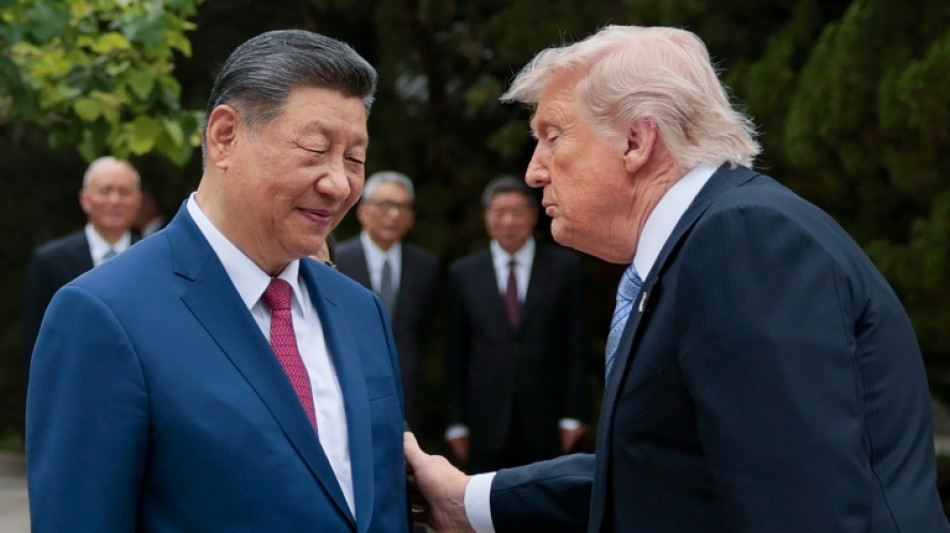
Rapprochement, debates, dissidents: US presidential visits to China / Photo: © POOL/AFP

 Repsol says profit more than triples on higher oil prices

 TotalEnergies says profit doubled on Mideast war
 Giant swing on Swiss peak aims to boost summer tourism as Alps warm
 ASEAN to call for open straits as US-Iran war casts shadow
 AI catches up with humans to score 100% at top maths contest
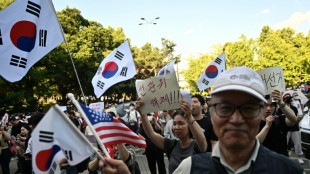 South Korea election office raided in fake turnout figures probe: investigators
 Killer whales: orcas blow fish to bits 'for fun', study finds
 Deadly wildfires force thousands from homes in parts of Europe
 Tech bounce lifts Asia stocks, oil extends gains on US-Iran fears

 Surrounded by militias, Sudanese fear endless cycle of war

 Commonwealth Games 'where champions are made' despite slimmed down model, argues president
 Trump family project in Albania has already caused 'irreparable' damage: NGOs

 Bollywood blast master keeps it real with fire and fury

 Tearful fights, edible offerings: A glimpse into the Maradona trial
 What's the deal with peptides? The hyped market under US review
 Tesla shares fall as Musk touts ambitious -- and costly -- plans
 Houthis claim Red Sea tanker strikes as US hits Iran again

 Wildfires ravage parts of southern France, Italy and Spain
 Alphabet beats expectations in second quarter, cloud revenue nearly doubles
 Trump threatens Iran infrastructure, Tehran vows 'eye for eye'
 US teen withdraws lawsuit against Meta over social media addiction
 Lebanon PM says Beirut working for 'complete Israeli withdrawal'
 EU conditionally clears Paramount bid for Warner Bros.
 Philipsen snaps 'horrible' drought with Tour de France stage 17 victory
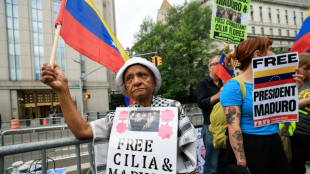 US trial of Venezuela's Maduro set for June 2027

Donald Trump's summit with China's leader Xi Jinping in Beijing this week was the latest in decades of high-level diplomatic encounters between the two countries marked by drama, tension and surprising breakthroughs.
Here are some of the most notable visits by US presidents to China:
- Cold War summit -
The United States cut ties with China when the Communist Party (CCP) took over the country in 1949.
Over two decades later, in February 1972, then US president Richard Nixon flew to China to break the ice.
Nixon met with Chairman Mao Zedong as well as premier Zhou Enlai, with whom he famously raised glasses of the fiery Chinese spirit baijiu.
At a banquet in the Great Hall of the People, Nixon declared "there is no reason for us to be enemies".
A secret visit by national security adviser Henry Kissinger the year before laid the groundwork for the presidential trip, alongside reciprocal visits of table tennis teams termed "ping-pong diplomacy".
Nixon's visit kicked off formal contacts that led to full diplomatic ties in January 1979.
The landmark trip is widely seen as a catalyst for China's emergence from decades of isolation.
- Ill-fated barbecue -
George H. W. Bush's February 1989 visit was overshadowed by growing calls for democratic reform in China that would culminate in massive protests and a bloody crackdown later that year.
A Texas-style barbecue hosted by Bush at a Beijing hotel during his visit sparked a small diplomatic crisis after the Chinese government objected to the inclusion of astrophysicist and dissident Fang Lizhi on the guest list.
Officials attempted to block Fang multiple times on his way to the banquet.
Bush later expressed regret to the Chinese over the incident.
In June that year, Fang played a key role in the pro-democracy Tiananmen protests that were violently crushed by the Chinese government.
- Televised debate -
Bill Clinton's nine-day tour of China in 1998 marked a thaw in relations after the US slapped sanctions on Beijing in the aftermath of the 1989 protests.
The visit's highlight was a surprise decision by Chinese President Jiang Zemin to allow a live broadcast of a press conference with Clinton.
In an extraordinary scene, the two presidents sparred on national television about the usually off-limits subjects of human rights and the Tiananmen crackdown.
"I did not anticipate being able to have that sort of open, sweeping communication with the Chinese people," Clinton said at the time.
- Olympics opening -
George W. Bush attended the spectacular opening ceremony of the 2008 Beijing Olympics, a highly symbolic display of ambition by an ascendant China.
Bush trod a delicate diplomatic line during his August 2008 trip, as human rights groups called for a tough stance on China's rule of Tibet, arrests of dissidents and Internet censorship.
The president made subdued calls for greater freedom of expression and religion while in China.
"We've emphasised that being a global economic leader carries with it the duty to act responsibly on matters from energy to the environment to development in Africa," Bush said at the time.
- Tarmac tension -
Barack Obama's last visit to China as president threw a spotlight on the country's growing assertiveness and mounting rivalry with Washington.
Obama made an awkward landing in September 2016 when there was no staircase provided for Air Force One at Hangzhou airport.
He was forced to use the plane's own staircase, only to step out onto the tarmac rather than a red carpet, prompting speculation of a snub.
The president later played down the moment, as well as an exchange where a Chinese official shouted at a White House staffer: "This is our country! This is our airport!"
Xi and Obama discussed Beijing's territorial claims in the South China Sea during the visit, an issue that has continued to set the region on edge.
- Trump 1.0 -
In contrast, Trump was given "state visit plus" treatment when he arrived in Beijing during his first term in November 2017.
The bitter trade war Trump launched in 2018 was still months away, and the US leader enjoyed a Chinese opera performance and a private tour of Beijing's Forbidden City with Xi.
Trump showed Xi videos of his granddaughter singing in Mandarin and reciting classical Chinese poetry, to which Xi responded that the girl deserved an "A+".
Trump's second state visit, which wrapped up Friday, was far more subdued.
The US president had said he expected a "big hug" from Xi, but the Chinese leader stopped short of reciprocating Trump's heavy praise for his "friend".
Still, Trump said "a lot of good" had come out of the meetings, after a walk with Xi among the rosebushes in central leadership compound Zhongnanhai.
Xi promised to send Trump some seeds for the White House rose garden.
M.Vogt--VB