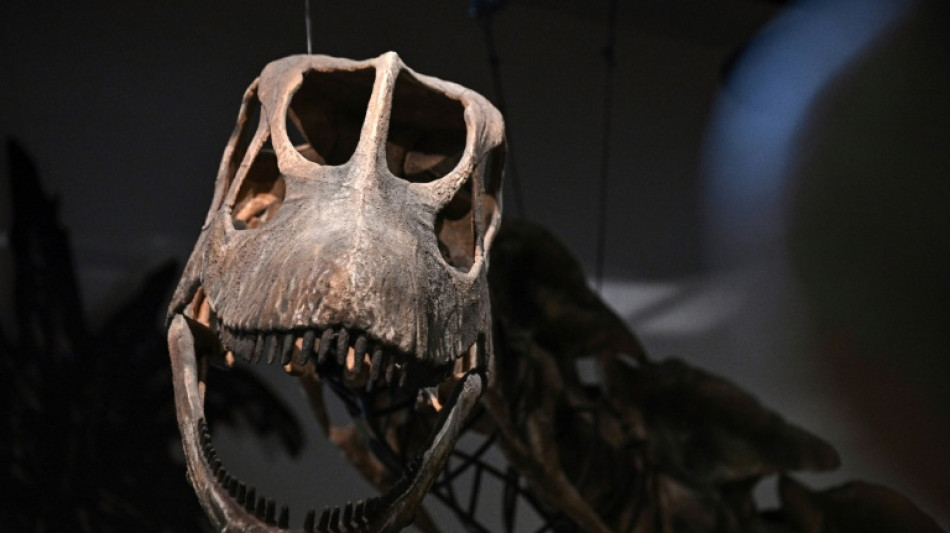
Southeast Asia's largest dinosaur identified in Thailand / Photo: © AFP

 Kyrgios gets month ban for cocaine, enters treatment programme

 Colombian judge bans strikes on guerrillas if minors are present
 Khachanov shocks ailing Auger-Aliassime, Swiatek and Osaka advance at US Open
 Lone juror blocking verdict in US mother's child murder trial: defense
 'Kinda chic' - Williams sisters set to launch US Open doubles bid

 Volkswagen says cutting 100,000 jobs by end of decade

 Russia slaps curfew on charity director over army criticism

 Ailing Auger-Aliassime upset by Khachanov at US Open

 Richarlison omitted from Tottenham's Premier League squad

 How El Nino is choking the Panama Canal

 Hamilton drives his Ferrari dream at Monza

 Senegal has an IMF loan, now what?

 Auger-Aliassime upset by Khachanov at US Open

 Hugging Face, the French start-up that became AI's warehouse

 World Cup winner Llorente retires from Spain team at 31
 Osaka squeezes into US Open third round

 Apple faces £2 bn lawsuit in UK over app privacy feature
 Former champ Swiatek eases into US Open third round

 DR Congo latest to promise moving Israel embassy to Jerusalem

 War criminal Mladic's body returns to Serbia with military honours

 Pierre Cardin museum brings designer's futurist style to Venice

 Slovenian rookie Omrzel triumphs as Mas extends Vuelta lead

 British, French leaders talk migrants, EU relations

 Heading for Ferrari's home race, Leclerc still dreams of world title
 Cafe at centre of Israel culture clash agrees to shut on Sabbath
Scientists have identified a massive new dinosaur from remains discovered in Thailand, with the creature estimated to have weighed as much an nine adult elephants.
The long-necked herbivore stretched 27 metres (88 feet) and weighed about 27 tonnes, according to a study published in the journal Scientific Reports.
It probably roamed what is now Thailand between 100 and 120 million years ago and is the largest ever found in SoutheastAsia, researchers said.
They estimated the new dinosaur had the same heft as nine adult Asian elephants.
"Our dinosaur is big by most people's standards -- it likely weighed at least 10 tonnes more than Dippy the Diplodocus," said lead researcher Thitiwoot Sethapanichsakul, referring to the enormous composite cast previously on display at London's Natural History Museum.
The Thai PhD student called the newly discovered sauropod "the last titan" because it was unearthed in one the youngest rock formations where dinosaurs are found in Thailand, according to University College London.
The region later became a shallow sea, he added, "so this may be the last or most recent large sauropod we will find in Southeast Asia."
The first remains of the enormous creature were unearthed a decade ago by locals in northeast Thailand, but the excavation was not completed until 2024, according to the study, published Thursday.
The remains partially resembled those of previously discovered sauropods, but had enough unique features to be considered a new species.
It has been dubbed Nagatitan chaiyaphumensis after a serpent from Southeast Asian folklore, a giant of Greek mythology and the province of Chaiyaphum where it was found.
A life-size reconstruction is on display at Bangkok's Thainosaur Museum, according to UCL.
H.Kuenzler--VB