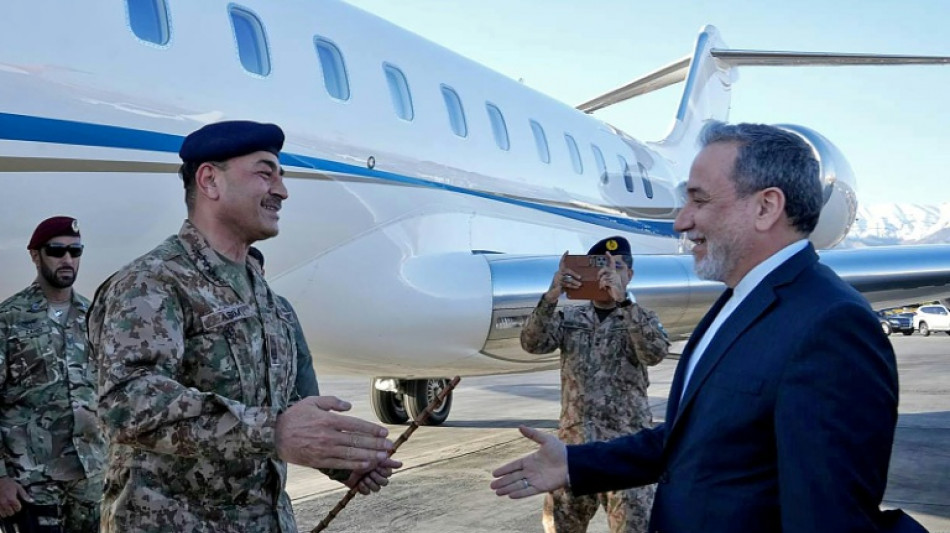
Pakistan's military chief takes lead on US-Iran talks in diplomatic blitz / Photo: © Iranian Foreign Ministry/AFP

 Nazi party records released online shatter German family myths
 US allying itself with Colombian 'narco-traffickers,' Petro accuses

 Putin to confront weak economy at 'Russian Davos', under threat of Ukrainian drones
 Thousands protest in Albania against Kushner real estate project
 US imposes sanctions on Cuban president, Castro family members
 Trump confirms mass rally, scrapping US 250th concerts

 Wemby counts on 'normal' Spurs to bounce back in NBA Finals
 Dangerous livestock pest case confirmed in Texas
 Latest 'Scary Movie' aims to cancel 'cancel culture,' creators say
 Lyles reigns in Rome 100m, Pathirage stuns with javelin
 Trump announces $700 mn support for US coal projects
 SpaceX IPO: rockets, AI losses and Musk in control
 Four-wicket Robinson sparks New Zealand collapse in 1st Test after England slump
 Four-wicket Robinson rocks New Zealand in 1st Test after England collapse
 Qualifier Chwalinska sets up Andreeva French Open final clash
 Unfazed Antonelli plans to race with freedom
 Designer Gabriela Hearst still believes in 'brilliance of humanity' despite AI
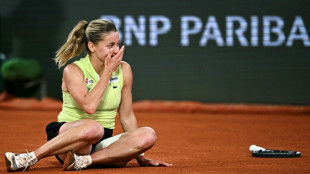 Qualifier Chwalinska downs Shnaider to reach French Open final
 UN nuclear watchdog raises 'proliferation' fears over Iran sites
 Hamilton coy on Monaco chances

 'In the queue': Busy with Iran, US has little energy for Kyiv
 Romanian president nominates EU deputy Tomac as PM to end deadlock
 What we know about Trump relatives' project in Albania
 Oil drops, stocks mostly higher despite AI concerns
 Iran leader says dealt enemies 'decisive blow' in Middle East war

Over a feverish few days of diplomacy, Pakistan's military and civilian politicians successfully divided the Middle East between them to push for a second round of US-Iran peace talks expected to take place in Islamabad this week.
The country's powerful military chief, Field Marshal Asim Munir, headed to Tehran on Wednesday for what would become a three-day trip, where Iranian leaders said he carried US proposals for a second round of peace talks.
Simultaneously, Prime Minister Shehbaz Sharif and his foreign minister conducted a whirlwind diplomatic tour across regional allies Saudi Arabia, Qatar and Turkey.
The twin trips illustrate the coordination at play in what is often described as a "hybrid regime" in Pakistan, and Munir's central role in the negotiating process.
"The synergy that is going on right now is giving results, and to take this momentum forward all this synergy will be needed," said Sheharyar Khan, executive director of the Islamabad-based National Dialogue Forum.
Munir was one of two Pakistani mediators in the room during face-to-face talks between the United States and Iran in Islamabad on April 11.
"It's not political leadership that takes the decision in these kinds of situations, but the military leadership," said a Pakistani official, speaking on condition of anonymity.
The official described Munir's visit to Iran as "important" in bringing both sides back to the negotiating table.
"The deal is almost done. He is the only person who can convince Iranians for a deal -- that's because of the trust level."
- 'Who is the strong man?' -
While a first round of peace talks between the United States and Iran did not yield an agreement, it did lead to the highest-level face-to-face negotiations between the two sides in decades, and communications channels remained open -- through Pakistan.
Building on that momentum, Pakistan's leaders have been pushing for a second round of talks in Islamabad, with security being stepped up across the capital on Sunday in anticipation.
Munir's rise on the global stage has coincided with a consolidation of military power in Pakistan, which has seen him given unprecedented legal immunity and an extended term.
The military as a whole has also taken a more prominent role in governance.
Critics and the political opposition say the moves, as well as sweeping constitutional reforms, have eroded democracy in the country.
However, the military has repeatedly denied meddling in the civilian domain -- even though it ruled Pakistan for nearly half its existence through a series of coups since independence in 1947.
The National Dialogue Forum's Khan said that, while both civilians and military leaders were working closely together in the current system, it was Munir who had the authority to call the shots.
"Who is the person who can give the results? Who is the strong man? Who is controlling? Who is in the lead? That is obviously Mr. Field Marshal," Khan said.
Munir has also built a close relationship with US President Donald Trump -- who often refers to him as his "favourite field marshal" -- since a brief but intense war with India last year.
Adam Weinstein, deputy director of the Middle East programme at Washington's Quincy Institute, said that relationship was crucial.
"Munir focused on Iran because it's the key stakeholder and he's seen as having the closest relationship with Trump," he said.
"... the prime minister focused on regional states with more traditional foreign policy bureaucracies, whose buy-in matters, but is less critical."
Muhammad Saeed, a retired Pakistani general, told AFP that Munir was in "direct communication" with the US leadership to negotiate through sticking points in the dialogue with Iran.
"His presence is bringing both the sides to a middle ground," he said.
L.Stucki--VB