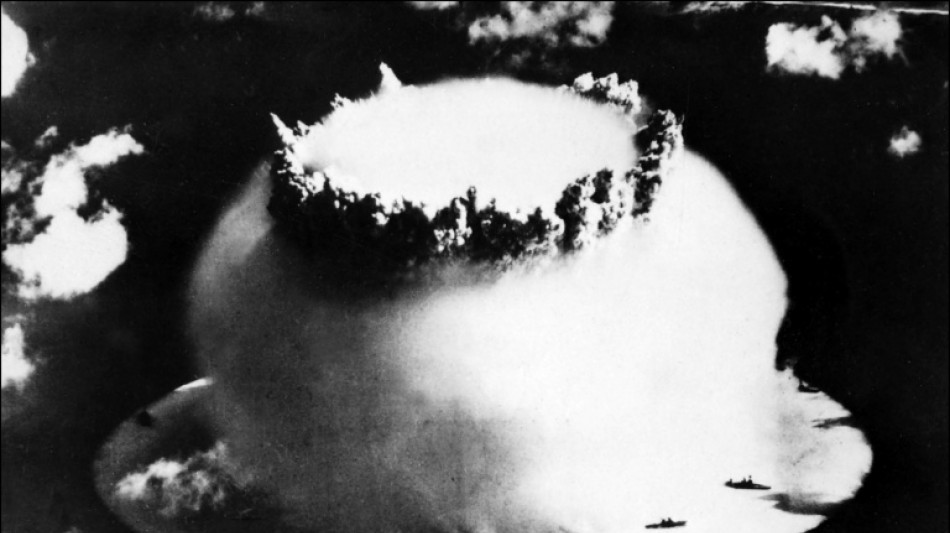
'They poisoned us': grappling with deadly impact of nuclear testing / Photo: © US Defense Nuclear Agency/AFP

 'Pragmatists' vs 'hardliners': Is Iran split over US deal?

 H5 bird flu detected in second Australia state
 Brazil aim for last 32 as World Cup goes into hectic phase

 Necessity drives gold miners in DR Congo's Ebola epicentre

 Japan PM heckled at WWII memorial

 Hanoi residents mount silent protest over home demolitions

 US Congress passes symbolic Iran war rebuke to Trump

 Bolivia's government is 'stoking a civil war,' ex-president Evo Morales tells AFP

 Fans in China put politics aside to cheer Japan at World Cup
 Geopolitics and AI in spotlight at China's 'Summer Davos'

 Race for robotaxi market arrives in London

 Moana Pasifika axed from Super Rugby after rescue talks fail

 Golden Boot battle steals the show at World Cup

 Red or green? For Brazil, the politics of World Cup kits matter

 US Congress passes landmark housing affordability bill

 Dream job: US soccer fans paid to watch every World Cup game

 Europe wilts under record heat as AC sales soar

 Rubio rejects Iran tolls on Hormuz as deal strains multiply

 Cubans bid farewell to revolution hero Valdes

 Ronaldo delights in silencing 'attacks' after making World Cup history

 'Paris in this heat is awful': Tourists change plans as sites close early
 'I'm back': Ronaldo scores at sixth World Cup as Portugal run riot

 US TV news host begs for info after kidnap note says mother is dead

 Ronaldo scores at sixth World Cup as Portugal run riot

 Portugal's Ronaldo first man to score at six World Cups

Nuclear weapons testing has affected every single human on the planet, causing at least four million premature deaths from cancer and other diseases over time, according to a new report delving into the deadly legacy.
More than 2,400 nuclear devices were detonated in tests conducted worldwide between 1945 and 2017.
Of the nine countries known to possess nuclear weapons -- Russia, the United States, China, France, the United Kingdom, Pakistan, India, Israel and North Korea -- only Pyongyang has conducted nuclear tests since the 1990s.
But a new report from the Norwegian People's Aid (NPA) humanitarian organisation, provided exclusively to AFP, details how the effects of past tests are still being felt worldwide.
"They poisoned us," Hinamoeura Cross, a 37-year-old Tahitian parliamentarian who was aged seven when France detonated its last nuclear explosion near her home in French Polynesia in 1996.
Seventeen years later, she was diagnosed with leukaemia, in a family where her grandmother, mother and aunt already suffered from thyroid cancer.
The explosions are known to have caused enduring and widespread harm to human health, societies and ecosystems.
But the NPA report details over 304 pages how an ongoing culture of secrecy, along with lacking international engagement and a dearth of data, have left many affected communities scrambling for answers.
"Past nuclear testing continues to kill today," said NPA chief Raymond Johansen, voicing hope the report would "strengthen the resolve to prevent nuclear weapons from ever being tested or used again".
- 'Very dangerous' -
The issue has gained fresh relevance after US President Donald Trump's suggestion last November that Washington could resume nuclear testing, accusing Russia and China of already doing so -- charges they rejected.
"This is very, very, very dangerous," warned Ivana Hughes, a Columbia University chemistry lecturer and head of the Nuclear Age Peace Foundation, who contributed to the NPA report.
"The nuclear testing period shows us that the consequences are extremely long-lasting and very serious," she told AFP.
The heaviest burden of past tests has fallen on communities living near test sites, today located in 15 different countries, including many former colonies of nuclear-armed states.
Survivors there continue to face elevated rates of illness, congenital anomalies and trauma.
The impact is also felt globally.
"Every person alive today carries radioactive isotopes from atmospheric testing in their bones," report co-author and University of South Carolina anthropology professor Magdalena Stawkowski told AFP.
- Millions of early deaths -
Hundreds of thousands of people around the globe are known to have already died from illnesses linked to past nuclear test detonations, the report highlighted.
It pointed to strong scientific evidence connecting radiation exposure to DNA damage, cancer, cardiovascular disease and genetic effects, even at low doses.
"The risks that radiation poses are really much greater than previously thought," report co-author Tilman Ruff told AFP.
The atmospheric tests alone, which were conducted up to 1980, are expected over time to cause at least two million excess cancer deaths, he said.
And "the same number of additional early deaths (are expected) from heart attacks and strokes", said Ruff, a Melbourne University public health fellow and co-founder of the International Campaign to Abolish Nuclear Weapons, which won the 2017 Nobel Peace Prize.
Ionising radiation, or particles that can snap DNA bonds in cells and turn them cancerous, is "intensely biologically harmful", he said.
"There is no level below which there are no effects".
The risks are not uniform, with foetuses and young children most affected, and girls and women 52-percent more susceptible to the cancer-inducing effects of radiation than boys and men.
- Culture of secrecy -
The NPA report documented a persistent culture of secrecy among states that had tested nuclear weapons.
In Kiribati, for instance, studies by Britain and the United States on health and environmental impacts remain classified, preventing victims from learning what was done to them.
And in Algeria, the precise sites where France buried radioactive waste after its tests there remain undisclosed, the report said.
None of the nuclear-armed states has ever apologised for the tests, and even in cases where they eventually acknowledged damage, the report said compensation schemes have tended to "function more to limit liability than to help victims in good faith".
Local communities, meanwhile, frequently lack adequate healthcare and health screening, as well as basic risk education -- leaving people unaware of the dangers or how to protect themselves.
"The harm is underestimated, it's under-communicated, and it's under-addressed," Stawkowski said.
- 'Guinea pigs' -
When Cross was diagnosed with leukaemia aged 24, she did not immediately blame the nuclear explosions in French Polynesia decades earlier.
"France's propaganda was very powerful," she told AFP, adding that in school she had only learned about the tests' positive economic impact for France's South Pacific islands and atolls.
She was later "shocked" to discover that rather than a handful of harmless "tests", France conducted 193 explosions in French Polynesia between 1966 and 1996.
The biggest was around 200 times more powerful than the bomb the United States dropped on Hiroshima in 1945.
"These weren't just tests. They were real bombs," she said, charging that her people had been treated as "guinea pigs" for decades.
- 'Trauma' -
Other communities near test sites have also borne a heavy burden.
Hughes pointed to the impact of the United States' 15-megaton Bravo test at Bikini Atoll in the Marshall Islands on March 1, 1954 -- "equivalent to 1,000 Hiroshima bombs -- an absolute monstrosity".
It vaporised one island and exposed thousands nearby to radioactive fallout.
Rongelap, about 120 kilometres (75 miles) from Bikini, saw "vaporised coral atoll mixed in with radioactive isotopes falling onto the island from the sky, with the children thinking it was snow", Hughes said.
The report criticised the "minimal" international response to the problem.
It especially highlighted the nuclear-armed states' responsibility to scale up efforts to assess needs, assist victims and clean up contaminated environments.
"We want to understand what happened to us," Cross said.
"We want to heal from this trauma."
W.Huber--VB