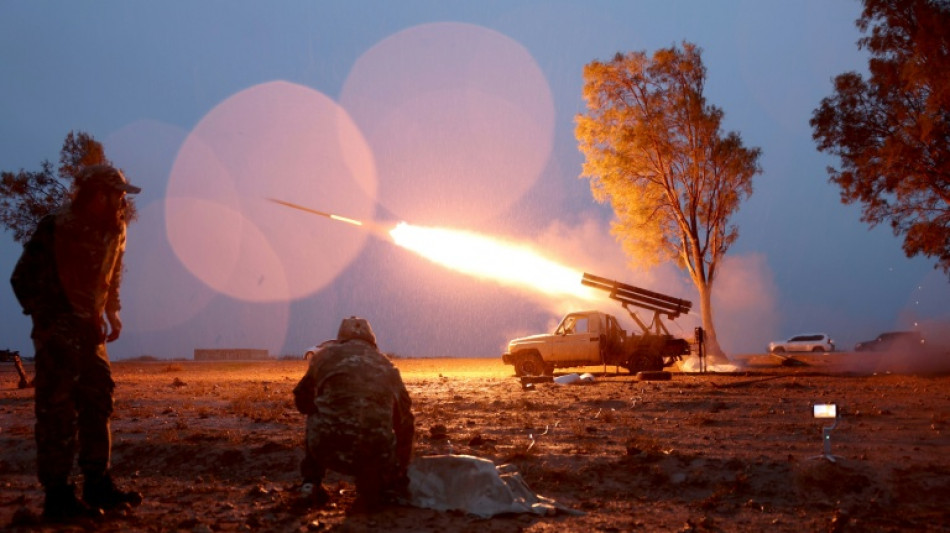
Kurdish-led forces withdraw from Syria's largest oil field: monitor / Photo: © AFP

 Stocks steady after tech rout, Brent falls below $75
 England captain Stokes 'man enough' to apologise for curfew breach
 England captain Stokes 'man enough' to apologise after curfew breach

 German naval ambitions suffer setback as warship order axed
 London police to extend use of live facial recognition, drones
 Europe swelters under record-breaking heatwave
 Iran says deal to end Mideast war 'declaration of US defeat'
 S.Korea chip giant SK hynix seeks $29 bn in Nasdaq listing: regulatory filing
 'Pragmatists' vs 'hardliners': Is Iran split over US deal?
 H5 bird flu detected in second Australia state
 Brazil aim for last 32 as World Cup goes into hectic phase
 Necessity drives gold miners in DR Congo's Ebola epicentre
 Japan PM heckled at WWII memorial

 Hanoi residents mount silent protest over home demolitions
 US Congress passes symbolic Iran war rebuke to Trump
 Bolivia's government is 'stoking a civil war,' ex-president Evo Morales tells AFP
 Fans in China put politics aside to cheer Japan at World Cup
 Geopolitics and AI in spotlight at China's 'Summer Davos'
 Race for robotaxi market arrives in London

 Moana Pasifika axed from Super Rugby after rescue talks fail

 Golden Boot battle steals the show at World Cup
 Red or green? For Brazil, the politics of World Cup kits matter
 US Congress passes landmark housing affordability bill
 Dream job: US soccer fans paid to watch every World Cup game
 Europe wilts under record heat as AC sales soar
Kurdish-led forces withdrew on Sunday from Syria's largest oil field, a conflict monitor said, as government troops extended their grip over swathes of territory in the country's north and east.
The push came after President Ahmed al-Sharaa issued a decree granting the Kurds official recognition in an apparent goodwill gesture, even as his Islamist government seeks to assert its authority over all of Syria after the ousting of longtime ruler Bashar al-Assad in 2024.
The Kurds' de facto autonomous administration, which controls large parts of the northeast, has said the announcement fell short, and the implementation of a deal to integrate Kurdish forces into the state has been stalled for months.
Government troops drove Kurdish forces from two Aleppo neighbourhoods following clashes last week, and on Saturday announced they had captured an area east of the city, as well as Tabqa, in Raqa province, on the southwestern banks of the Euphrates.
At dawn on Sunday, the Kurdish-led Syrian Democratic Forces (SDF) withdrew "from all areas under its control in the eastern Deir Ezzor countryside, including the Al-Omar and Tanak oil fields", the head of the Syrian Observatory for Human Rights, Rami Abdel Rahman, told AFP.
Al-Omar is the country's largest oil field, and was home to the United States' largest base in Syria.
The Kurds' reported withdrawal there follows the government's announcement that it had retaken two other oil fields, Safyan and Al-Tharwa, in Raqa province.
An AFP correspondent in Tabqa saw government armoured vehicles and tanks around the city, with security personnel patrolling the streets.
Intermittent gunfire could be heard from what one security officer said were limited clashes with the SDF.
Shops in the city were closed, but some residents milled around outside their homes, lighting fires to keep warm.
One resident, Ahmad Hussein, told AFP that "people are afraid, but we hope that things will improve over the coming few days".
"We have suffered a lot, and I hope that the situation will improve with the arrival of the Syrian army," he added.
- 'Betrayal' -
The government's push has so far captured Arab-majority areas that had come under Kurdish control during the fight against the Islamic State group, whose defeat in Syria was secured with the help of the US-backed SDF.
Both the government and the Kurdish forces have reported several casualties in clashes that broke out after an agreement for the Kurds to pull back from areas near Aleppo to the east of the Euphrates collapsed.
Both sides traded blame for violating the deal.
The Kurdish administration on Sunday accused government forces of attacking their fighters "on multiple fronts" while the army said the SDF was not fulfilling a commitment to "fully withdraw" east of the river.
Kurdish authorities ordered a curfew in the Raqa region after the army designated a swathe of territory southwest of the Euphrates a "closed military zone".
Deir Ezzor governor Ghassan Alsayed Ahmed said on Saturday that the SDF fired rockets at neighbourhoods in government-controlled territory, while the SDF said pro-government forces attacked its positions in several towns on the east bank of the Euphrates.
The Deir Ezzor governorate announced on Sunday that "all public institutions and official departments are closed today", and urged "people to stay at home".
- Calls for de-escalation -
The United States has long supported the Kurdish forces, but it has also backed Syria's new Islamist authorities.
US envoy Tom Barrack met Syrian Kurdish leader Mazloum Abdi in Erbil on Saturday, the presidency of Iraq's autonomous Kurdistan region said, and the US Central Command urged government forces "to cease any offensive actions" between Aleppo and Tabqa.
France's President Emmanuel Macron and the president of Iraqi Kurdistan, Nechirvan Barzani, called for de-escalation and a ceasefire.
Turkey, which is close to the new Syrian authorities and views Kurdish fighters in Syria as a security threat affiliated with the Kurdistan Workers' Party (PKK), has praised Syria's operation.
But imprisoned PKK leader Abdullah Ocalan, who has led the unfolding peace process between his group and the Turkish state, "sees this situation (in Syria) as an attempt to sabotage" that process, a delegation said after visiting him in jail on Saturday.
Kurdish authorities called for demonstrations on Sunday in several places including Qamishli, their main city in the northeast.
burs-lar/smw/jfx
A.Zbinden--VB