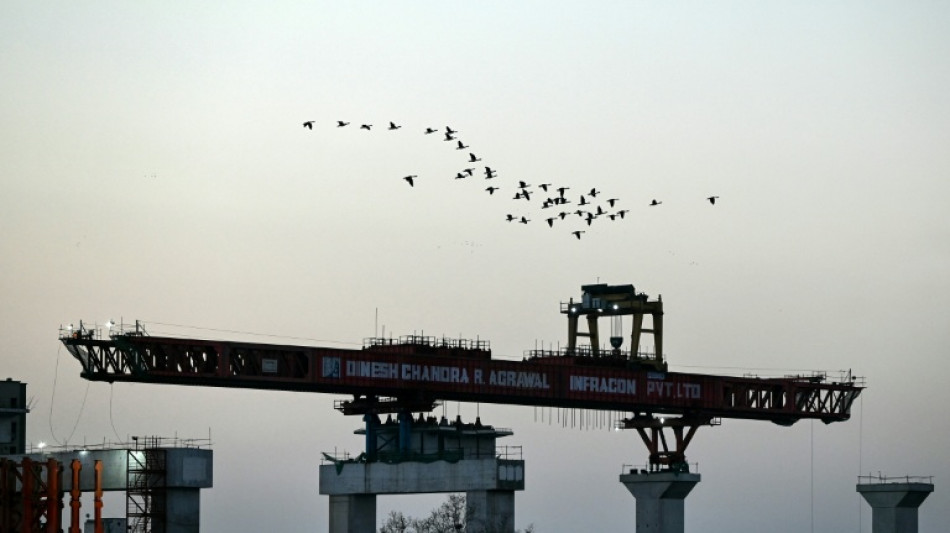
India's economy is booming, but uneven growth clouds ascent / Photo: © AFP

 Antonelli 'mad' about crash in Azerbaijan qualifying

 'Perfect lap' gives Russell pole for Azerbaijan GP as Antonelli crashes out

 UN Security Council condemns Houthi attacks on Saudi Arabia

 China swimmer makes Asian Games history as Thai wins 100m sprint

 Top French literary prize drops best-selling novel over AI claims

 US 'must choose' whether to end war: Iran president

 Pope warns against losing humanity in AI-driven 'paradise of machines'

 Pope warns against losing humanity in 'paradise of machines'

 From FBI warning to literary acclaim: the Russian journalist who took on Putin

 China swimmer in Asian Games first as North Korea lifters reign

 French literary prize removes novel from longlist after AI claims

 China's Zhang wins record seventh Asian Games swimming gold

 Verstappen edges Russell in final practice in Azerbaijan

 English, Spanish, Italian, German football leagues call for FIFA reform

 Pope arrives in France on first official visit in 18 years

 Pope arrives in France on first state visit in 18 years

 Heavy fighting, internet disruption as Ethiopia conflict rages

 From transit to consumption: drug use surges in Mozambique

 Chicago teams, Guardians and Padres all book MLB playoff berths

 Bijan Robinson destroys Packers in 35-14 win for Falcons

 Harimoto hails new era as Japan dethrone table tennis kings China

 India rape cases turn focus back onto women's safety

 Rebellious Afghan taxi drivers defy ban on music

 Brazil candidates mount digital armies for fierce online campaign

 Nepal PM says floods 'a warning to the world' about climate change

For years India's economy was driven by its vast services sector that saw millions of people working away in low-cost back offices providing consultancy for predominantly western companies.
But over the past decade they have given way to centres that allow firms to tap top-tier talent and technology, where white-collar staff perform tasks ranging from IT and data analytics to innovation and design.
Today, these centres are the shiniest parts of India's red-hot economy but not everyone has been able to enjoy the boom times as opportunities remain uneven.
Amazon's biggest office in the world is now located in southern India, and top financiers like JPMorgan have roughly 20 percent of their workforce scattered across Indian cities.
The government says the country is now home to about one-fifth of the world's chip design engineers, helped by hiring from firms like Qualcomm and MediaTek.
This has boosted services sector growth and helped make India the fastest-growing major economy -- a title it has firmly held onto since 2021.
Alouk Kumar, the head of an Indian consultancy that helps global giants set up offshore business centres, says his phone hasn't stopped buzzing in recent weeks.
"Demand and interest have been crazy... the number of calls I have got from European firms has soared," he said. "The way it is increasing, the next 10 years will belong to India."
The surge in growth saw Prime Minister Narendra Modi's government declare in December that India had overtaken Japan as the world's fourth-largest economy.
But figures last month indicate the announcement was premature, with the crossover unlikely to happen for at least another year.
Still, economists say the eventual switch will represent a landmark achievement -- less than three decades ago, Japan was the second-largest economy in the world, and India was still struggling to dismantle its quasi-socialist economic system.
Market reforms in the 1990s unlocked an eventual $283 billion software‑services industry, while a credit boom in the 2000s helped the country's biggest conglomerates expand globally.
And since 2014, a huge infrastructure drive -- new highways, airports and ports -- has underpinned swift growth.
"India's feat cannot be trivialised," said Dhiraj Nim, an economist at ANZ Research.
Many countries, he noted, "failed to capitalise" on similar opportunities or "squandered them in the face of global shocks and imprudent policies".
This world-beating growth --- India's economy roughly doubles in size every decade, compared to Japan, which has basically flatlined -- has helped transform the country.
Poverty, for instance, has fallen.
The World Bank estimates the share of Indians living on $4.20 or less per day plunged from 57.7 percent in 2011–12, to 23.9 percent in 2022–23.
Slowly rising incomes have also led to the emergence of a middle class, estimated at over 300 million.
- 'Illusion' -
But experts caution that the gains from rapid expansion remain wildly uneven.
"There are still a lot of youngsters who are left behind by the progress of our economy," said Amit Saxena of Ambe International.
The firm sends thousands of blue-collar workers overseas each year in search of regular, better paid work.
Nearly half of India's population also continues to rely on agriculture for subsistence.
That keeps GDP per capita far below that of other major economies -- it is 12 times smaller than Japan's and 20 times smaller than Germany's.
"India's economic growth is largely fuelled by demand from the top 100 million people," said Bhaskar Chakravorti, Dean of Global Business at The Fletcher School at Tufts University.
He added that a "significant portion of India's workforce remains in relatively low-productivity and informal sectors".
Chakravorti traces the gaping wage hole to India's services-driven growth, which supports a "narrower slice" of the population, in contrast to China's manufacturing-led boom.
Most economists say India needs sustained eight percent annual growth for two decades to become a high‑income country.
But in the near term, they warn, the priority is creating quality jobs for the millions entering the labour force each year.
Analysts at Morgan Stanley believe India will require an average GDP growth rate of 12.2 percent to truly tackle underemployment.
Shifting workers from farms to factories is central to that goal.
While India has attracted firms like Apple to assemble iPhones, it is far from having become a manufacturing powerhouse.
In rural parts of Maharashtra state, the gulf between national headlines and reality feels stark.
Nitin Gaikwad, 32, supplements his meagre farm income by laying roads, under a government jobs scheme meant to provide guaranteed work at fixed wages.
"I don't see any progress anywhere. If they are saying this, it is only in the cities, where there are metros and flights," he said.
"It is an illusion that the country is progressing. The villages have remained untouched."
U.Maertens--VB