Philippines' 'Cockroach Lord' goes to bat for misunderstood bugs / Photo: © AFP

 Most Asian stocks track Wall St rally, yen drops after BoJ rate hike

 Russians begin voting in controlled election as war drags on

 Trump 'clearly' wants dialogue with Pyongyang: South Korean President

 Bank of Japan hikes rates to 31-year high to battle inflation

 Thailand's Muslim separatists vow to fight to the end

 Mideast turmoil, AI set to dominate UN gathering of world leaders

 Australia to detain tourists who overstay visa, minister says

 Championship rivals brace for renewal of bitter feuds

 In Brazil's Amazon, the hunt for oil fuels hopes and fears

 Australian athlete who soiled herself apologises for continuing Hyrox race

 Baby orangutans in India expose 'frightening' scale of trafficking
 Doom Loop? Ed Sheeran struggles against Gaza tide
 Sudanese women hold fast to threatened henna body art

 Man Utd misery puts Carrick under pressure, Spurs feeling the heat

 Prized Mexican relic returns on loan, two centuries on

 Venezuela unblocks some censored news sites

 Samba stars on debut in Man City rout of Norwich

 Oversight Board blasts 'inadequate' Meta safeguards for AI deepfakes

 The Easter Island origins of buzzy Malkovich drama 'Wild Horse Nine'

 Third body recovered after Grand Canyon flash flood

 Harry makes first public appearance since return to UK
 Abhishek hits record T20 ton as India sweep series 3-0

 Abhishek hits record T20 ton as India sweep T20 series 3-0

 English FA calls for Infantino to release World Cup sell-off documents

 GM delivers first components for US interceptor missiles

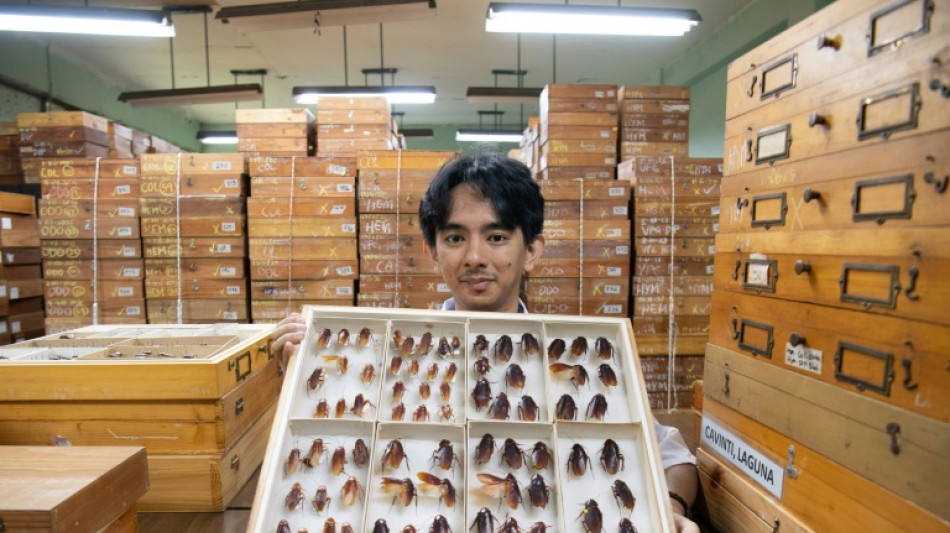
A thin band of light from Cristian Lucanas's headlamp pierces the blackness of a Philippine rainforest as he digs through the underbrush before gently scooping up a cockroach with his bare hands.
As the Southeast Asian country's lone expert on the oft-misunderstood insect -- and discoverer of 15 species -- friends have dubbed the soft-spoken scientist "Ipis Lord", after the local name for the ubiquitous bug.
While fully aware most view cockroaches as disgusting, disease-bearing pests, the 31-year-old University of the Philippines entomologist says they deserve more study -- and credit -- for their key role in the planet's ecosystem.
"I also hated cockroaches when I was a child," Lucanas said with a grin during an interview with AFP in the college town of Los Banos, south of Manila.
"Fear of cockroaches is innate," he conceded, adding he usually tells people "I work in a museum" when asked about his job.
His girlfriend, also an entomologist, is more understanding, though her work focuses on insects less reviled than the cockroach, of which there are more than 4,600 known species.
"It's possible the real total is double or even triple that," said Lucanas, unable to hide his enthusiasm.
"For the longest time, no one was studying them," he said, calling it "sad" given the size and variety of the archipelago nation's cockroach population.
The massively biodiverse Philippines has about 130 known species, three-fourths of which are found nowhere else on earth.
Lucanas thinks there could be another 200 local varieties yet to be documented.
"Because of their outsized role in the ecosystem, its processes would be hampered if they disappear," he said.
Like dung beetles and earthworms, cockroaches are detritivores, built to eat and break down dead organic matter -- including their own kind -- and return them to the soil.
While some cockroach species do carry disease-spreading microbes, a world without them would slow the process of decomposition crucial for sustaining ecosystems, he said.
Birds and spiders would lose a key food source, and plants would absorb less carbon dioxide, potentially contributing to global warming.
Even so, Lucanas keeps a can of bug spray handy at work, ready to kill any live cockroaches that might view the museum's 250,000 preserved insect species as a potential snack.
Lucanas's obsession began 12 years ago on a field trip to a bat cave on a remote island, its floor crawling with cockroaches feasting on guano.
When his biology class adviser was unable to identify the species, Lucanas knew he had found his niche.
A lifelong fan of J.R.R. Tolkien, Lucanas often names his discoveries after creatures in the author's "Lord of the Rings" trilogy: "Valar", "Hobbitoblatta", and "Nazgul".
Their ranks are set to grow once he finishes writing up scientific papers on his newest finds, he promised.
Given the uniqueness of his specialty, the young scientist occasionally finds himself in demand, albeit for very specific situations.
The country's biggest bug spray firm once invited him to lecture its staff on cockroach identification.
Its top restaurant chain also sought his advice, desperate to stop raids on their commissary by so-called German cockroaches, an invasive species from India.
"Control is not really my forte," Lucanas admitted.
But cockroaches are far from the indestructible creatures that they are often portrayed as, he insists.
It is not true, for instance, that cockroaches will inherit the earth after a nuclear war, he said, noting that their resistance to radioactive exposure is about on par with other insects.
Humans, not bombs, pose a more immediate threat to the creatures, he said, noting that some species, especially in mountain environments, reproduce slowly and could disappear if their habitats are encroached upon.
Several cave-dwelling Philippine species first described in the 1890s during the Spanish colonial period "have not been seen again" since their habitats were opened to tourism, he explained.
He laments that most science funding in his country "goes to research that will directly affect humans", worrying that at best he will only be able to catalog and explain the Philippines' cockroaches.
But for now, that's enough, he said when asked about the decades still left in his career.
"I think I'll stick with what I'm doing. It's how I've built my reputation.
"And I really do enjoy working with cockroaches."
M.Betschart--VB