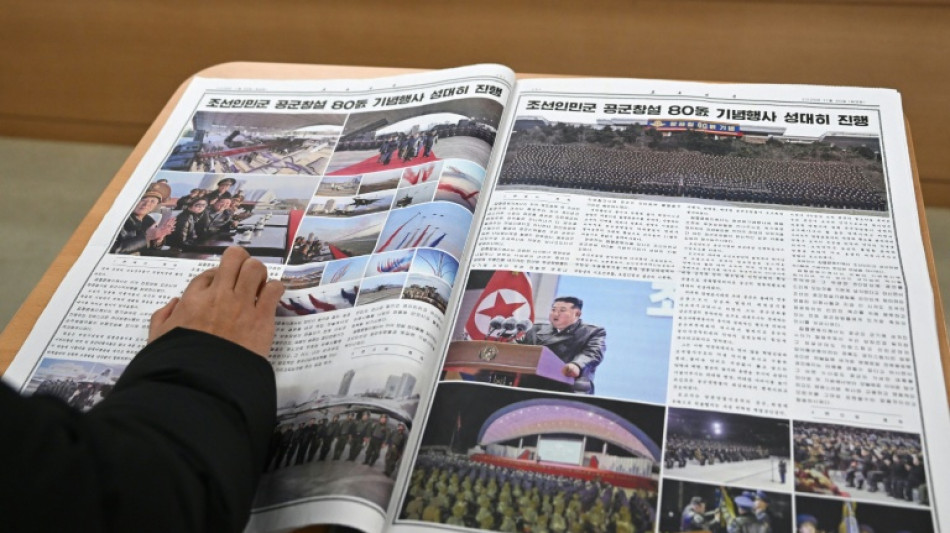
South Koreans now free to read North's newspaper, once banned as seditious / Photo: © AFP

 Massive police deployment blocks Kenya protest anniversary

 Court orders TotalEnergies to account for clients' emissions

 Stocks rally on renewed AI optimism, oil price declines

 Venezuela twin quakes kill at least 164 with many trapped under rubble

 IOC votes to continue ski mountaineering for 2030 Games

 Stocks rally on AI optimism after Micron's blowout forecast

 Tunisia's short-lived World Cup experience lays bare deep dysfunctions

 'Everything collapsed': Venezuela region hit hardest by quakes cries for help

 Kenya police turn out in force on protest anniversary

 Baking heatwave gives Europe no respite

 Trump climate pushback spurs courtroom battles, report says

 Kenya police in massive show of force on protest anniversary
 USA, Germany in control as Dutch eye World Cup knockouts

 Violence feared as Kenya marks protest anniversary

 Ukraine recovery summit opens, overshadowed by Kyiv-Warsaw row

 Chad sees influx of drone victims from Sudan

 'We shut up big mouths,' says South Africa's World Cup coach Broos

 Mothers search, men weep amid debris of Venezuela quakes

 South Africa stun South Korea to make World Cup history
 Clarke fears Scotland 'probably going home' after Brazil World Cup loss

 Secret cameras, mics and AI reveal rare Cambodia wildlife

 Bulgaria's milk farmers falter in former yogurt empire

 Trump opens US 250th birthday party with rally-style speech

 TotalEnergies awaits ruling in high-stakes climate trial
 Spice Girls' debut 'Wannabe' turns 30, amid reunion talk

Packed with missile tests, propaganda hailing the great leaders and tirades against the United States, North Korea's top newspaper was long considered so incendiary that South Korea banned its citizens from reading it.
But dovish President Lee Jae Myung is now seeking better ties with Pyongyang and has joked that he doesn't believe the public will "become commies" by reading the Rodong Sinmun.
That means from this week South Koreans can access the publication -- whose name means "Workers' Newspaper" -- at select locations without state approval.
Prospective readers no longer have to identify themselves and submit an application explaining their purpose, though they still must visit public libraries to view a copy.
Opinions in the South Korean capital Seoul were divided on allowing free access to propaganda from Pyongyang.
All media in North Korea is tightly controlled by the government, and the Rodong Sinmun is the mouthpiece of the repressive ruling Workers' Party.
"It's like giving people access to ISIS propaganda," said Park Si-won, a 22-year-old university student, referring to the militant group also known as Islamic State.
"You wouldn't do that unless you wanted them to join the terrorist group."
Hong Se-wung, 81, called the change "undesirable".
"To allow people to read the newspaper of a hostile country, or to lead them towards reading it, the very idea itself is extremely unsettling."
But others were skeptical that South Koreans would go out of their way to seek out the paper.
"Many people these days don't even read physical newspapers anyway. I doubt they'll make the effort to read Rodong Sinmun," said Son Yu-jin, 27, a graduate student.
- 'Symbolic change' -
South Korea and the nuclear-armed North remain officially at war, and Seoul long banned all access to Pyongyang's propaganda on security grounds.
Many restrictions remain in place -- North Korean websites are still inaccessible from South Korean IP addresses.
At Seoul's national library on Friday, AFP journalists saw a handful of people flipping through copies of Rodong Sinmun, its pages replete with photos of North Korean leader Kim Jong Un -- whose name is always carried in bold type.
But elsewhere, AFP struggled to find a library that had actually implemented the new rules.
"Practically speaking, this is really a symbolic change," said Chad O'Carroll, whose specialist website NK News hosts a platform for reading North Korean media.
"Overall, it would be much easier for students of North Korea studies to work with these materials if the South Korean government made the websites of North Korean state media accessible."
That, he said, would require politically difficult changes to Seoul's security law.
Seoul has vowed to "steadily expand access" to information on North Korea as it works to improve ties that are at their worst levels in years.
The move is not reciprocal -- North Koreans remain banned from accessing any South Korean content at all and risk heavy penalties if caught doing so.
Lee has described the relaxation of Cold War-era censorship as an "opportunity to understand the reality of North Korea accurately".
And businesswoman Bae Jee-woo agreed.
"Even if South Korean citizens can access the Rodong Sinmun directly, they would be able to interpret it based on their own standards and philosophies," she told AFP.
"It's highly unlikely that they would be significantly influenced by North Korea's propaganda or anything like that."
S.Leonhard--VB