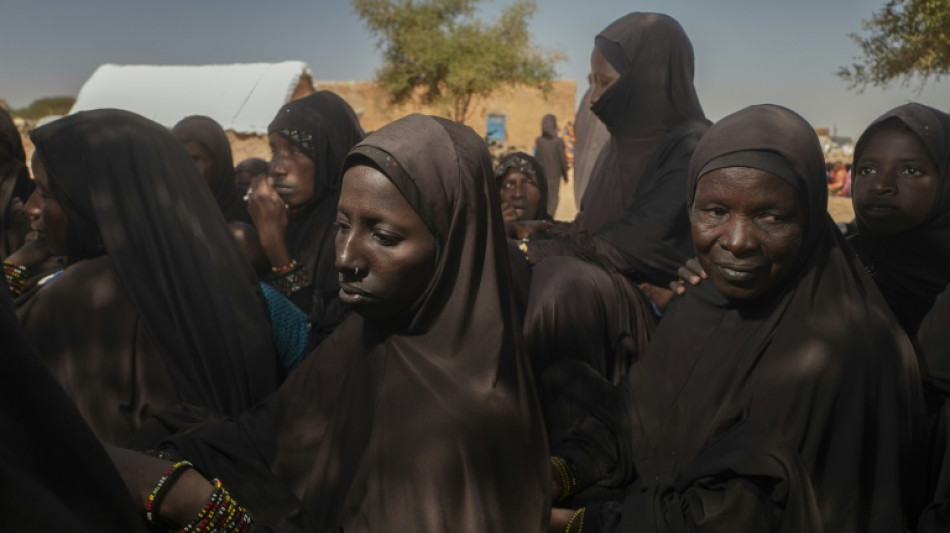
Strangled by jihadist blockade, Malians flee their desert town / Photo: © AFP

 Wolff says Russell will be at Mercedes next season

 Djokovic inspired by Serena as he targets history at Wimbledon

 Stokes falls cheaply as England collapse in New Zealand decider

 Russell bounces back to beat Antonelli in final practice

 Iran says US violated peace deal as both sides trade fire

 Injured Australian pair Leckie, Italiano out of World Cup
 Farmers fear drought as Italy's longest river runs dry

 Budapest Pride to push for equality after reversed ban

 World Cup fans get taste of American life -- at the mall
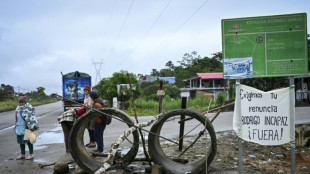
 World Cup turns New York's Times Square into global fan hub

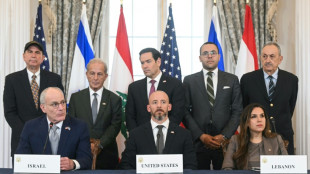 Lebanon, Israel and US sign trilateral framework pact

 Cape Verde extend World Cup fairytale to set up Argentina meeting
 Messi to start dead-rubber World Cup group match on bench

 US and Iran trade strikes putting new strain on Mideast ceasefire

 Maple Leafs make teen McKenna top pick in NHL Draft

 California appeals court orders Weinstein resentencing for sex assault

 Scheffler fires 60 to grab 36-hole PGA Travelers lead

 Austria's Rangnick shuts down conspiracy talk ahead of Algeria World Cup clash

 Should we fear an AI bubble bust?
 US strikes Iran sites after cargo ship attack

 Gueye double keeps Senegal's World Cup hopes alive

 US stocks recover from tech tremors as oil prices fall

 OpenAI restricts limited release of new model to US only
 Scheffler fires 60 to grab early PGA Travelers lead

 Trump blasts 'godless' Democrats in incendiary speech to evangelicals

Fatima gripped her newborn tightly against her chest as the Tuareg woman queued beneath the scorching Mauritanian afternoon sun to register herself and her child as refugees.
She was forced to flee the Malian town of Lere, near the border with Mauritania, after her community came under a total blockade by jihadists some two weeks ago.
Dressed in a brightly coloured tunic, she waited in the shade of an ochre wall in the Mauritanian border post of Fassala, alongside a few dozen others who had also fled the waxing insurgency in her west African country.
Since September, blockades such as that on Lere have been multiplying across Lere, carried out by jihadists from the JNIM, the Al-Qaeda-linked Group for the Support of Islam and Muslims.
The jihadists are simultaneously imposing a fuel blockade on Mali that has paralysed the landlocked Sahel country's economy.
The resulting unrest and violence have sent refugees fleeing westwards into Mauritania.
- 'Nothing left to eat' -
"We were told we had to leave the town. There was nothing left to eat. So, we left," Fatima said.
Between 2,000 and 3,000 people have fled to Mauritania from Lere and its surroundings in the last two weeks, according to the United Nations refugee agency.
"This is the largest influx of Malian refugees since late 2023," explained Norik Soubrier, a field expert for the European Union's humanitarian branch.
The people who had gathered near the registration area in Fassala appeared worn out by the sun and covered in dust.
Weary after several days of walking, many had travelled with their entire families. Some had brought their meagre resources: a donkey, a few goats, a horse.
Mali's suffocating fuel blockade and deteriorating security situation has had serious consequences in the capital Bamako and other regions, choking off smaller towns like Lere, which is located roughly 60 kilometres (40 miles) from the border.
The JNIM has been attacking fuel tankers entering Mali from neighbouring countries, in a bid to put pressure on the ruling military junta by stifling the economy.
The situation has prevented harvesting in several regions, limited access to electricity and forced the government, which has struggled to contain the insurgency since seizing power following back-to-back coups, to briefly close schools.
- 24 hours to leave -
Two residents of Lere who escaped to Mauritania told AFP the assailants had given locals "a 24-hour ultimatum" to leave the town, and those who could not or who refused were either "murdered or taken hostage".
"They suspect them of being in league with the Malian army, which is why there were these reprisals," added the other man, dressed in a green boubou robe and traditional turban.
Suspected jihadists have killed 14 civilians in the central Malian town in recent days, officials and locals told AFP.
One local official said armed fighters had launched an attack last week, "and kidnapped 12 people, who they then killed". The official, who blamed the JNIM, requested anonymity for security reasons.
In a separate incident, two herders who had been kidnapped four days earlier were "found dead a few kilometres from the town", the source said.
"These people were not killed randomly", a community leader told AFP. "They had lists. They were informed and were looking for specific names".
"When the Malian armed forces go out, they can move around without any problems. There is no fighting. But as soon as they return to the barracks, the JNIM replaces them, and the population is trapped," he explained.
"And even fleeing is now impossible. They (jihadists) gave people a limited time to leave. Now it's over."
Jihadists have set up roadblocks in the south and west of the landlocked country near the borders with Senegal and Mauritania, from which vital goods are imported every day.
The JNIM is the most influential jihadist group in Mali and represents the "most significant threat in the Sahel", according to the United Nations.
In recent months, the JNIM has expanded its influence over swathes of territory -- how much is not yet clear -- funding itself through tax collection and kidnap for ransom.
C.Kreuzer--VB