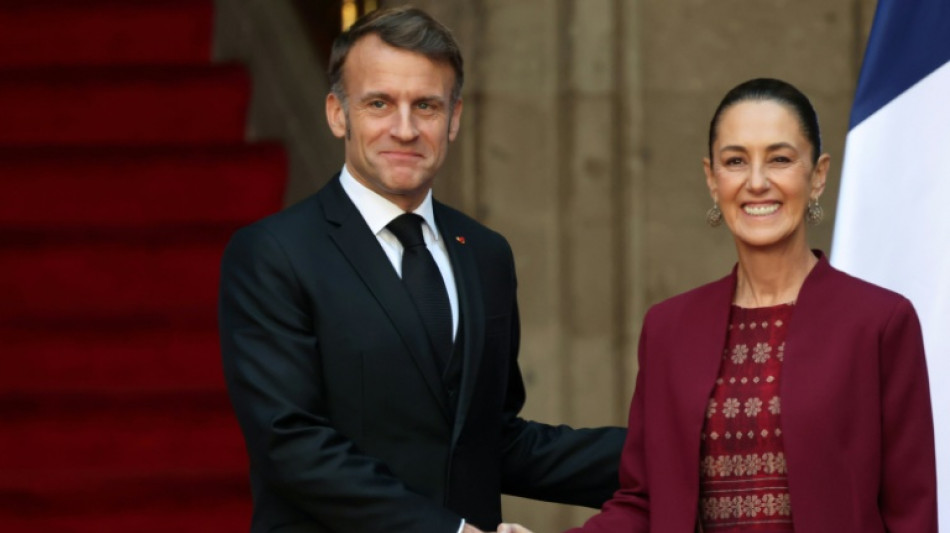
Return of centuries-old manuscripts key to France-Mexico talks / Photo: © AFP

 Davidovich Fokina wins in Mallorca for first ATP title

 Sabalenka urges Grand Slams to 'get it done' in prize money boycott row

 Russell snatches pole as Verstappen, Antonelli fourth for Austria GP grid

 Smith and supersub Foulkes strike for New Zealand in England finale

 Supersub Foulkes strike for New Zealand in England finale

 Wolff says Russell will be at Mercedes next season

 Djokovic inspired by Serena as he targets history at Wimbledon

 Stokes falls cheaply as England collapse in New Zealand decider

 Russell bounces back to beat Antonelli in final practice

 Iran says US violated peace deal as both sides trade fire

 Injured Australian pair Leckie, Italiano out of World Cup

 Farmers fear drought as Italy's longest river runs dry

 Budapest Pride to push for equality after reversed ban

 World Cup fans get taste of American life -- at the mall

 World Cup turns New York's Times Square into global fan hub

 Lebanon, Israel and US sign trilateral framework pact

 Cape Verde extend World Cup fairytale to set up Argentina meeting

 Messi to start dead-rubber World Cup group match on bench

 US and Iran trade strikes putting new strain on Mideast ceasefire

 Maple Leafs make teen McKenna top pick in NHL Draft

 California appeals court orders Weinstein resentencing for sex assault

 Scheffler fires 60 to grab 36-hole PGA Travelers lead

 Austria's Rangnick shuts down conspiracy talk ahead of Algeria World Cup clash

 Should we fear an AI bubble bust?

 US strikes Iran sites after cargo ship attack

The return of two centuries-old manuscripts from France to Mexico will headline talks during French President Emmanuel Macron's visit to the Latin American country on Friday -- a request expected to meet headwinds.
At the heart of the discussions are two manuscripts illustrating Indigenous Mexica life: the Codex Borbonicus, kept at the library of French parliament's lower house, the National Assembly, and the Codex Azcatitlan, which is part of France's National Library collection.
"Our main interest is the return of these codices, which are very important to Mexico," said Mexican President Claudia Sheinbaum in October.
- What is a codex? -
Mexican manuscripts are generally referred to as codices by researchers, according to Olivier Jacquot, head of collections of the French National Library's manuscripts department.
These codices include both pictographic and alphabetical narrations of the history, rituals and beliefs of the people of present-day Mexico before and after the arrival of Spanish colonisers in the 16th century.
The Codex Borbonicus gets its name from the Palais Bourbon, the seat of the French parliament's lower house, where it has been preserved since the 19th century.
It represents the "divinatory and solar calendars" of the Mexica civilisation -- a dominant Indigenous population in pre-Hispanic Mexico -- according to the French culture ministry.
The Codex Azcatitlan narrates the history of the city of Mexico-Tenochtitlan "from the migration from the mythical Aztlan to the fall of the Mexica empire at the hands of the Spanish and their Indigenous allies in 1521", according to the Mexican government's Memorica site, a platform to preserve and share the country's heritage.
- How did they come to be in France? -
France's National Assembly library acquired the Codex Borbonicus in an 1826 auction, according to the institution.
However, the codex is believed to have been stolen from a library in Spain years earlier during the Napoleonic era.
The Codex Azcatitlan was donated to the National Library in 1898 by Augustine Goupil, widow of the Franco-Mexican collector Eugene Goupil, along with other manuscripts, Jacquot said.
They were gifted on the condition that the collection "always be preserved in its entirety in the Library", said Marie de Laubier, the National Library's collections director.
- Why is Mexico claiming them? -
Mexico has ramped up efforts to recover historical and cultural heritage outside the country since the administration of Sheinbaum's predecessor, Andres Manuel Lopez Obrador.
"The trafficking of cultural goods harms the people," Diego Prieto, director of Mexico's National Institute of Anthropology and History, said in May, announcing the repatriation of 16,200 cultural items since 2018 from various countries.
On Thursday, Sheinbaum advisor Jose Alfonso Suarez del Real said they plan to discuss with Macron the return of the Codex Azcatitlan as part of next year's celebrations of 200 years of French-Mexican relations.
This manuscript "is essential for understanding the development of what was Mexico-Tenochtitlan from its foundation until the early 17th century" and "of enormous interest to the Mexican people", Suarez del Real said.
In May, Suarez del Real said Mexico had been calling for the return of the Codex Borbonicus since the 19th century.
In 2024, the Indigenous Hnahnu people insisted on its return because it contains the "formulas" for the Mexica Fuego Nuevo (New Fire) ceremony, next to be held in 2027.
- What is France's response? -
Before Macron's visit to Mexico, the French presidency said the issue of the codices was "an important matter about which we have a very open dialogue with the Mexicans".
Relations were strained in 1982 when a Mexican lawyer, Jose Luis Castaneda, stole the Codex Tonalamatl from France's National Library and brought it back to Mexico, where it has remained.
Both the French National Assembly and National Library say their possession of the manuscripts is legal and defend the principle of "inalienability of public collections" in France.
Far-left lawmakers presented a bill in April to repeal this legal principle, but it is unlikely to succeed.
"The National Assembly's board is the only body competent to decide on (its) collections," its press office told AFP.
The preservation of the manuscripts, which can only be exhibited temporarily due to their fragility, is another argument against moving them.
P.Keller--VB