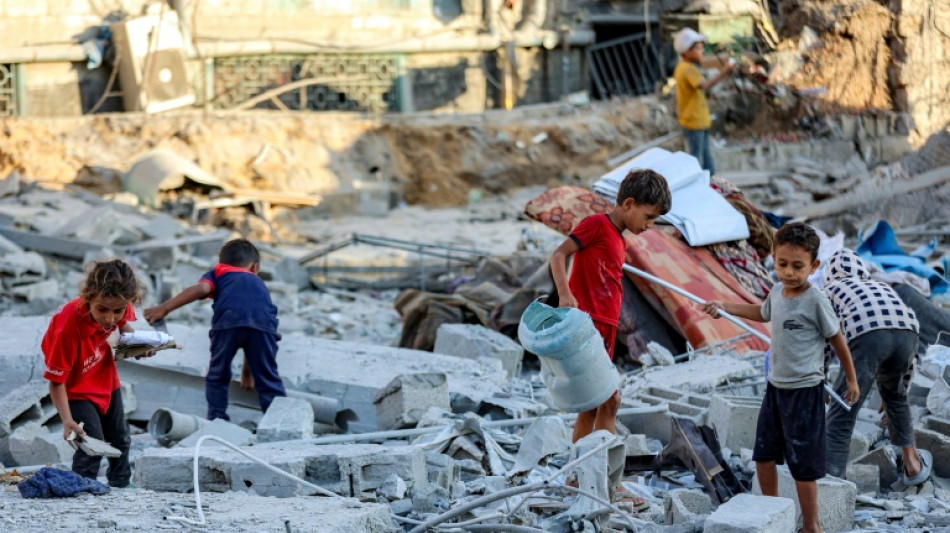
In Gaza's ruins, a grandmother keeps family and hope alive / Photo: © AFP

 England top group to set up DR Congo World Cup clash, Portugal held
 England moving on at World Cup but questions linger

 Venezuela quakes kill 1,400 as time running out to find survivors
 Australia World Cup goalkeeper Patrick Beach has beach named after him

 Take brutally hot weather seriously, heatstroke survivor warns

 Australia boosts shark-spotting drone coverage at Sydney beaches

 Scotland boss Clarke resigns after World Cup exit confirmed

 Kane, Bellingham on target as England win World Cup group

 Croatia battle past Ghana to sew up World Cup Last 32 spot

 US, Iran clash, putting fragile deal under growing strain

 Ryu takes one-shot lead over Henderson at Women's PGA Championship

 Jangoo and Chase put West Indies in control against Sri Lanka

 World Cup star Gakpo requests privacy after death of unborn son
 Aid planes landing at partially reopened Venezuela airport after quakes

 Spain's Williams hits out at Uruguay over World Cup injury
 World's largest particle smasher halts for upgrade to boost hunt for dark matter

 Ex-Olympic medallist Canderloro elected French Ice Sports chief

 Prince Harry and family to stay at royal residences on UK visit

 'Why not?': Cape Verde eye seismic World Cup shock against Argentina
 Russell snatches controversial pole in Austria after Verstappen crash

 Davidovich Fokina wins in Mallorca for first ATP title

 Sabalenka urges Grand Slams to 'get it done' in prize money boycott row

 Russell snatches pole as Verstappen, Antonelli fourth for Austria GP grid

 Smith and supersub Foulkes strike for New Zealand in England finale
 Supersub Foulkes strike for New Zealand in England finale

With no shoes to protect their tiny dust-covered feet, Hiam Muqdad's grandchildren toddled unfazed through the bombed-out ruins of their Gaza City neighbourhood in search of clean water.
Clutching large black buckets and their grandmother's hand, the infant trio seemed not to notice the scars left by two years of war, barely registering the enormous piles of rubble, warped metal and toppled buildings lining their path.
Muqdad, 62, told AFP she went out every morning with the children to search for water, sometimes finding enough for a few days and sometimes not at all.
"Children no longer say 'I want to go to nursery or school' but rather 'I want to go get water or food or a food parcel'," she said. "The child's dream is gone".
"In the past they used to go to the park but today children play on the rubble."
Reaching a mound of broken breeze blocks, the children, whose parents live in the southern city of Khan Yunis, diligently scrambled for scraps that could be used to make a fire.
Torn pieces of cardboard, a discarded milk carton, a plastic bottle and a few thin twigs made up the haul.
Fuel secured, the group began their walk back through the hazy ruins to their makeshift home.
- 'Tear of joy, tear of sadness' -
Muqdad lost both her house and relatives during the gruelling war between Israel and Hamas, which flattened vast swathes of the Palestinian territory and displaced most of its population at least once.
After the US-brokered ceasefire came into effect on October 10, the family returned from the south to the Al Nasr neighbourhood of Gaza City to pitch a tent in the rubble of their ruined home.
"When they said there was a truce, oh my God, a tear of joy and a tear of sadness fell from my eye," Muqdad said, recalling those she had lost.
The war, triggered by Hamas's October 7, 2023 attack on Israel, has killed at least 68,519 people in Gaza, according to figures from the Hamas-run government's health ministry that are considered reliable by the United Nations.
Muqdad's house was entirely destroyed by a bulldozer, she said, explaining that afterwards she "couldn't even find a mattress in it".
Sheets of battered corrugated metal mark out the small patch of sand the family now calls home, forming an island of life in the ruins.
Outside, the street is flattened, and only the skeletons of collapsed buildings remain.
Early each morning, with the sun still low in the sky, Muqdad emerges from the family's igloo-shaped tent to set about instilling order into the chaos of displacement.
Sitting in front of a large Palestinian flag, she delights in showing her grandchildren the pasta they are going to cook on an open fire.
While she said it is enough to satisfy their hunger, Muqdad lamented that she "cannot buy vegetables or anything because we do not have cash and no income".
Israel repeatedly cut off supplies into Gaza during the war, exacerbating dire humanitarian conditions.
The World Health Organization said on Thursday there had been little improvement in the amount of aid going into Gaza since the ceasefire, and no observable reduction in hunger.
- 'Bring life back' -
After two years of war, Gaza's public services are crippled and the territory is buried under more than 61 million tonnes of debris, according to UN data analysed by AFP. Three quarters of buildings have been destroyed.
"We want to remove all the rubble," Muqdad said, adding the destruction was particularly affecting the children's mental health.
In the watery sunlight, the young children milled around on large mats spread out on the sand, sometimes passing the time sitting on upturned buckets.
After returning from their trip to collect fire material and water, Muqdad sat on the floor to begin washing the family's clothes by hand in a large metal vat.
But as evening fell, the family's thin foam mattresses were brought back into the tent and the day's activities halted as darkness descended.
"I light a candle because I don't have electricity or a battery or anything," Muqdad said.
Despite the suffering and severe lack of daily essentials, Muqdad said she still held out hope that things could get better.
"We want to bring life back even a little, and feel that there is hope."
A.Zbinden--VB