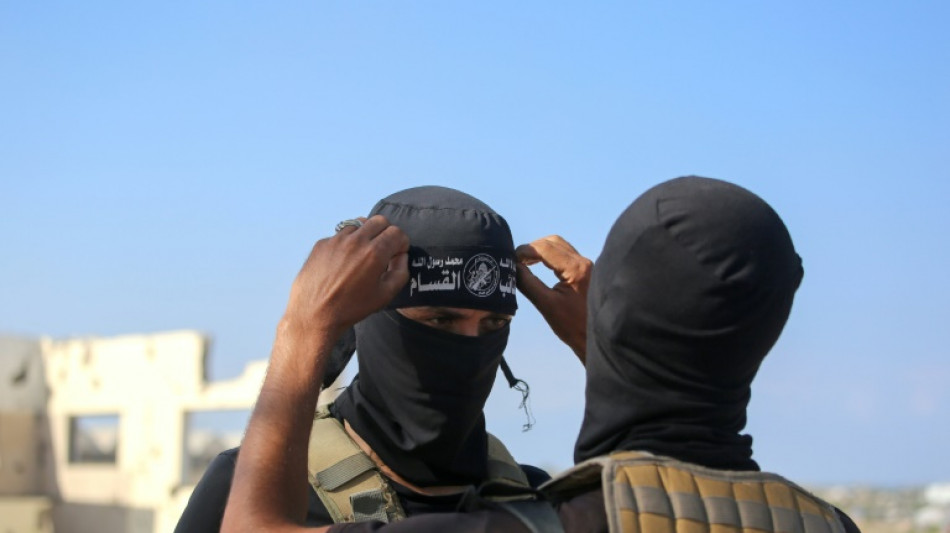
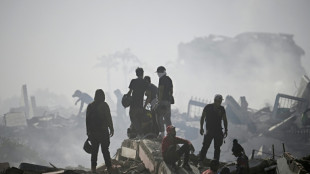
The armed groups clashing with Hamas in Gaza / Photo: © AFP/File

 England top group to set up DR Congo World Cup clash, Portugal held
 England moving on at World Cup but questions linger
 Venezuela quakes kill 1,400 as time running out to find survivors
 Australia World Cup goalkeeper Patrick Beach has beach named after him
 Take brutally hot weather seriously, heatstroke survivor warns

 Australia boosts shark-spotting drone coverage at Sydney beaches
 Scotland boss Clarke resigns after World Cup exit confirmed

 Kane, Bellingham on target as England win World Cup group

 Croatia battle past Ghana to sew up World Cup Last 32 spot

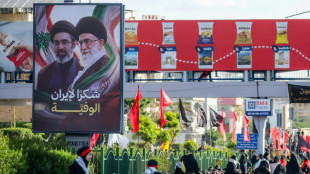
 US, Iran clash, putting fragile deal under growing strain

 Ryu takes one-shot lead over Henderson at Women's PGA Championship

 Jangoo and Chase put West Indies in control against Sri Lanka

 World Cup star Gakpo requests privacy after death of unborn son
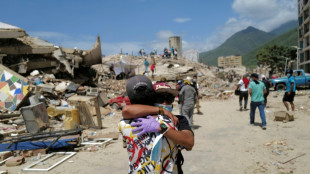
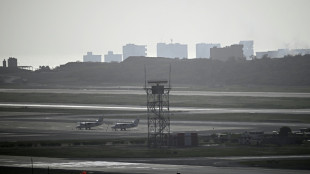 Aid planes landing at partially reopened Venezuela airport after quakes
 Spain's Williams hits out at Uruguay over World Cup injury
 World's largest particle smasher halts for upgrade to boost hunt for dark matter

 Ex-Olympic medallist Canderloro elected French Ice Sports chief
 Prince Harry and family to stay at royal residences on UK visit

 'Why not?': Cape Verde eye seismic World Cup shock against Argentina
 Russell snatches controversial pole in Austria after Verstappen crash

 Davidovich Fokina wins in Mallorca for first ATP title

 Sabalenka urges Grand Slams to 'get it done' in prize money boycott row

 Russell snatches pole as Verstappen, Antonelli fourth for Austria GP grid

 Smith and supersub Foulkes strike for New Zealand in England finale

 Supersub Foulkes strike for New Zealand in England finale

Shortly after a ceasefire took effect in Gaza, clashes erupted between armed groups, some backed by Israel and others loyal to Hamas, as the Islamist movement sought to reassert control over the devastated territory.
Some of these groups are criminal gangs, others consist of members of historically influential Gaza families, and some combine both elements, experts told AFP.
As Gaza's post-war governance remains uncertain, Hamas has redeployed its armed wing, the Ezzedine al-Qassam Brigades, along with two auxiliary units -- the Sahm and Radea forces — to areas vacated by Israeli troops.
- Gangs -
Several armed gangs in Gaza are reportedly acting under Israeli protection, and allegedly loot aid convoys entering the territory, where shortages remain dire after Israel's wartime blockade.
The most notorious is the Popular Force, led by Yasser Abu Shabab, who has openly called for Hamas's overthrow and is said to operate under Israeli protection.
His hundreds-strong group is based in southern Rafah, near Kerem Shalom, Gaza's main Israeli-controlled aid crossing.
According to Nasser Khdour, a Palestinian researcher with the conflict-monitoring organisation ACLED, at least three other similar groups have emerged.
One is led by Rami Heles in eastern Gaza City, another by Ashraf al-Mansi in the north, and a third by Hossam al-Astal in Khan Yunis in the south, he said.
- Little legitimacy -
"These four groups seem to operate mainly in areas still under Israeli control," Khdour said, referring to areas beyond the so-called "yellow line," the boundary behind which Israeli troops are stationed under the ceasefire agreement with Hamas.
These gangs "are considered looters," Tahani Mustafa, a researcher with the European Council on Foreign Relations (ECFR), told AFP. Hamas accuses them of being collaborators with Israel.
Both she and Khdour agree that the groups are too weak to threaten Hamas's dominance, serving more as a nuisance than as serious rivals.
"Hamas is still the most capable and the strongest armed group in Gaza," Khdour said.
Because these gangs are self-serving and lack political affiliation, they hold little legitimacy among Gazans.
"Legitimacy for Palestinians comes from the resistance (to Israel) and also from like traditional parties like Fatah, Hamas, Palestinian Islamic Jihad, or (the Popular Front for the Liberation of Palestine)," said Khdour.
Hamas's political control, military organisation, and ideological legitimacy still outweigh those of the gangs or clans, none of which, analysts say, have the strength or support to challenge it.
- Clashes With Hamas -
Hamas labels most armed groups not linked to any Palestinian faction as "outlaws" and accuses them of endangering the fragile truce with Israel.
In a recent operation, Hamas's Radea ("Deterrence") Force raided Abu Shabab's stronghold in Rafah, according to a source close to the force, who said the fighters stayed on their side of the yellow line.
Two Israeli soldiers were killed in the same area around the time of the raid, prompting Israel to accuse Hamas of violating the ceasefire.
It swiftly responded with air strikes that killed dozens of Palestinians across Gaza, according to the territory's health ministry, before reaffirming the truce.
The Deterrence unit later claimed responsibility for another operation in Rafah on Tuesday, announcing the arrest of "hundreds of outlaws" linked to Abu Shabab's and Heles's factions.
More than 300 weapons were seized, including "advanced arms obtained from the Israeli army," according to a source close to Radea.
- Different Hamas forces -
ACLED had recorded 15 violent incidents involving the Deterrence Force since June 2025, Khdour said.
In contrast, the Sahm ("Arrow") Force, created in 2024, has been involved in about 130 incidents that have left 160 Palestinians dead.
Khdour said Sahm primarily targets looters, whether individuals or organised groups, and is notorious for its harsh punishments, including summary executions.
"In the majority of the cases, they shoot or break the legs of the looters or those collaborating (with Israel) or beat them with iron batons," he said.
Only 27 percent of Sahm's actions targeted gangs or clans, he said, the rest involved civilians accused of looting or collaborating with Israeli forces.
- Families and Clans -
Other armed actors include members of long-established Gaza families and Bedouin clans, some with ties to Sinai.
According to Muhammad Shehada, another ECFR researcher, these clans possess hundreds of fighters and large stockpiles of weapons, having engaged in smuggling and criminal activities throughout the war.
Hamas forces recently stormed a stronghold belonging to some members of the Doghmush family in Gaza City's Sabra neighbourhood.
The operation saw dozens of members arrested and eight publicly executed in a Gaza City street, in footage that quickly went viral.
Unlike the gangs, many family-based groups are said to have accepted Hamas amnesty deals in exchange for surrendering their arms.
Early in the war, Israel had proposed that clan leaders form a governing council to replace Hamas in Gaza.
But the families rejected the idea, saying they lacked legitimacy and capability.
"Not only could they not, but they did not want to," Mustafa summarised.
az-crb-lba-jd/dc/jw
N.Schaad--VB