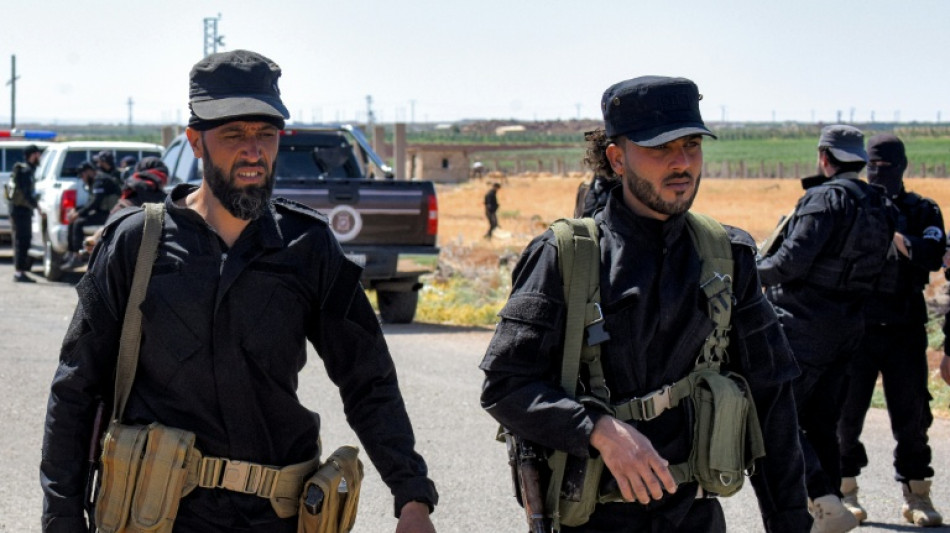
Syria deploys forces after dozens killed in Bedouin-Druze clashes / Photo: © AFP

 South African election results renew debate over identity-based voting

 South African voters report smoother local election but declining IEC trust

 Dolly Parton museum and Nashville hotel open after singer’s death

 George and Amal Clooney attend New York political-comedy reading

 British buyers pay substantial premiums for period-home appearance

 Thomas Markle released to house arrest after child-abuse-image charge

 Dawn of War 4 developers chose Adeptus Mechanicus for tactical variety

 Italy face unbeaten South Africa in Turin Nations Championship match

 ChatGPT interactive interface feature tested across six custom tools

 Freshways milk-price cut deepens pressure on UK dairy farms

 Labour and National remain virtually tied as New Zealand vote count advances

 The Good Daughter adapts Karin Slaughter thriller with Rose Byrne and Meghann Fahy

 Heavy-lift drone evacuates wounded Ukrainian soldier from frontline kill zone

 Morrison says West Brom recovered after pressure from successive derby losses

 Britain considers 2027 state visit for Ukraine’s Zelensky

 Arizona Democrats Secure Historic Trifecta with New Legislative Leadership

 Carney Welcomes U.S. Trade Reversal After Democratic Midterm Victory

 Armenian FM Discusses EU Accountability for Palestinian Rights in Madrid

 Trump and Vance Pursue Secret Diplomacy with Iran Amid Military Pressure

Syria deployed security forces Monday in the southern province of Sweida after at least 50 people were killed in clashes between Sunni Bedouin tribes and Druze fighters, a monitor said.
The outbreak of sectarian violence underscores the challenges facing the administration of interim leader Ahmad al-Sharaa, whose Islamist forces overthrew president Bashar al-Assad in December, in a country reeling from 14 years of war.
The latest fighting, which began Sunday, continued sporadically into Monday in several villages, said the Syrian Observatory for Human Rights war monitor and the Suwayda 24 news outlet.
The clashes reportedly erupted when a Druze vegetable vendor was seized by armed Bedouins on the main highway linking Sweida to Damascus.
The incident triggered a series of retaliatory abductions by both sides. Suwayda 24 said those abducted were released Sunday night.
The Observatory raised its death toll Monday to 50, including 34 Druze -- among them two children -- 10 Bedouins and six members of the security forces. State television confirmed six deaths among the security forces.
The highway between Damascus and Sweida remained closed, said the Britain-based monitor, which relies on a network of sources on the ground.
The defence ministry put the toll at 30 dead and around 100 wounded.
Dozens more have been wounded amid armed clashes and mortar fire in Sweida city and nearby villages.
- 'Lack of state institutions' -
Syria's defence and interior ministries announced the deployment of military units to the affected areas, the establishment of safe corridors for civilians, and a commitment to "end the clashes quickly and decisively".
"The lack of state, military and security institutions is a major reason for the ongoing tensions in Sweida," Interior Minister Anas Khattab said Sunday on X.
"The only solution is to reactivate these institutions to ensure civil peace," he added.
The latest unrest follows deadly violence in April and May, when clashes between Druze fighters and security forces in Druze-populated areas near Damascus and Sweida killed more than 100 people.
The Observatory said members of Bedouin tribes, who are Sunni Muslim, had sided with security forces during earlier confrontations.
Local leaders and religious figures brokered agreements at the time to de-escalate the tensions, putting Druze fighters in charge of local security in Sweida since May, though armed Bedouins remain present in several areas.
On Sunday, Sweida governor Mustapha al-Bakur urged his constituents to "exercise self-restraint", while Druze community leaders urged authorities to step in.
In response to the violence, the education ministry announced the postponement of Monday's scheduled secondary school exams in the province.
- Israel and the Druze -
Syria's pre-civil war Druze population numbers around 700,000, many in Sweida province.
The Druze, followers of an esoteric religion that split from Shiite Islam, are mainly found in Syria, Lebanon and Israel.
Bedouin and Druze factions have a longstanding feud in Sweida, and violence occasionally erupts between the two.
A surge in violence in March targeting the Alawite community -- with more than 1,700 killed -- and the subsequent attacks on Druze areas have undermined confidence in the new Syrian authorities' ability to protect minorities.
In the wake of those incidents, Israel -- which has occupied part of Syria's Golan Heights since 1967 -- cited the protection of the Druze to justify several strikes, including one in early May near the presidential palace in Damascus.
Israel is home to around 152,000 Druze, according to the latest available data, including 24,000 living in the Israeli-occupied Golan, of whom fewer than five percent hold Israeli citizenship.
G.Frei--VB