Chimps ingest alcohol daily: study / Photo: © AFP

 Mancini brings nine newcomers into the first squad of his Italy comeback

 Czechs level Davis Cup tie against USA as South Korea eye Finals

 New France boss Zidane confirms Mbappe as captain after naming first squad

 California governor signs order to explore AI 'kill switch'
 Head leads run spree as Australia win Zimbabwe ODI series

 In-form Raphinha wants to finish career at Barcelona

 Warren Buffett steps down as Berkshire Hathaway chairman

 Carrick confident Man Utd can 'work through' tough time

 Mbappe ends Nike partnership to join Swiss brand On

 Liverpool boss Iraola puts Bournemouth love affair on hold

 'A disaster' if Man City do not win says Maresca after flawless start

 Kerry James Marshall: American 'blackness' painter celebrated in Europe

 Spain coach De la Fuente offers 'full support' to people of Ceuta

 Russia seizes assets of Nestle, French firms over West's Ukraine support
 England can build on World Cup 'spirit', says Tuchel

 UNESCO can be 'moderator' in AI debate: chief to AFP

 Infantino 'must go', says German FA vice-president

 Russia seizes assets of Nestle, French firms

 Japan's busiest rail station tests robot bins

 Anthropic says AI systems moving towards building themselves

 Asian stocks boosted by falling oil, yen weakens after BoJ rate hike
 Pakistan court blocks expulsion of Afghan medical college students

 Athletes 'can't take it any more' as Asian Games issues mount

 Allen lights up Bills' new stadium with 41-31 win over Lions

 Afghan medical students in Pakistan hope court stops college expulsions

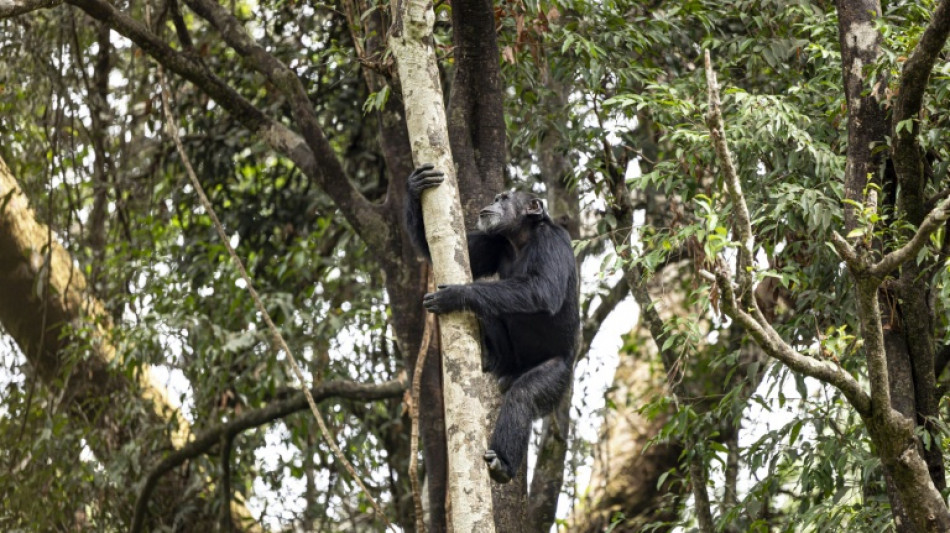
Chimpanzees consume the equivalent of at least one alcoholic drink per day as they eat ripe, fermenting fruit, says a study out Wednesday that addresses one possible reason why humans are drawn to booze.
The study, carried out in the wilds of Africa where the animals live, supports the theory that people may have inherited from primates a taste for alcohol and ability to metabolize it even though it is toxic for us.
The researchers collected fruits that chimps eat and measured their ethanol content, which is produced as sugar ferments. They concluded that these evolutionary cousins of ours consume alcohol on a daily basis.
And not just a little. Through the large amount of fruit that chimps eat, the researchers reckon the animals take in about 14 grams (half an ounce) of alcohol per day.
Correcting for body size, it is like the chimps are drinking a pint of beer per day, Aleksey Maro, lead author of the study published in the journal Science Advances, told AFP.
"It's not an insubstantial amount of alcohol, but very diluted and more associated with food," said the PhD candidate at the University of California, Berkeley.
- The 'drunken monkey' theory -
"We've seen for the first time that, indeed, our closest living relatives are consuming physiologically relevant doses of alcohol routinely daily," Maro said.
This is in line with the "drunken monkey theory" espoused more than a decade ago by US biologist Robert Dudley, who co-authored the new study.
As the theory goes, humans liking alcohol and being able to metabolize it stems from our primate ancestors ingesting it daily through the fruit they eat.
"The drunken monkey hypothesis is becoming more and more a reality," said Maro. "Its name is unfortunate. A better name would be the evolutionary hangover."
The theory was initially met with skepticism among experts. But it has gained traction in recent years as studies showed that some primates eat fermented fruit and, given a choice of nectars with varying amounts of alcohol, they prefer the booziest one.
Nathaniel Dominy, a professor of anthropology and evolutionary biology at Dartmouth College who did not take part in this study, welcomed it enthusiastically.
"The paper is a tour de force," he told AFP.
Dominy also said it "puts to rest the debate over the prevalence of ethanol in tropical fruits."
But he added that the study raises new questions on the biological and behavioral consequences of chronic low-level ethanol exposure for nonhuman primates.
Another unanswered question is whether chimps actively search out boozy fruit or just eat it when they find it. The researchers in this study said they did not know.
The issue of chimps ingesting alcohol will remain under study to learn more about the origins of human alcohol consumption and assess its risks and possible benefits, according to Maro.
"We can learn about ourselves through the chimpanzees," he said.
T.Egger--VB