Turkey breathes easier as Iran-Israel truce eases fallout risk
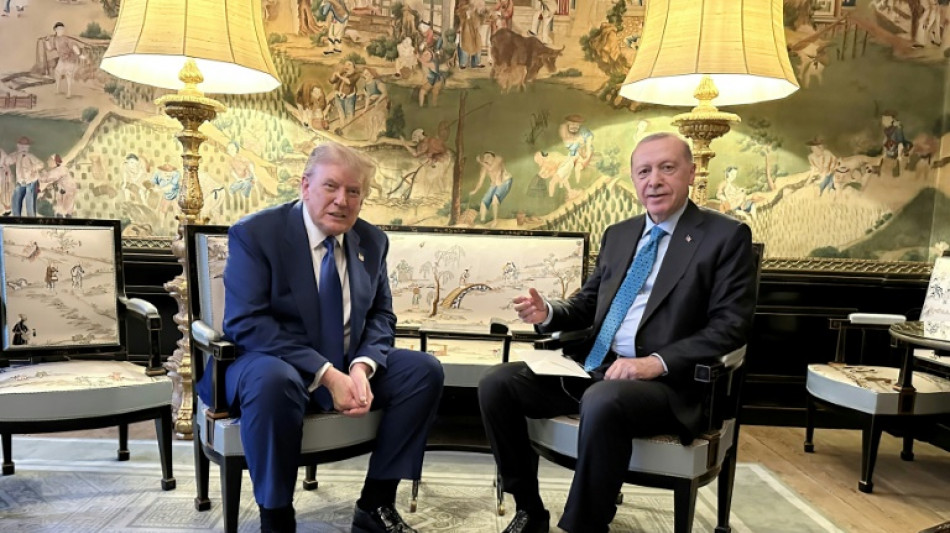
/ Photo: © TURKISH PRESIDENTIAL PRESS SERVICE/AFP

 South African election results renew debate over identity-based voting

 South African voters report smoother local election but declining IEC trust

 Dolly Parton museum and Nashville hotel open after singer’s death

 George and Amal Clooney attend New York political-comedy reading

 British buyers pay substantial premiums for period-home appearance

 Thomas Markle released to house arrest after child-abuse-image charge

 Dawn of War 4 developers chose Adeptus Mechanicus for tactical variety

 Italy face unbeaten South Africa in Turin Nations Championship match

 ChatGPT interactive interface feature tested across six custom tools

 Freshways milk-price cut deepens pressure on UK dairy farms

 Labour and National remain virtually tied as New Zealand vote count advances

 The Good Daughter adapts Karin Slaughter thriller with Rose Byrne and Meghann Fahy

 Heavy-lift drone evacuates wounded Ukrainian soldier from frontline kill zone

 Morrison says West Brom recovered after pressure from successive derby losses

 Britain considers 2027 state visit for Ukraine’s Zelensky

 Arizona Democrats Secure Historic Trifecta with New Legislative Leadership

 Carney Welcomes U.S. Trade Reversal After Democratic Midterm Victory

 Armenian FM Discusses EU Accountability for Palestinian Rights in Madrid
As the fragile Iran-Israel truce took hold, there was no letup in Turkey's diplomatic efforts Wednesday to prevent any return to a conflict fraught with risk for Ankara's domestic and regional policies.
Hours after US President Donald Trump announced the ceasefire, Turkey's President Recep Tayyip Erdogan met him for talks on the sidelines of a NATO summit for their third conversation in 10 days.
Erdogan's "intensive diplomatic efforts" to curb the conflict also involved calls with Russia's Vladimir Putin, Iran's Masoud Pezeshkian and top Middle Eastern leaders.
"Turkey has been trying very hard to de-escalate the situation, but it's not seen as a credible mediator, neither by Iran nor by Israel," Gonul Tol of the Washington-based Middle East Institute told AFP.
Turkey's ties with Israel have been shattered by the Gaza war and Iranians see Ankara as complicit "because it hosts this strategic radar", she said of a NATO early-warning system at Kurecik base in eastern Turkey that can detect Iranian missile launches.
Turkey has categorically denied radar data was used to help Israel but its presence has rattled Iran -- with several Iranian military officials warning it could be "the first target" in case of a wider war, she said.
Even so, Erdogan reportedly sought to set up US-Iran talks in Istanbul last week, which only failed because Iran's Ayatollah Ali Khamenei -- in hiding due to assassination threats -- couldn't be reached to approve it, the Axios news site said.
Unsettled by the long arm of Israel's reach, Erdogan upped Turkey's deterrence, ordering the defence industry to increase production of medium and long-range missiles. warning Ankara was "making preparations for every kind of scenario".
"Concerns about a possible Turkish-Israeli confrontation in the short term seem exaggerated... (but) both would be wise to reduce tensions," said Gallia Lindenstrauss, senior research fellow at the Institute for National Security Studies (INSS).
- Fears of Iran in chaos -
For Turkey, the big fear would be seeing neighbouring Iran plunged into chaos as happened in Iraq and Syria, said Soner Cagaptay of the Washington Institute of Near East Policy.
"Ankara absolutely does not want to see Iran descending into chaos, decentralisation or civil war which could create cross-border threats or fresh refugee flows," he told AFP.
In Iraq and Syria, destabilisation had created a power vacuum that was used by the Islamic State (IS) group and Kurdish PKK militants "to launch attacks into Turkey", fuelling Ankara's efforts to support both nations' recentralisation, he said.
But "the biggest risk" would be another flow of refugees: "If Iran collapses, there's only one country the Iranians will flee to in large numbers: Turkey," he said.
On Friday, Erdogan warned Germany's Friedrich Merz the conflict "could harm the region and Europe in terms of migration" although there was no sign of any influx at the Turkish border last week.
- Risk to Turkey's PKK move? -
Turmoil in Iran could also harm Ankara's efforts to draw a line under its decades-long conflict with the PKK, which last month said it would disarm, Tol said.
Although most PKK-linked groups embraced the call to disarm, its Iranian affiliate, the Kurdistan Free Life Party (PJAK), did not, with Ankara concerned any unrest could embolden recalcitrant Kurdish separatists.
"The worry is that this chaos may strengthen the PJAK. There are PKK fractions who are not happy with (founder Abdullah) Ocalan's call who could think: why disarm now when there's so much chaos we can capitalise on," she told AFP.
A more immediate concern for Turkey was the economic implications of the conflict, she said, with its crisis-hit economy already "struggling" with rising energy prices while fighting hard to bring down inflation.
"But if Iran closed down (the Strait of) Hormuz, that would mean a bigger jump in energy prices and that's something Turkey is deeply worried about," she said.
Oil prices spiked during the 11-day conflict as concerns grew that Iran might disrupt supplies passing through Hormuz, peaking on Monday after US warplanes hit Iran.
With the ceasefire taking hold, Turkey was breathing easier Wednesday -- although the Iran-Israel crisis remained high on the agenda at the NATO summit.
K.Hofmann--VB