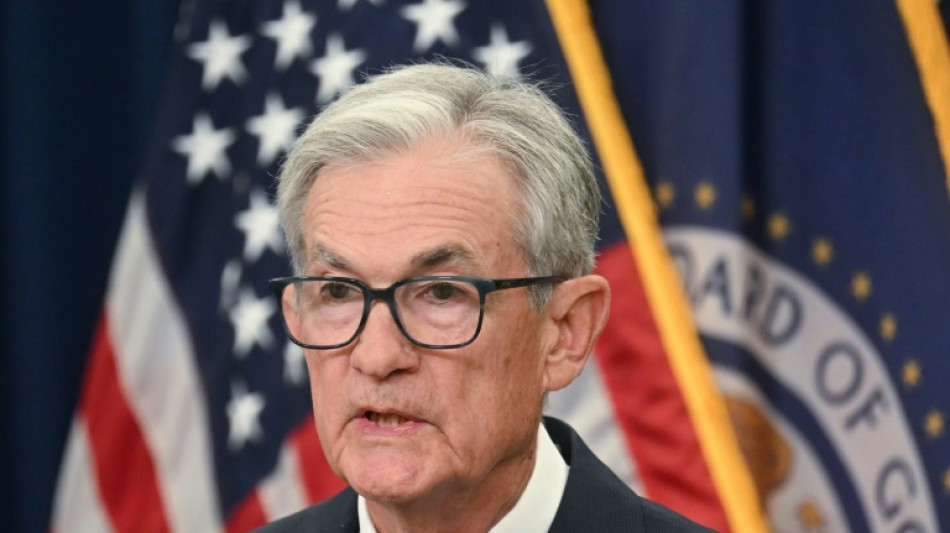
Powell warns of inflation risks if US Fed cuts rates 'too aggressively' / Photo: © AFP/File

 Freshways milk-price cut deepens pressure on UK dairy farms

 Labour and National remain virtually tied as New Zealand vote count advances

 The Good Daughter adapts Karin Slaughter thriller with Rose Byrne and Meghann Fahy

 Heavy-lift drone evacuates wounded Ukrainian soldier from frontline kill zone

 Morrison says West Brom recovered after pressure from successive derby losses

 Britain considers 2027 state visit for Ukraine’s Zelensky

 Arizona Democrats Secure Historic Trifecta with New Legislative Leadership

 Carney Welcomes U.S. Trade Reversal After Democratic Midterm Victory

 Armenian FM Discusses EU Accountability for Palestinian Rights in Madrid

 Trump and Vance Pursue Secret Diplomacy with Iran Amid Military Pressure

 Classic Car Values Surge: De Tomaso Vallelunga Leads 190% Gain

 Microsoft Ends Oracle AI Computing Rental Deal Amid Cloud Strategy Shift

US Federal Reserve chief Jerome Powell warned Tuesday that slashing interest rates too quickly could allow inflation to remain elevated, but stressed that the central bank faces dual challenges moving forward.
"There is no risk-free path," he told a Rhode Island event. "If we ease too aggressively, we could leave the inflation job unfinished and need to reverse course later to fully restore two-percent inflation."
"If we maintain restrictive policy too long, the labor market could soften unnecessarily," the US central bank chair added.
The Fed made its first rate cut of the year last week, lowering the benchmark lending rate by 25 basis points in a widely anticipated move.
The reduction came while the independent central bank faced intensifying pressure from Donald Trump. The president has repeatedly criticized Powell -- calling him a "numbskull" -- for keeping rates unchanged.
But Powell's remarks underscore the tightrope that Fed officials walk as they work to maintain price stability and maximum employment, balancing both inflation and labor market concerns.
Policymakers have been divided on the best path forward as the jobs market weakened while inflation remained above their two-percent target.
New Fed Governor Stephen Miran, who was newly appointed by Trump, voted against last week's rate decision and instead pushed for a bigger 50-basis-points cut.
On the other hand, even as policymakers penciled in two more rate reductions overall this year, several projected no further cuts as well.
For now, Powell noted that increases in goods prices, which are driving a recent inflation pick-up, appear to largely reflect higher tariffs.
The pass-through of US tariffs to consumers has appeared later and less than expected, but Powell said that many forecasts anticipate this could continue well into next year.
He vowed that officials would ensure a one-time increase in costs due to Trump's sweeping duties does not become an ongoing inflation problem.
The Fed's current policy stance leaves it "well positioned to respond to potential economic developments," Powell said.
Uncertainty around the path of inflation remains high, he said, while risks surrounding employment have risen, with job creation dropping sharply.
He noted that the overall economic effects of major changes in trade, immigration, fiscal and regulatory policy remain to be seen.
C.Koch--VB