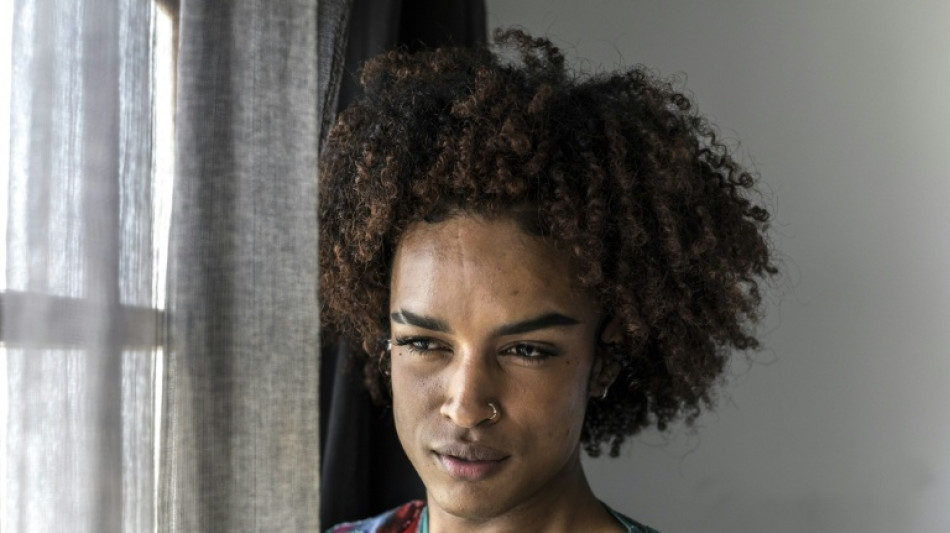
Cape Verde, Africa's outlier in LGBTQ tolerance / Photo: © AFP

 French Senate weighs bill to make protesters pay for unrest damage
 'A very sad day': Arteta despair as Arsenal stunned by Fleetwood
 Charles tackles thorny legacy of slavery on Caribbean trip

 Former Grand Slam winner Wawrinka ends tennis career

 Brazil's Flavio Bolsonaro flees to US after election loss
 'Faerie' nights: 'ACOTAR' fans finally get their book

 American woman convicted of getting military training from Islamic State

 Israel opposition holds narrow edge over Netanyahu in first projections

 Floriani hits maiden goal as Lazio go top
 Trump set to drastically loosen oil and gas sector's methane rules

 Storied Paris department store seeks bankruptcy protection

 Xhaka, Embolo can return to Swiss squad after fake Covid docs affair

 Allegri suspended for two Serie A games after red card

 Flight data, satellite images reveal growing US role at Ecuador base
 McInnes feels 'guilt' ahead of Hearts return with Rangers
 Brazil's Lula turns 81, vows to work '24 hours a day'

 Boeing releases cautious growth plan as shares fall sharply
 Exiled Russian dissident Navalnaya warns dictators becoming 'more cunning'
 Bayern 'risk' reaps huge reward for Ballon d'Or winner Kane

 Record turnout as Israeli voters deliver verdict on Netanyahu

 Iraola says Isak 'feels the trust' after Liverpool scoring streak

 French media protest manhandling of journalists at far-right party rally

 EU seeks deportation powers for beefed up border agency
 Two charged with UK security offences over airbase plot: police

 Maresca defends Donnarumma, Guehi after Man City defeat
Cape Verdean make-up artist Leonardo put the finishing touches to a singer's look at a shoot for a music video, open and comfortable about being a gay man in Africa.
The archipelago off the coast of west Africa is an island of tolerance in a continent where anti-LGBTQ laws have become increasingly repressive.
Perfectly made up himself and wearing shorts and a top baring his shoulders, Leo, as he is known, works among the technicians and musicians without fear of being insulted, attacked or reported and sent to prison.
"Make-up has a power... and I love it when I transform people by creating artistic make-up or when I transform myself," he told AFP, in the country's second city of Mindelo on the island of Sao Vicente.
With long jail terms imposed for same-sex relations in other parts of Africa, Leo, 29, said he felt lucky to be a Cape Verdean.
"Even now there are people with really closed minds," he said. "But there is no comparison with other places."
"It is hard to know that our brothers are passing through extremely difficult situations mostly in Africa.
"To be punished just because of who you are, I think, is extremely harsh," he added.
- Crackdown in Africa -
Same-sex relations have been legal in Cape Verde since 2004. Four years later, the country of around 500,000 inhabitants also banned workplace discrimination based on sexual orientation.
The archipelago is currently the most welcoming country in Africa for the LGBTQ community ahead of South Africa, according to Equaldex, which assesses same-sex rights, laws and public opinion worldwide.
Cape Verde lies west of Senegal, which passed a law in March doubling sentences for same-sex relations from five to 10 years in prison, after a string of arrests on homosexuality charges.
Around 30 African countries criminalise same-sex relations, with jail terms including life in prison and the death penalty, even if it is mainly not applied.
Sao Vicente, one of Cape Verde's 10 islands, has the largest LGBTQ community.
The country's oldest port, it has always been open to the world, interaction with other nations and the diaspora in Europe and the United States.
"I think we are a mixed population," Leo said. "We have a lot of different influences, we are really influenced by the Europeans and I think that helped a lot."
- 'Holding hands' -
Tall, with a disarming smile framed by false eyelashes, Leo has a calm demeanour. Completing his look are tattoos, rings and false nails.
He lives with two black cats -- one affectionate, the other more wild -- which he said reflects the two sides of his personality.
As a small child he knew he was gay and said that despite some difficulties growing up, he now felt comfortable in his own skin.
"When I was in the fourth or fifth grade (aged nine or 10), I would leave the house to go to school but I would never get there, because of bullying," he said.
After he turned 21, he began living by himself, pursued a career as a make-up artist and could wear clothes that reflect his feminine side.
"In my last relationship, we used to walk around holding hands" without encountering problems, he said.
Leo's self-confidence partly comes from his relationship with his mother, Manuela, a 51-year-old hairdresser and nail technician.
The two share a salon in Mindelo where Leo's customers come for make-up and manicure appointments, but his skills are in demand among singers and other artists, too.
"I am really proud of him because he fought for his goals," Manuela said.
"I have dealt with (his sexual orientation) all by myself," she added, becoming emotional.
"A mother... should respect their children. We have to support them in what they want to be, be it their love life or career."
- 'Paradise' -
In another sign of Cape Verde's openness, a small group of gay actors last month performed at a theatre in Mindelo depicting the daily struggles of three cross-dressers from the Fonte Filipe area of the city, which has a sizeable LGBTQ community.
"You don't choose to become homosexual, it's not a choice! Why do people treat us like this?" one of the actors cried tearfully on stage.
The play, "Font Flip is Burning", references the US documentary "Paris Is Burning", which shone a light on the Harlem drag balls in the 1980s.
For two evenings, a long way from New York City, the three actors -- Walter, Alessandro and Stephan -- brought one of the balls to life, strutting to techno music in high heels, mini-dresses and glamorous make-up.
In real life, Walter Pires, 37, is a physical education teacher in Santo Antao, an island near Sao Vicente.
The charismatic actor and dancer is openly gay and a leading figure in the community.
"I never had any problem with my family," he said. "I was always free since I was a child. Of course, sometimes I feel a little pressure from people but I never felt the need to hide myself."
Pires said he does not feel discriminated against and is "respected" by his students.
"I always try to bring the topic to the class and discuss these topics with them... what the LGBT+ acronym means, sexual orientation," he said.
In years gone by, he said some gay people in Mindelo had faced prejudice, losing their jobs or their homes.
But Cape Verde now is "almost a paradise", he said. "The new generation is more open and respectful but that is the result of the work we have done in the past."
- 'Non-negotiable' freedom -
Cape Verde's outgoing minister of family and social inclusion, Fernando Elisio Freire, said that the constitution and government "protect those who have a different sexual orientation".
"Cape Verde is a tolerant, open country and everyone deserves to be treated equally before the law," he told AFP.
The decision to legalise same-sex relations stems from a "deep respect for individual dignity and difference" to allow peaceful co-existence, he added.
Freedom of sexual orientation for every citizen is "non-negotiable", Freire said.
But Sindji Cawinny, a 29-year-old transwoman, has had a different experience.
She was forced to leave the island of Sal three years ago after the owner of the restaurant where she worked demanded she stop wearing make-up and women's clothes to work.
"I quit that job. I wasn't going to stop doing what I loved because of their ignorance," she added.
Since then, she has been self-employed, working in events in Mindelo and giving catwalk lessons for beauty contests.
"I realised that if I am a gay man who dresses like a man, it's easier to get a job," she added.
"I'd like to continue my life as a transgender woman but I've resigned myself," she said.
- Worry over hard-won rights -
English teacher and artist Janette da Graca, a 31-year-old lesbian, works to raise awareness and defend LGBTQ rights.
She worries that people may begin to question the situation in Cape Verde if they see what is going on in Senegal and finds it "worrying" that hard-won rights are being rowed back.
"It doesn't make sense that people would care about who I love or who I live with," she said.
"I just go with who I am. Accept me, who can. Who can't, they're not part of my life," she added.
She often looks solemn, especially when talking about her mother who, unlike her father and sisters, has not accepted her sexual orientation and still makes comments about her short hair and style, which includes combat boots, a Nirvana t-shirt and silver chains.
At the school where she teaches, Da Graca suspects that some colleagues disapprove of her look but said her "students just love it".
She still gets stared at, disapproving comments or worse, mostly from men.
"I do believe that we have a lot of tolerance and awareness but we need more," Da Graca said.
"There is a lot of ignorance, so knowledge is always the key. Of course, there will be people who won't accept it anyway, but at least we try," she added.
J.Marty--VB