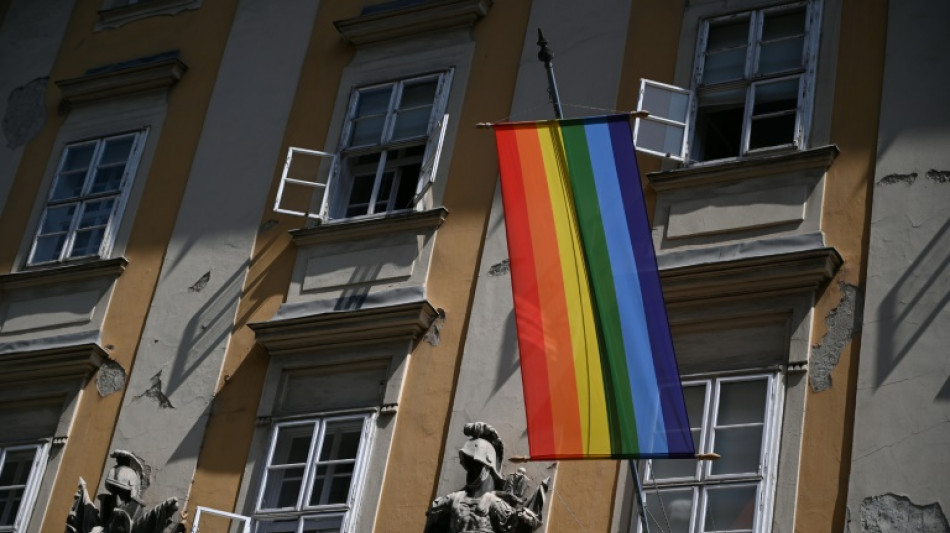
'Noble to attend': Budapest prepares for 'banned' Pride march / Photo: © AFP

 South African election results renew debate over identity-based voting

 South African voters report smoother local election but declining IEC trust

 Dolly Parton museum and Nashville hotel open after singer’s death

 George and Amal Clooney attend New York political-comedy reading

 British buyers pay substantial premiums for period-home appearance

 Thomas Markle released to house arrest after child-abuse-image charge

 Dawn of War 4 developers chose Adeptus Mechanicus for tactical variety

 Italy face unbeaten South Africa in Turin Nations Championship match

 ChatGPT interactive interface feature tested across six custom tools

 Freshways milk-price cut deepens pressure on UK dairy farms

 Labour and National remain virtually tied as New Zealand vote count advances

 The Good Daughter adapts Karin Slaughter thriller with Rose Byrne and Meghann Fahy

 Heavy-lift drone evacuates wounded Ukrainian soldier from frontline kill zone

 Morrison says West Brom recovered after pressure from successive derby losses

 Britain considers 2027 state visit for Ukraine’s Zelensky

 Arizona Democrats Secure Historic Trifecta with New Legislative Leadership

 Carney Welcomes U.S. Trade Reversal After Democratic Midterm Victory

 Armenian FM Discusses EU Accountability for Palestinian Rights in Madrid
Defiant about potential fines after police declared a ban, organisers and volunteers are working to ensure Saturday's Budapest Pride march is the largest Hungary has ever seen.
"This legal wrangling only made many feel compelled to express their solidarity," 25-year-old engineering student Csanad Sebesy told AFP.
"Now it is more noble to attend," he added.
Sebesy is one of the record number of people -- more than 250 -- organisers said have applied to help at the parade despite the threat of penalties.
He volunteered last year too, but said the preparatory training this time focussed more on legal issues.
"I really liked that because there were concerns about the event existing in a legal grey area."
Prime Minister Viktor Orban announced in February that he intended to ban the Pride celebration.
Within weeks, the government had codified into law and the constitution provisions designed to prohibit the annual march.
Those changes -- condemned by the European Union and rights groups -- advance the years-long clampdown on LGBTQ rights in the central European country.
They allow authorities to fine organisers and attendees of a banned event up to 500 euros ($570) and empower police to use facial recognition to identify offenders.
- 'I don't give a damn' -
The organisers and Budapest city council tried to exploit a legal loophole to allow the parade to proceed but police still issued a ban.
The capital's progressive mayor, Gergely Karacsony, insisted the march would go ahead regardless.
He said the police decision had "no value" because a municipal event does not require formal authorisation.
For many volunteers, this is the first time they have applied to help at the march.
"After seeing the proposed legislation, I felt I had two options -- either I could completely collapse and not get up for three days or I could quickly figure out how to help," said Emma Elefanti.
The 26-year-old student said she hoped in this way to support her loved ones in the LGBTQ community.
"I don't care about being fined. It's not a meaningful deterrent. I'll gladly participate to help out the community," she told AFP.
Marta Aleva volunteered to show that threats don't work.
"Even if it's 30 degrees Celsius (86 degrees Fahrenheit) and we have to cover ourselves in mosquito repellent and sunscreen, we have to be there now," said the lawyer.
"I don't give a damn about the ban."
- 'Psychological pressure' -
The Hungarian Helsinki Committee and two other rights groups have pledged to provide legal aid to attendees facing fines.
Support is pouring in from abroad as well, with solidarity messages for Hungary's LGBTQ community displayed at Pride celebrations across Europe.
Dozens of European Parliament lawmakers are due to attend the Budapest march and the assembly has promised to share safety tips.
European Equalities Commissioner Hadja Lahbib and ministers from several EU countries are expected, organisers said.
Under Orban, Hungary has progressively rolled back LGBTQ rights in the name of "child protection".
The government's targeting of the parade has caused "immense psychological pressure" for volunteers, the head of the organising foundation, Viktoria Radvanyi, told AFP.
But they dismissed Orban's warning about not wasting "money and time" on this year's parade, spending hours on tasks as mundane as inventories of high-visibility jackets.
Since the ban was imposed, they also face a one-year prison sentence for continuing preparations.
- 'Not permissible' -
Despite the pressure, Radvani predicted this year's Pride would be "largest Hungary ever seen", surpassing the estimated 35,000 attendees of past years.
"We're not just standing up for ourselves... If this law isn't overturned, eastern Europe could face a wave of similar measures," she explained.
"We have seen many historical examples of what happens when people deprived of rights simply bow down."
"But it is not permissible to march through the city or engage in behaviour that we believe is contrary to the interests of children," he told French LCI TV this month.
The government suggested Kincsem Park racecourse or Puskas Stadium in Budapest as possible venues.
But volunteer Sebesy predicted efforts to prevent the public parade would ultimately be in vain.
"They can't change moral standards with regulations," he said.
"Society has grown more accepting. I feel absolutely comfortable in Hungary as a gay man."
N.Schaad--VB