NASA launches mission to study space weather / Photo: © AFP

 Houthis target Red Sea shipping as US hits Iran
 Record-equalling Red Sox streak halted at 15 wins

 Messi-less Miami beat Fire 3-2 to spoil Lewandowski's MLS debut

 Mercedes expect Hungary challenge from Hamilton and Ferrari
 In Ghana, one man's race to save critically endangered fish
 Wilson captain, Slipper absent in Kiss's first Wallabies squad

 New Mideast fighting puts eurozone rate-setters on alert

 Venezuelans search for animal companions lost in the quakes
 Argentine Football Association says US did not detain its president
 June heatwave cost UK economy more than £1bn: study

 Google-parent Alphabet beats expectations, cloud revenue nearly doubles
 US announces civilian nuclear deal with Saudi Arabia

 Tesla shares dip after profit misses expectations

 Red Sox tie club record with 15th straight MLB win

 US eyes offshore nuclear reactors

 The Sterling Announces Luxury Cocktail Lounge Concept and Investor Showcase in Orlando

 Inter Miami signs Brazil veteran Casemiro but MLS probes deal

 White House accuses China's Moonshot of stealing Anthropic AI

 Pogacar sweating on Yates's fitness ahead of Tour Queen stage

 Ukrainian soldiers and civilians welcome new army commander
 UK fintech Revolut valuation soars to $115 bn: source

 German FM, on Africa tour, eyes business ties amid US, China pressure

 Rubio says at ASEAN meeting he expects 'positive' US visit by China's Xi

 Philipsen wins Tour de France 17th stage

 DonnaPro Introduces AI-Trained Executive Assistants for European CEOs

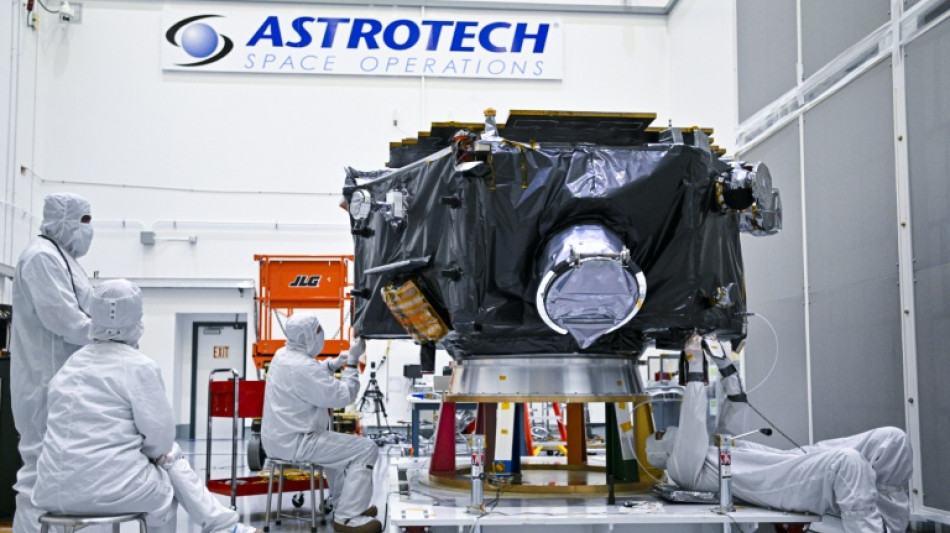
The United States launched three spacecraft on Wednesday in an effort to better monitor space weather such as solar storms, which can interfere with technology and power systems on Earth.
The three probes blasted off from Florida's Kennedy Space Center aboard a Falcon 9 rocket, built by the private company SpaceX.
Once in space, the probes will begin a long journey to reach the Lagrange 1 point -- a spot approximately 1.5 million kilometers (930,000 miles) from the Sun that offers a stable vantage point for observation.
The "Interstellar Mapping and Acceleration Probe" (IMAP) will use its instruments to study the Sun's high-energy particles and the protective magnetic bubble surrounding our solar system known as the heliosphere, data that can offer insight into space weather and cosmic radiation.
Solar storms are high-radiation events caused by flares on the Sun's surface, and are very difficult to predict.
They can impact activities on Earth, including aviation, mobile communications and power grids -- and potentially endanger astronauts and satellites in space.
The Space Weather Follow-on (SWFO-L1) spacecraft, operated by the National Oceanic and Atmospheric Administration (NOAA), aims to detect the weather patterns in advance.
"It can't stop an incoming threat, but it can give us time to prepare," said Irene Parker of NOAA.
With notice, authorities could shelter astronauts, warn aircraft pilots of forthcoming disruptions of GPS systems and adapt power grids in anticipation.
And the Carruthers Geocorona Observatory, the third passenger on the rocket, will study the Earth's exosphere in a bid to better understand how space weather affects it.
B.Baumann--VB