In first, China unveils specific emissions targets / Photo: © AFP

 BASIS.pro Expands On-Chain Infrastructure with XDC Network Partnership and Zypher DAO as Auto Earn Goes Live

 Samson relishing battle with teen star Sooryavanshi for India spot

 Pickle-flavoured tart? AI inspires Japan's convenience stores

 Macau holds first closed-door national security trial
 Bank of Japan set to raise rates under pressure from inflation, US

 Zverev, Shelton back on court for Davis Cup qualifiers
 Peace is a 'dangerous' word in Russian city heading to polls

 Meta chief pushes back on AI slowdown calls

 'Resident Evil' film brings video game's ethos to the big screen

 Court orders N. Korea pay Seoul $32.5 mn for blowing up office
 US military buildup in Palau stirs war fears

 US Fed to deliver rate decision with markets betting on hike
 Saudi, Egypt demand open Red Sea as Riyadh vows response to Houthi attacks

 Capitals say hockey star Ovechkin 'was asked' to film Putin ad

 Spurs in 'tough moment' after League Cup exit as De Zerbi says sorry

 Arteta salutes 'unbelievable' Dowman after Arsenal's teen star sinks Ipswich

 Empty seats as schools reopen in Venezuela's quake-hit Guaira

 Messi set for Argentina farewell in Benin friendly

 Ton-up Brook leads from the front as England hammer Sri Lanka in 1st T20

 AI giants pursue self-regulation as safety fears mount

 Argentina begin life after Messi with Bolivia friendly

 Helen Mirren delves into Patricia Highsmith's mind in 'A Talent for Murder'

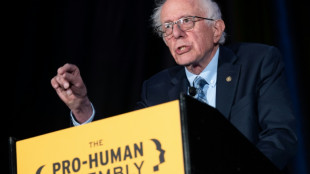 Sanders, Bannon warn of AI dangers in rare US left-right alignment

 US Senate crypto bill collapses amid partisan deadlock

 Raptors confirm Leonard return after Clippers salary cap scandal

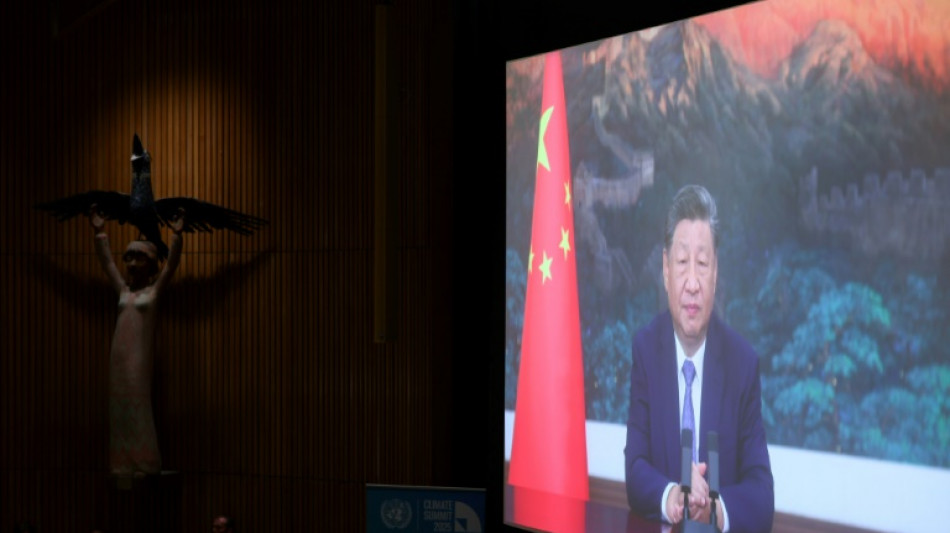
China on Wednesday issued its first ever absolute targets for cutting planet-warming gases, a landmark pledge from the world's top polluter as the United States doubles down on fossil fuels and Europe falters.
The announcement was delivered via video by President Xi Jinping to a UN climate summit where some 120 nations will outline plans to curb global warming, which is intensifying disasters worldwide from floods in Pakistan to raging wildfires in Spain.
Under the new plan, China will reduce economy-wide emissions by 7–10 percent by 2035 relative to the year of the country's peak emissions, believed to be 2025.
Observers said that while the absolute figure may seem modest, China has a record of under-promising while over-delivering, driven by its green technology boom.
It comes as the United States under President Donald Trump, who called climate change a "con job" at the UN a day earlier, boosts fossil fuels both at home and abroad.
"Green and low carbon transition is the trend of our time," said Xi in an official translation. "While some country is acting against it, the international community should stay focused in the right direction."
China, responsible for nearly 30 percent of global emissions, had previously pledged to peak its carbon output before 2030 and achieve carbon neutrality by 2060, without ever previously setting near-term numeric targets for total emissions reductions.
The new goal is backed by commitments to expand wind and solar six times over 2020 levels, drastically expand forests, and ramp up electric cars production.
Most wealthy nations, historically the biggest contributors to warming, peaked decades ago but still lack credible plans to reach carbon neutrality by 2050.
- Behind schedule -
"Beijing's commitment is a cautious step that favors steadiness and delivery over ambition" Li Shuo, an expert at the Asia Society think tank who is well-connected in Beijing, told AFP.
"The good news is that in a world increasingly driven by self-interest, China may be better positioned than most to advance climate action," he added.
The stated trajectory is similar to the path followed by the US and EU in the decade after their peak emissions but would fall well short of what is needed to limit warming to 1.5C above pre-industrial levels -- the target set by the 2015 Paris Agreement to avoid the worst climate catastrophes.
But by presenting a target well ahead of COP30, the year's main climate gathering in Belem, Brazil, China signals its ongoing commitment to the international process after the United States departed the Paris agreement for a second time.
Under the 2015 accord -- which nearly every country is part of -- nations freely set their own targets but must strengthen them every five years.
Most are behind schedule, notably the European Union, where several states fear moving too fast could hurt industry.
France, for example, faces shaky finances and political turmoil, and wants more clarity on investment frameworks before committing to deeper decarbonization.
But French President Emmanuel Macron used his turn at the podium to rebut Trump's broadside on climate change, telling fellow leaders the science is "clear enough."
- Catastrophe v hope -
The UN meanwhile is trying to strike a balance between warning of catastrophe and maintaining hope.
On one hand, UN Secretary-General Antonio Guterres told AFP last week that chances of limiting warming to 1.5C are on the verge of "collapsing," a view echoed by climatologists, with current temperatures already about 1.4C above pre-industrial levels.
But on Wednesday, he struck a more positive note, saying the landmark Paris climate accord "has made a difference," as he opened the summit.
"In the last 10 years, projected global temperature rise has dropped from four degrees Celsius to less than three," he said.
Part of that progress stems from China. A decade ago, three-quarters of its electric mix came from coal -- a figure now down to half. Its booming exports of solar panels, batteries, and electric cars are cutting emissions abroad as well.
H.Gerber--VB