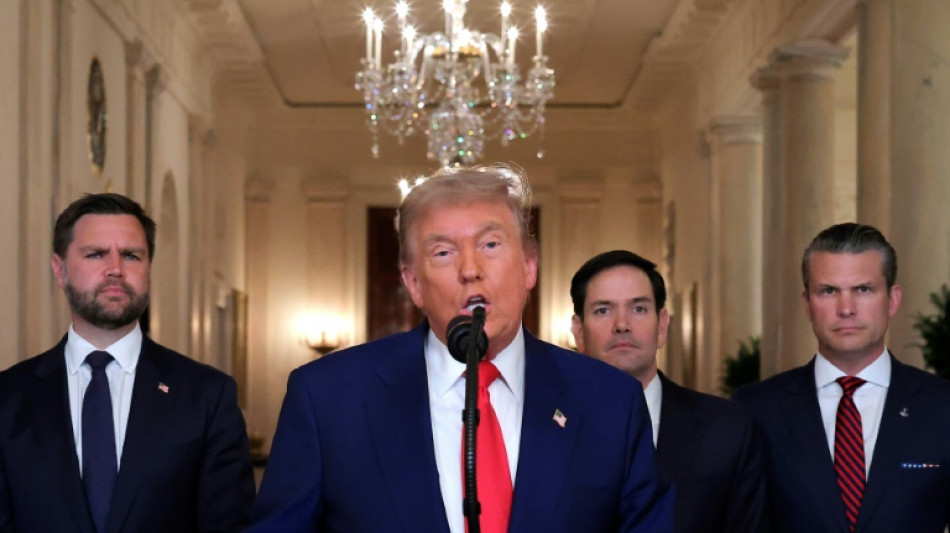
Bombing Iran, Trump gambles on force over diplomacy / Photo: © POOL/AFP

 South African election results renew debate over identity-based voting

 South African voters report smoother local election but declining IEC trust

 Dolly Parton museum and Nashville hotel open after singer’s death

 George and Amal Clooney attend New York political-comedy reading

 British buyers pay substantial premiums for period-home appearance

 Thomas Markle released to house arrest after child-abuse-image charge

 Dawn of War 4 developers chose Adeptus Mechanicus for tactical variety

 Italy face unbeaten South Africa in Turin Nations Championship match

 ChatGPT interactive interface feature tested across six custom tools

 Freshways milk-price cut deepens pressure on UK dairy farms

 Labour and National remain virtually tied as New Zealand vote count advances

 The Good Daughter adapts Karin Slaughter thriller with Rose Byrne and Meghann Fahy

 Heavy-lift drone evacuates wounded Ukrainian soldier from frontline kill zone

 Morrison says West Brom recovered after pressure from successive derby losses

 Britain considers 2027 state visit for Ukraine’s Zelensky

 Arizona Democrats Secure Historic Trifecta with New Legislative Leadership

 Carney Welcomes U.S. Trade Reversal After Democratic Midterm Victory

 Armenian FM Discusses EU Accountability for Palestinian Rights in Madrid
For nearly a half-century the United States has squabbled with Iran's Islamic republic but the conflict has largely been left in the shadows, with US policymakers believing, often reluctantly, that diplomacy was preferable.
With President Donald Trump's order of strikes on Iran's nuclear sites, the United States -- like Israel, which encouraged him -- has brought the conflict into the open, and the consequences may not be clear for some time to come.
"We will only know if it succeeded if we can get through the next three to five years without the Iranian regime acquiring nuclear weapons, which they now have compelling reasons to want," said Kenneth Pollack, a former CIA analyst and supporter of the 2003 Iraq war who is now vice president for policy at the Middle East Institute.
US intelligence had not concluded that Iran was building a nuclear bomb, with Tehran's sensitive atomic work largely seen as a means of leverage, and Iran can be presumed to have taken precautions in anticipation of strikes.
Trita Parsi, an outspoken critic of military action, said Trump "has now made it more likely that Iran will be a nuclear weapons state in the next five to 10 years."
"We should be careful not to confuse tactical success with strategic success," said Parsi, executive vice president of the Quincy Institute for Responsible Statecraft.
"The Iraq war was also successful in the first few weeks but President Bush's declaration of 'Mission Accomplished' did not age well," he said.
- Weak point for Iran -
Yet Trump's attack -- a week after Israel began a major military campaign -- came as the cleric-run state is at one of its weakest points since the 1979 Islamic revolution toppled the pro-Western shah.
Since the October 7, 2023 attack on Israel by Hamas, which enjoys Iran's support, Israel -- besides obliterating much of Gaza -- has decimated Lebanon's Hezbollah, a militant group that would once reliably strike Israel as Tehran's proxy.
Iran's main ally among Arab leaders, Syria's Bashar al-Assad, was also toppled in December.
Supporters of Trump's strike argued that diplomacy was not working, with Iran standing firm on its right to enrich uranium.
"Contrary to what some will say in the days to come, the US administration did not rush to war. In fact, it gave diplomacy a real chance," said Ted Deutch, a former Democratic congressman who now heads the American Jewish Committee.
"The murderous Iranian regime refused to make a deal," he said.
Top Senate Republican John Thune pointed to Tehran's threats to Israel and language against the United States and said that the state had "rejected all diplomatic pathways to peace."
- Abrupt halt to diplomacy -
Trump's attack comes almost exactly a decade after former president Barack Obama sealed a deal in which Iran drastically scaled back its nuclear work -- which Trump pulled out of in 2018 after coming into office for his first term.
Most of Trump's Republican Party and Israeli Prime Minister Benjamin Netanyahu, who has long seen Iran as an existential threat, attacked Obama's deal because it allowed Tehran to enrich uranium at levels well beneath weapons grade and the key clauses had an end date.
But Trump, billing himself a peacemaker, just a month ago said on a visit to Gulf Arab monarchies that he was hopeful for a new deal with Iran, and his administration was preparing new talks when Netanyahu attacked Iran.
This prompted an abrupt U-turn from Trump.
"Trump's decision to cut short his own efforts for diplomacy will also make it much harder to get a deal in the medium and long runs," said Jennifer Kavanagh, director of military analysis at Defense Priorities, which advocates restraint.
"Iran now has no incentive to trust Trump's word or to believe that striking a compromise will advance Iran's interests."
Iran's religious rulers also face opposition internally. Major protests erupted in 2022 after the death in custody of Mahsa Amini, who was detained for defying the regime's rules on covering hair.
Karim Sadjadpour, a senior fellow at the Carnegie Endowment for International Peace, wrote on social media that Trump's strikes could either entrench the Islamic Republic or hasten its downfall.
"The US bombing of Iran's nuclear facilities is an unprecedented event that may prove to be transformational for Iran, the Middle East, US foreign policy, global non-proliferation and potentially even the global order," he said.
"Its impact will be measured for decades to come."
W.Huber--VB