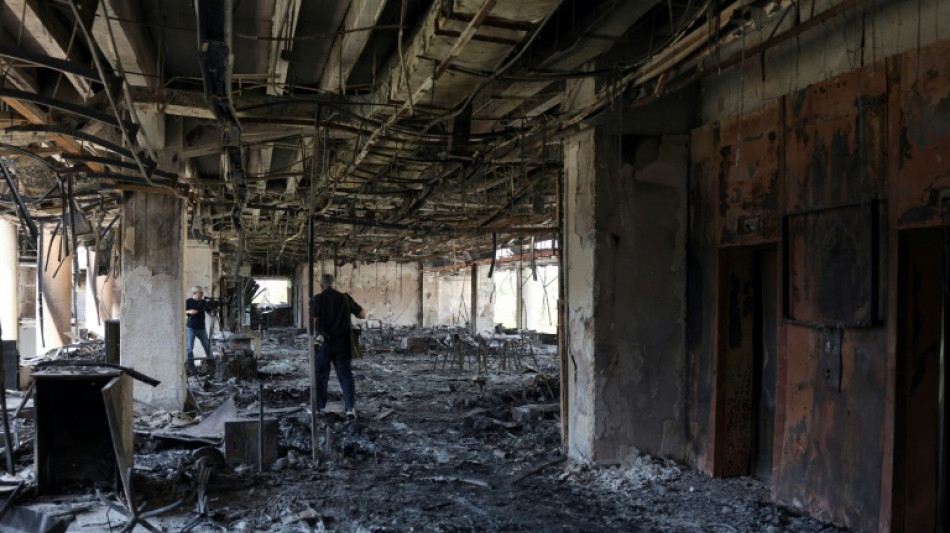
Tech-fueled misinformation distorts Iran-Israel fighting / Photo: © AFP

 South African election results renew debate over identity-based voting

 South African voters report smoother local election but declining IEC trust

 Dolly Parton museum and Nashville hotel open after singer’s death

 George and Amal Clooney attend New York political-comedy reading

 British buyers pay substantial premiums for period-home appearance

 Thomas Markle released to house arrest after child-abuse-image charge

 Dawn of War 4 developers chose Adeptus Mechanicus for tactical variety

 Italy face unbeaten South Africa in Turin Nations Championship match

 ChatGPT interactive interface feature tested across six custom tools

 Freshways milk-price cut deepens pressure on UK dairy farms

 Labour and National remain virtually tied as New Zealand vote count advances

 The Good Daughter adapts Karin Slaughter thriller with Rose Byrne and Meghann Fahy

 Heavy-lift drone evacuates wounded Ukrainian soldier from frontline kill zone

 Morrison says West Brom recovered after pressure from successive derby losses

 Britain considers 2027 state visit for Ukraine’s Zelensky

 Arizona Democrats Secure Historic Trifecta with New Legislative Leadership

 Carney Welcomes U.S. Trade Reversal After Democratic Midterm Victory
AI deepfakes, video game footage passed off as real combat, and chatbot-generated falsehoods -- such tech-enabled misinformation is distorting the Israel-Iran conflict, fueling a war of narratives across social media.
The information warfare unfolding alongside ground combat -- sparked by Israel's strikes on Iran's nuclear facilities and military leadership -- underscores a digital crisis in the age of rapidly advancing AI tools that have blurred the lines between truth and fabrication.
The surge in wartime misinformation has exposed an urgent need for stronger detection tools, experts say, as major tech platforms have largely weakened safeguards by scaling back content moderation and reducing reliance on human fact-checkers.
After Iran struck Israel with barrages of missiles last week, AI-generated videos falsely claimed to show damage inflicted on Tel Aviv and Ben Gurion Airport.
The videos were widely shared across Facebook, Instagram and X.
Using a reverse image search, AFP's fact-checkers found that the clips were originally posted by a TikTok account that produces AI-generated content.
There has been a "surge in generative AI misinformation, specifically related to the Iran-Israel conflict," Ken Jon Miyachi, founder of the Austin-based firm BitMindAI, told AFP.
"These tools are being leveraged to manipulate public perception, often amplifying divisive or misleading narratives with unprecedented scale and sophistication."
- 'Photo-realism' -
GetReal Security, a US company focused on detecting manipulated media including AI deepfakes, also identified a wave of fabricated videos related to the Israel-Iran conflict.
The company linked the visually compelling videos -- depicting apocalyptic scenes of war-damaged Israeli aircraft and buildings as well as Iranian missiles mounted on a trailer -- to Google's Veo 3 AI generator, known for hyper-realistic visuals.
The Veo watermark is visible at the bottom of an online video posted by the news outlet Tehran Times, which claims to show "the moment an Iranian missile" struck Tel Aviv.
"It is no surprise that as generative-AI tools continue to improve in photo-realism, they are being misused to spread misinformation and sow confusion," said Hany Farid, the co-founder of GetReal Security and a professor at the University of California, Berkeley.
Farid offered one tip to spot such deepfakes: the Veo 3 videos were normally eight seconds in length or a combination of clips of a similar duration.
"This eight-second limit obviously doesn't prove a video is fake, but should be a good reason to give you pause and fact-check before you re-share," he said.
The falsehoods are not confined to social media.
Disinformation watchdog NewsGuard has identified 51 websites that have advanced more than a dozen false claims -- ranging from AI-generated photos purporting to show mass destruction in Tel Aviv to fabricated reports of Iran capturing Israeli pilots.
Sources spreading these false narratives include Iranian military-linked Telegram channels and state media sources affiliated with the Islamic Republic of Iran Broadcasting (IRIB), sanctioned by the US Treasury Department, NewsGuard said.
- 'Control the narrative' -
"We're seeing a flood of false claims and ordinary Iranians appear to be the core targeted audience," McKenzie Sadeghi, a researcher with NewsGuard, told AFP.
Sadeghi described Iranian citizens as "trapped in a sealed information environment," where state media outlets dominate in a chaotic attempt to "control the narrative."
Iran itself claimed to be a victim of tech manipulation, with local media reporting that Israel briefly hacked a state television broadcast, airing footage of women's protests and urging people to take to the streets.
Adding to the information chaos were online clips lifted from war-themed video games.
AFP's fact-checkers identified one such clip posted on X, which falsely claimed to show an Israeli jet being shot down by Iran. The footage bore striking similarities to the military simulation game Arma 3.
Israel's military has rejected Iranian media reports claiming its fighter jets were downed over Iran as "fake news."
Chatbots such as xAI's Grok, which online users are increasingly turning to for instant fact-checking, falsely identified some of the manipulated visuals as real, researchers said.
"This highlights a broader crisis in today's online information landscape: the erosion of trust in digital content," BitMindAI's Miyachi said.
"There is an urgent need for better detection tools, media literacy, and platform accountability to safeguard the integrity of public discourse."
burs-ac/jgc
E.Burkhard--VB