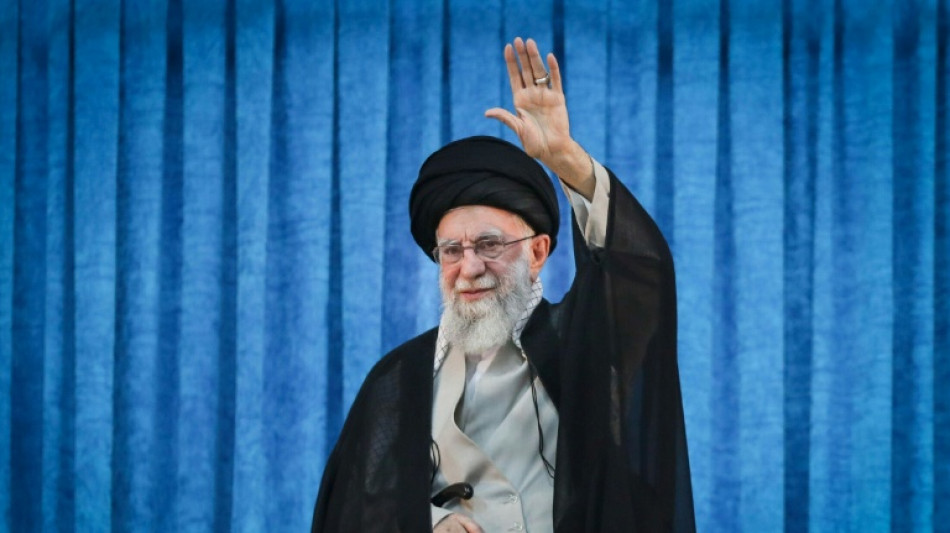
Trump says Iran 'slowwalking' as Khamenei opposes nuclear proposal / Photo: © KHAMENEI.IR/AFP

 South African election results renew debate over identity-based voting

 South African voters report smoother local election but declining IEC trust

 Dolly Parton museum and Nashville hotel open after singer’s death

 George and Amal Clooney attend New York political-comedy reading

 British buyers pay substantial premiums for period-home appearance

 Thomas Markle released to house arrest after child-abuse-image charge

 Dawn of War 4 developers chose Adeptus Mechanicus for tactical variety

 Italy face unbeaten South Africa in Turin Nations Championship match

 ChatGPT interactive interface feature tested across six custom tools

 Freshways milk-price cut deepens pressure on UK dairy farms

 Labour and National remain virtually tied as New Zealand vote count advances

 The Good Daughter adapts Karin Slaughter thriller with Rose Byrne and Meghann Fahy

 Heavy-lift drone evacuates wounded Ukrainian soldier from frontline kill zone

 Morrison says West Brom recovered after pressure from successive derby losses

 Britain considers 2027 state visit for Ukraine’s Zelensky

 Arizona Democrats Secure Historic Trifecta with New Legislative Leadership

US President Donald Trump accused Tehran on Wednesday of "slowwalking" on a nuclear deal, after Iran's supreme leader Ayatollah Ali Khamenei said the latest proposal from Washington was against the national interest.
The longtime foes have held five rounds of talks since April to thrash out a new accord to replace the deal with major powers that Trump abandoned during his first term in 2018, but sharp differences remain over whether Tehran can continue to enrich uranium.
On Saturday, Iran said it had received "elements" of the US proposal through Omani mediators, the details of which have not been publicly disclosed.
"The proposal presented by the Americans is 100 percent against" notions of independence and self-reliance, Khamenei said in a televised speech, invoking ideals of the 1979 Islamic revolution.
"Independence means not waiting for the green light from America and the likes of America."
Iran's enrichment of uranium has emerged as a major point of contention.
Trump said on Monday his administration would not allow "any" enrichment, despite Tehran's insistence it is its right under the nuclear non-proliferation treaty.
In a post on Truth Social on Wednesday, Trump said he spoke with Russian President Vladimir Putin who "suggested that he will participate in the discussions with Iran".
"It is my opinion that Iran has been slowwalking their decision on this very important matter, and we will need a definitive answer in a very short period of time!" Trump said.
- Low-level enrichment -
Khamenei said enrichment is "key" to Iran's nuclear programme and that the United States "cannot have a say" on the issue.
"If we have 100 nuclear power plants but don't have enrichment, they will be of no use to us," because "nuclear power plants need fuel" to operate, he said.
The New York Times reported Tuesday that the US proposal includes "an arrangement that would allow Iran to continue enriching uranium at low levels" as the US and other countries "work out a more detailed plan intended to block Iran's path to a nuclear weapon".
It said the proposal would see the United States facilitating "the building of nuclear power plants for Iran and negotiate the construction of enrichment facilities managed by a consortium of regional countries".
Iran has previously said it is open to temporary limits on its enrichment of uranium, and is willing to consider the establishment of a regional nuclear fuel consortium.
But it has stressed that such a consortium is "in no way intended to replace Iran's own uranium enrichment programme".
Iran's chief negotiator, Foreign Minister Abbas Araghchi, said in a Wednesday post on X: No enrichment, no deal. No nuclear weapons, we have a deal."
Iran currently enriches uranium to 60 percent, far above the 3.67-percent limit set in the 2015 deal but still short of the 90 percent threshold needed for a nuclear warhead.
- 'Less than satisfactory' -
The UN nuclear watchdog, the International Atomic Energy Agency, said in its latest quarterly report last week that Iran had further stepped up its production of highly enriched uranium.
In a separate report, it also criticised "less than satisfactory" cooperation from Tehran, particularly in explaining past cases of nuclear material found at undeclared sites.
The reports came ahead of a planned IAEA Board of Governors meeting in Vienna later this month which will review Iran's nuclear activities.
Washington and other Western governments have continued to accuse Iran of seeking a nuclear weapons capability. Iran insists its programme is for peaceful purposes only.
The 2015 deal provided Iran with relief from international sanctions in return for UN-monitored restrictions on its nuclear activities.
Trump reimposed US sanctions when he quit the agreement in 2018 and has since tightened them with secondary sanctions against third parties who violate them.
Britain, France and Germany, the three European countries who were party to the 2015 deal, are currently weighing whether to trigger the sanctions "snapback" mechanism in the accord.
The mechanism would reinstate UN sanctions in response to Iranian non-compliance -- an option that expires in October.
Iran has criticised the IAEA report as unbalanced, saying it relied on "forged documents" provided by its arch foe Israel.
C.Stoecklin--VB