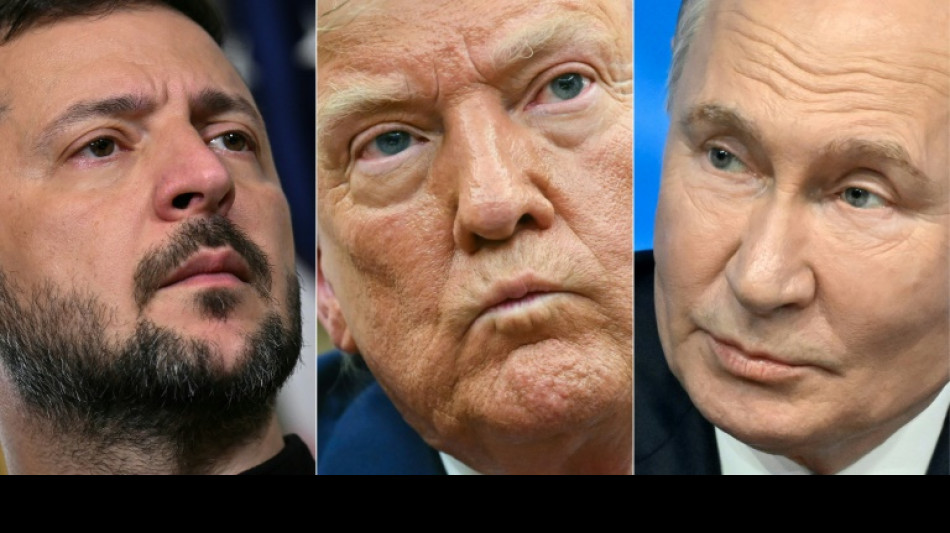
Trump's mixed signals on Russia cloud European strategy / Photo: © AFP

 South African election results renew debate over identity-based voting

 South African voters report smoother local election but declining IEC trust

 Dolly Parton museum and Nashville hotel open after singer’s death

 George and Amal Clooney attend New York political-comedy reading

 British buyers pay substantial premiums for period-home appearance

 Thomas Markle released to house arrest after child-abuse-image charge

 Dawn of War 4 developers chose Adeptus Mechanicus for tactical variety

 Italy face unbeaten South Africa in Turin Nations Championship match

 ChatGPT interactive interface feature tested across six custom tools

 Freshways milk-price cut deepens pressure on UK dairy farms

 Labour and National remain virtually tied as New Zealand vote count advances

 The Good Daughter adapts Karin Slaughter thriller with Rose Byrne and Meghann Fahy

 Heavy-lift drone evacuates wounded Ukrainian soldier from frontline kill zone

 Morrison says West Brom recovered after pressure from successive derby losses

 Britain considers 2027 state visit for Ukraine’s Zelensky

 Arizona Democrats Secure Historic Trifecta with New Legislative Leadership

European countries, aiming for deeper economic sanctions to push Russia into a ceasefire in Ukraine, struggle with US President Donald Trump's ambivalent attitude on the issue, analysts say.
Trump has expressed impatience -- accusing Russian President Vladimir Putin of "playing with fire" -- and made threats, but does not seem to follow them up with action, they say.
Diplomatic efforts to end the war, now in its fourth year, have intensified in recent weeks, with Putin being accused of stalling on peace talks.
The Wall Street Journal and CNN both reported that Trump was now considering fresh sanctions against Russia, while stressing that he could still change his mind.
On Wednesday, Trump expressed his frustration with Moscow, but also appeared to kick the can down the road by saying he would determine within "about two weeks" whether Putin was serious about ending the fighting.
As the EU prepares a fresh package of sanctions against Moscow, the bloc's 18th, the chances of coordinated international sanctions, flagged by French President Emmanuel Macron during a visit to Kyiv with the German, British, and Polish leaders on May 10, seem increasingly remote.
- 'Again be disappointed' -
German media reported Tuesday that recent discussions between Europeans and Americans about Russia's evasion of sanctions had failed.
"It seems that European hopes for joint action with the Americans... will once again be disappointed," said the Sueddeutsche Zeitung daily, citing an internal German foreign ministry document about an EU Foreign Affairs Council meeting in Brussels last week.
The document cites EU sanctions envoy David O'Sullivan as saying that transatlantic coordination on Russian sanctions had collapsed. Even G7 cooperation had "lost momentum," the newspaper said in its report based on the document.
Led by Paris, Berlin and London, Europeans are pitting their proactive stance against Washington's apparent passivity, said Sven Biscop, an expert at the Egmont Institute, a Belgian think tank.
When Trump announced direct negotiations with Putin without Kyiv or Brussels, and when Ukraine's future NATO entry was ruled out, "the EU indicated it would continue its process of Ukraine's accession, arm it even after a hypothetical ceasefire, maintain sanctions, and deploy reassurance forces," he noted.
"We deploy our levers but cannot force Trump to use his, or compel Putin to give up the war. We do not have that power," he said.
Phillips O'Brien, strategy expert at the University of St Andrews in Scotland, suspects that European leaders have become victims of "maybe the greatest example of political gaslighting in US foreign policy history".
Despite all Trump's posturing on imposing sanctions on Russia, "he clearly has no intention of doing so", O'Brien said.
Europeans, meanwhile, are in favour of a plan by US Senator Lindsey Graham, who has called for a "secondary" sanctions plan, including a 500-percent tariff on countries importing Russian fossil fuels and raw materials.
- 'What kind of rogue?' -
They hope that a US constitutional provision for a "discharge petition" wins the day, which would allow the sanctions bill to be adopted independently of the executive branch.
This would put Trump at arm's length from any sanctions move, allowing him to remain in a non-committal "mediation position", said a European diplomat who declined to be identified.
This stance confirms a new reality that Europeans are having to navigate: Washington now positions itself halfway between its traditional western European allies and Russia.
This could, down the road, allow Trump to wash his hands of the conflict altogether if negotiations go nowhere -- just like he did on the North Korea issue in 2019, during his first term.
"The question is no longer whether the United States will go rogue but what kind of rogue it will become," said Michael Beckley, a political scientist at the Foreign Policy Research Institute, an American think tank.
"Will it be a reckless, hypernationalist power that lashes out, cuts ties, and pursues limited gain at great long-term cost? Or can it channel its strength into a more strategic posture?", he asked.
On Friday, Macron said that Washington faces a "credibility test" over its response to Russia dragging its feet on a Ukraine ceasefire.
burs-dt-dla/jh/as
G.Frei--VB