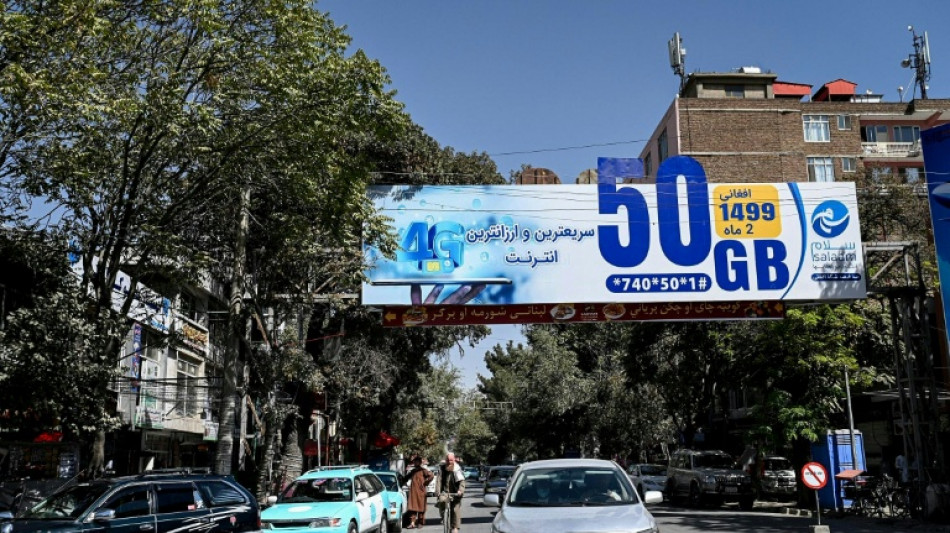
Mobile and internet restored across Afghanistan: AFP journalists / Photo: © AFP

 Houthis target Red Sea shipping as US hits Iran
 Record-equalling Red Sox streak halted at 15 wins

 Messi-less Miami beat Fire 3-2 to spoil Lewandowski's MLS debut
 Mercedes expect Hungary challenge from Hamilton and Ferrari

 In Ghana, one man's race to save critically endangered fish
 Wilson captain, Slipper absent in Kiss's first Wallabies squad

 New Mideast fighting puts eurozone rate-setters on alert

 Venezuelans search for animal companions lost in the quakes

 Argentine Football Association says US did not detain its president

 June heatwave cost UK economy more than £1bn: study

 Google-parent Alphabet beats expectations, cloud revenue nearly doubles
 US announces civilian nuclear deal with Saudi Arabia

 Tesla shares dip after profit misses expectations

 Red Sox tie club record with 15th straight MLB win

 US eyes offshore nuclear reactors
 The Sterling Announces Luxury Cocktail Lounge Concept and Investor Showcase in Orlando

 Inter Miami signs Brazil veteran Casemiro but MLS probes deal

 White House accuses China's Moonshot of stealing Anthropic AI

 Pogacar sweating on Yates's fitness ahead of Tour Queen stage

 Ukrainian soldiers and civilians welcome new army commander

 UK fintech Revolut valuation soars to $115 bn: source

 German FM, on Africa tour, eyes business ties amid US, China pressure

 Rubio says at ASEAN meeting he expects 'positive' US visit by China's Xi

 Philipsen wins Tour de France 17th stage

 DonnaPro Introduces AI-Trained Executive Assistants for European CEOs

Mobile networks and the internet were restored across Afghanistan on Wednesday, 48 hours after the Taliban authorities shut down telecommunications.
Confusion gripped the South Asian country on Monday night when mobile phone service and the internet went down without warning, freezing businesses and cutting Afghans off from the rest of the world.
The massive blackout came weeks after the government began cutting high-speed internet connections to some provinces to prevent "immorality", on the orders of shadowy supreme leader Hibatullah Akhundzada.
AFP journalists reported on Wednesday that mobile phone signals and wifi had returned to provinces across the country, including Kandahar in the south, Khost in the east, central Ghazni, and Herat in the west.
The Taliban government has yet to comment on the telecommunications shutdown.
On Wednesday night, hundreds of Afghans poured onto the streets in the capital Kabul, spreading the word that the internet was back.
"It's like Eid al-Adha; it's like preparing to go for prayer," said 26-year-old Sohrab Ahmadi, a delivery driver.
"We are very happy from the bottom of our hearts."
After days of tension, Afghans celebrated by buying sweets and balloons, as drivers honked their horns, phones pressed to their ears.
"The city is alive again," Mohammad Tawab Farooqi, a restaurant manager in the city told AFP.
- Businesses, airports, banks closed -
It is the first time since the Taliban government won their insurgency in 2021 and imposed a strict version of Islamic law that communications have been cut in the country.
Netblocks, a watchdog organisation that monitors cybersecurity and internet governance, said the blackout "appears consistent with the intentional disconnection of service".
It said connectivity had slowed to one percent of ordinary levels.
A government official warned AFP minutes before the shutdown on Monday evening that the fibre optic network would be cut, affecting mobile phone services, "until further notice".
There were widespread closures of businesses, airports, and markets, while banks and post offices were unable to operate.
Afghans were unable to contact each other in or out of the country, and many families stopped their children from going to school during the uncertainty.
Those living in Herat and Kandahar travelled to border towns to catch signals from neighbouring Iran and Pakistan.
The United Nations said on Tuesday the shutdown "left Afghanistan almost completely cut off from the outside world", and called on authorities to restore access.
Internet connections have been extremely slow or intermittent over the past weeks.
On September 16, when the first internet services were first cut in northern provinces, Balkh provincial spokesman Attaullah Zaid said the ban had been ordered by the Taliban's leader.
"This measure was taken to prevent vice, and alternative options will be put in place across the country to meet connectivity needs," he wrote on social media.
"Recent studies in Afghanistan found that internet applications have badly affected the ongoing, economic, cultural and religious foundations of society," he said.
P.Vogel--VB