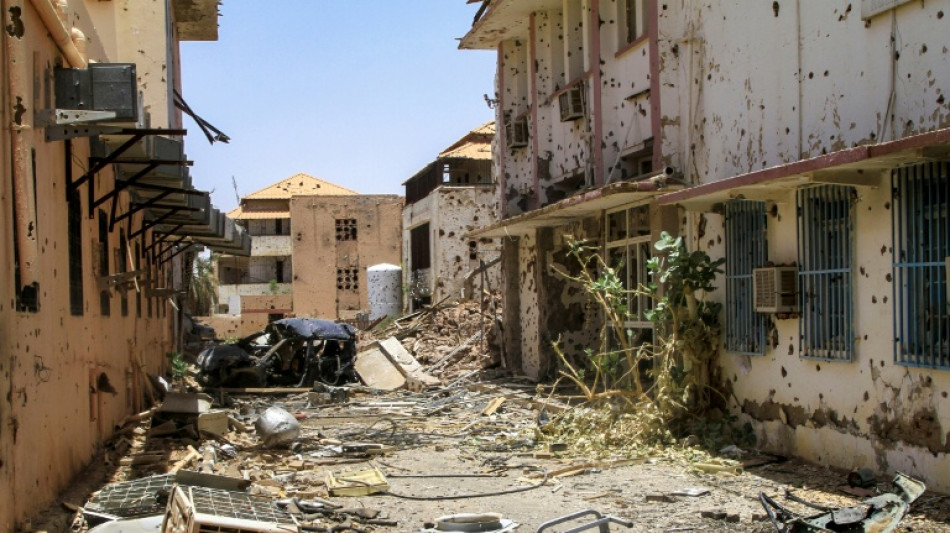
Paramilitaries claim capture of key Sudan towns / Photo: © AFP/File

 South African election results renew debate over identity-based voting

 South African voters report smoother local election but declining IEC trust

 Dolly Parton museum and Nashville hotel open after singer’s death

 George and Amal Clooney attend New York political-comedy reading

 British buyers pay substantial premiums for period-home appearance

 Thomas Markle released to house arrest after child-abuse-image charge

 Dawn of War 4 developers chose Adeptus Mechanicus for tactical variety

 Italy face unbeaten South Africa in Turin Nations Championship match

 ChatGPT interactive interface feature tested across six custom tools

 Freshways milk-price cut deepens pressure on UK dairy farms

 Labour and National remain virtually tied as New Zealand vote count advances

 The Good Daughter adapts Karin Slaughter thriller with Rose Byrne and Meghann Fahy

 Heavy-lift drone evacuates wounded Ukrainian soldier from frontline kill zone

 Morrison says West Brom recovered after pressure from successive derby losses

 Britain considers 2027 state visit for Ukraine’s Zelensky

 Arizona Democrats Secure Historic Trifecta with New Legislative Leadership

Paramilitary forces fighting Sudan's military have said they captured two strategic towns in the war-ravaged nation, which has been hit by a cholera outbreak that killed 70 people in the capital this week.
For more than two years Africa's third-largest country has been engulfed by a war between the army, led by the nation's de facto ruler, General Abdel Fattah al-Burhan, and the paramilitary Rapid Support Forces (RSF).
The surge in cholera infections comes weeks after drone strikes blamed on the RSF knocked out water and electricity supplies across the capital Khartoum, which now faces a mounting health emergency.
The RSF announced Thursday that its forces had retaken the key towns of Dibeibat, in South Kordofan state, and Al-Khoei, in West Kordofan state, which border South Sudan.
"The liberation of Dibeibat, followed by Al-Khoei, not only means a field victory; it also consolidates the complete control of the RSF over most of the Kordofan region," an RSF spokesman said in a statement.
Al-Khoei, located around 100 kilometres (62 miles) from El-Obeid -- a crossroads between Khartoum and the Darfur region -- had been briefly recaptured by the army this month.
Residents confirmed to AFP that Dibeibat, which links the states of North and South Kordofan, was now under RSF control.
The conflict has effectively split Sudan in two: the army controls the centre, east and north of the country, while paramilitaries hold almost all of Darfur in the west and parts of the south.
The war has killed tens of thousands of people, displaced 13 million and created what the United Nations has described as the world's worst humanitarian crisis.
- Cholera outbreak -
Last week, the military-backed government said it had dislodged RSF fighters from their last bases in Khartoum state, two months after retaking the heart of the capital from the paramilitaries.
Khartoum has been a battleground throughout the war and remains devastated, with health and sanitation infrastructure barely functioning.
Up to 90 percent of hospitals in the conflict's main battlegrounds have been forced out of service by the fighting.
Now the capital is facing a major health crisis.
A cholera outbreak claimed 70 lives on Tuesday and Wednesday, the health ministry for Khartoum state said Thursday.
Health officials also recorded more than 2,100 new infections over the same two days.
But the UN's humanitarian agency, OCHA, said it is "difficult to assess the true scale of the outbreak" with "significant discrepancies" in official data.
The federal health ministry reported 172 deaths in the week to Tuesday, 90 percent of them in Khartoum state.
Authorities said 89 percent of patients in isolation centres are recovering, but warn that deteriorating environmental conditions are driving a surge in cases.
Cholera vaccinations have begun in Jebel Awila, the hardest-hit district in Khartoum, UN chief Antonio Guterres's spokesman said Thursday.
Meanwhile the World Health Organization had delivered more than 22 metric tons of cholera and emergency health supplies, spokesman Stephane Dujarric said.
- 'On the brink' -
Cholera is endemic to Sudan, but outbreaks have become worse and more frequent since the war broke out.
Since August, health authorities have recorded more than 65,000 cases and over 1,700 deaths across 12 of Sudan's 18 states.
"Sudan is on the brink of a full-scale public health disaster," said Eatizaz Yousif, the International Rescue Committee's Sudan director.
"The combination of conflict, displacement, destroyed critical infrastructure and limited access to clean water is fuelling the resurgence of cholera and other deadly diseases."
Aid agencies warn that without urgent action, the spread of disease is likely to worsen with the arrival of the rainy season next month, which severely limits humanitarian access.
Sudan's government also faces US sanctions over allegations by Washington that the Sudanese military used chemical weapons last year in its war against the RSF.
On Thursday, Sudan's foreign ministry announced the creation of a national committee to investigate the charge, while expressing its "disbelief in the validity of the US administration's accusations".
burs/srm/dv/sco/rsc
A.Ruegg--VB