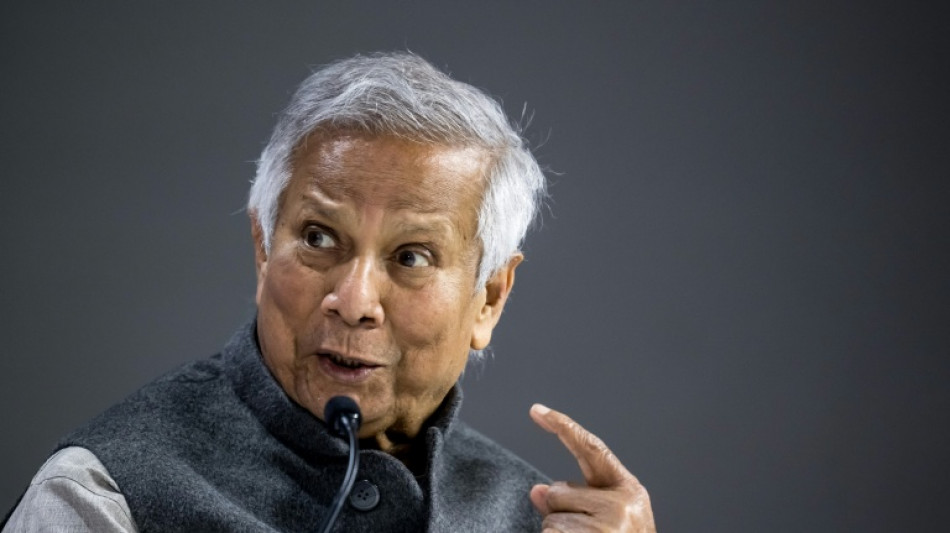
Bangladesh minister says Yunus 'not going to step down' / Photo: © AFP

 South African election results renew debate over identity-based voting

 South African voters report smoother local election but declining IEC trust

 Dolly Parton museum and Nashville hotel open after singer’s death

 George and Amal Clooney attend New York political-comedy reading

 British buyers pay substantial premiums for period-home appearance

 Thomas Markle released to house arrest after child-abuse-image charge

 Dawn of War 4 developers chose Adeptus Mechanicus for tactical variety

 Italy face unbeaten South Africa in Turin Nations Championship match

 ChatGPT interactive interface feature tested across six custom tools

 Freshways milk-price cut deepens pressure on UK dairy farms

 Labour and National remain virtually tied as New Zealand vote count advances

 The Good Daughter adapts Karin Slaughter thriller with Rose Byrne and Meghann Fahy

 Heavy-lift drone evacuates wounded Ukrainian soldier from frontline kill zone

 Morrison says West Brom recovered after pressure from successive derby losses

 Britain considers 2027 state visit for Ukraine’s Zelensky

 Arizona Democrats Secure Historic Trifecta with New Legislative Leadership

Bangladesh's Muhammad Yunus "needs to remain" in office as interim leader to ensure a peaceful transition of power, a cabinet member and special adviser to Yunus said Friday.
Yunus, the 84-year-old Nobel Peace Prize winner who took over after a mass uprising last year, had threatened to quit the job if parties did not give him their backing, a political ally and sources in his office said.
The South Asian nation has been in political turmoil since the student-led revolt that toppled then-prime minister Sheikh Hasina in August 2024, with parties protesting on the streets over a string of demands.
"For the sake of Bangladesh and a peaceful democratic transition, Professor Yunus needs to remain in office," Faiz Ahmad Taiyeb, a special assistant to Yunus, and head of the Ministry of Posts, Telecommunications and Information Technology, said in a post on Facebook.
"The Chief Adviser is not going to step down," he added. "He does not hanker after power."
He later deleted his post.
Bangladesh's political crisis has escalated this week, with rival parties protesting on the streets of the capital Dhaka with a string of competing demands.
Yunus's reported threat to stand down came after thousands of supporters of the powerful Bangladesh Nationalist Party (BNP) rallied in Dhaka on Wednesday, holding large-scale protests against the interim government for the first time.
Yunus has promised polls will be held by June 2026 at the latest in the Muslim-majority nation of around 170 million people.
But supporters of the BNP -- seen as front-runners in the highly anticipated elections that will be the first since Hasina was overthrown -- demanded he fix a date.
- 'Chaotic phase' -
Yunus's relationship with the military has also reportedly deteriorated.
According to local media and military sources, army chief General Waker-Uz-Zaman said on Wednesday that elections should be held by December, warning that Bangladesh was in a "chaotic phase" and that the "situation is worsening by the day".
Taiyeb issued a warning to the army on Friday. "The army can't meddle in politics," he wrote.
"The army doesn't do that in any civilised country," he added.
"By saying that the election has to be held by December, the military chief failed to maintain his jurisdictional correctness."
- 'Excessive restriction' -
The army played a decisive role in the ending of Hasina's rule by not stepping in to quash the uprising, after at least 1,400 protesters were killed in a police crackdown.
It was Waker-Uz-Zaman who announced that Hasina had been overthrown, with the military taking brief control, before handing over to Yunus.
The army issued a statement late on Thursday it said was aimed to combat those seeking to create divisions between the military and the public.
"Some vested interest groups are circulating misleading information and trying to create a divide between the army and the general public," the army said in a statement late Thursday.
It released a list of the hundreds of people it had briefly sheltered inside army bases in the chaotic days following Hasina's ouster "to save them from extrajudicial killings".
Among those the army said it sheltered to "save lives" were 24 political figures, as well as judges, civil service staff, academics and more 525 police personnel.
The army did not give details on those it accused of seeking to undermine its support.
The National Citizen Party (NCP) -- made up of many of the students who spearheaded the uprising against Hasina, and a group close to Yunus -- has previously accused of the army of supporting Hasina's Awami League party.
Hasina, 77, remains in self-imposed exile in India, where she has defied an arrest warrant to face trial for crimes against humanity related to the police crackdown.
The government banned the Awami League this month after protests outside Yunus's house, a move that sparked criticism from Human Rights Watch, calling it an "excessive restriction on fundamental freedoms that mirrors the previous government's abusive clampdown".
E.Gasser--VB