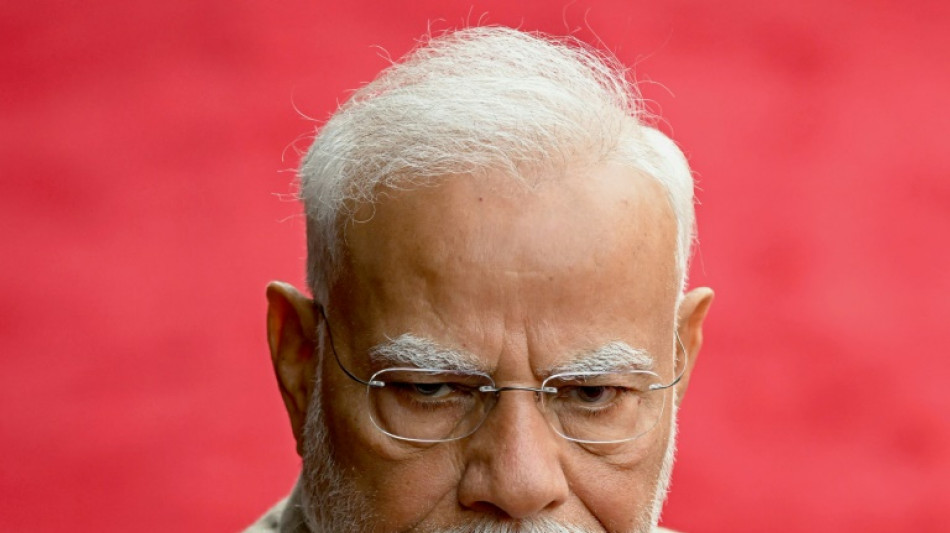
India and US at odds on Kashmir truce: analysts / Photo: © AFP

 South African election results renew debate over identity-based voting

 South African voters report smoother local election but declining IEC trust

 Dolly Parton museum and Nashville hotel open after singer’s death

 George and Amal Clooney attend New York political-comedy reading

 British buyers pay substantial premiums for period-home appearance

 Thomas Markle released to house arrest after child-abuse-image charge

 Dawn of War 4 developers chose Adeptus Mechanicus for tactical variety

 Italy face unbeaten South Africa in Turin Nations Championship match

 ChatGPT interactive interface feature tested across six custom tools

 Freshways milk-price cut deepens pressure on UK dairy farms

 Labour and National remain virtually tied as New Zealand vote count advances

 The Good Daughter adapts Karin Slaughter thriller with Rose Byrne and Meghann Fahy

 Heavy-lift drone evacuates wounded Ukrainian soldier from frontline kill zone

 Morrison says West Brom recovered after pressure from successive derby losses

 Britain considers 2027 state visit for Ukraine’s Zelensky

US President Donald Trump's claim to have helped end fighting between arch-rivals India and Pakistan has driven a wedge between him and Indian Prime Minister Narendra Modi, analysts say.
A week since Trump announced a surprise truce between India and Pakistan to end a brief but intense conflict, New Delhi and Washington differ about the way it was achieved.
The US administration thought "an intervention at this stage might give them some basic benefit in terms of highlighting Trump's role," Indian foreign policy expert Harsh V. Pant told AFP.
"That... became the driver and in a sense the hurry which with Trump announced the ceasefire," said Pant from the New Delhi-based Observer Research Foundation (ORF) think tank.
Fighting began when India launched strikes on May 7 against what it called "terrorist camps" in Pakistan following an April militant attack in Indian-administered Kashmir that killed 26 people.
New Delhi blamed Islamabad for backing the militants it claimed were behind the attack, which Pakistan denies.
Trump announced the truce after four days of missile, drone and artillery attacks from both sides, killing about 70 people, including dozens of civilians, and sent thousands fleeing.
He later boasted about bringing India and Pakistan "back from the brink", telling Fox News on Friday it was "a bigger success than I'll ever be given credit for".
New Delhi however shrugs off these claims, which go against decades-long Indian policy that opposes foreign mediation in conflicts with Islamabad.
India and Pakistan claim the currently divided Kashmir in full. New Delhi considers the Himalayan region an internal matter, with politicians long viewing external mediation as a sign of weakness.
Modi's first speech since the ceasefire did not mention US involvement and his government has since insisted that talks with Pakistan are "strictly bilateral".
India was also quick to dismiss Trump's suggestion that trade pressures hastened a truce.
"The issue of trade did not come up" in discussions with US officials, the Indian foreign ministry said this week.
- 'Upstaged' -
According to ORF fellow Manoj Joshi, Trump's rhetoric is "irritating" for India -- whose strategic location and massive market size have made the country an important ally for the United States.
But India is being "very cautious" because it is in negotiations for a trade deal with Washington to avoid steep tarriffs, he said.
"We (India) would like the agenda to go in a different direction," said Joshi.
It is also a thorny matter domestically.
Main opposition Congress party said Trump's announcement had "upstaged" the Hindu nationalist leader's "much-delayed address".
It also demanded an all-party meeting to ask whether India is changing its policy on "third-party mediation" for Kashmir, disputed between Pakistan and India.
The two South Asian rivals had in the 1970s agreed to settle "differences by peaceful means through bilateral negotiations".
- 'Irritating' -
Modi has previously poked fun at former Congress governments for "weak" responses against Pakistan in various skirmishes.
"So India would obviously respond to that and deny that... about as politely as they feel they can get away with," said South Asia researcher Pramit Pal Chaudhuri of political consultancy Eurasia Group.
Trump's claimed mediation was welcomed by Islamabad, which "needed an American intervention to give them the off-ramp they needed to get out of a conflict", Chaudhuri added.
On Thursday, Indian Foreign Minister Subrahmanyam Jaishankar reaffirmed that "where Pakistan is concerned, our relations, our dealings with them will be bilateral, and strictly bilateral."
But the same day, speaking from Qatar, Trump repeated claims of brokering a ceasefire and using trade as a tool.
"(I said) let's do trade instead of war. And Pakistan was very happy with that, and India was very happy with that," Trump said in his speech.
It has been a decade since Modi last met a Pakistani leader. Since then, relations have deteriorated, coming to a head when India unilaterally revoked Kashmir's limited autonomy in 2019.
According to Joshi, "the hyphenation of India and Pakistan" is also "irritating" for New Delhi, which has tried to carve out a separate identity on the global stage.
"The optics of Trump hammering it day after day... is politically damaging for Modi," Sushant Singh, a former Indian soldier and South Asian studies lecturer at Yale University, wrote on X.
"(Modi) can't personally counter Trump, and despite attempts by India's big media to play it down, social media amplifies Trump," Singh said.
L.Meier--VB