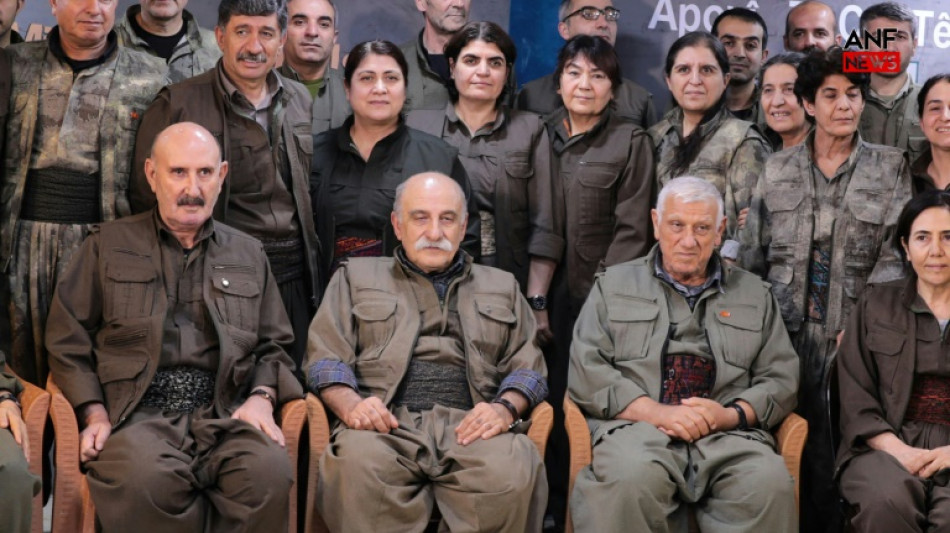
Kurdish militant group PKK ends decades of armed struggle / Photo: © ANF NEWS/AFP

 South African election results renew debate over identity-based voting

 South African voters report smoother local election but declining IEC trust

 Dolly Parton museum and Nashville hotel open after singer’s death

 George and Amal Clooney attend New York political-comedy reading

 British buyers pay substantial premiums for period-home appearance

 Thomas Markle released to house arrest after child-abuse-image charge

 Dawn of War 4 developers chose Adeptus Mechanicus for tactical variety

 Italy face unbeaten South Africa in Turin Nations Championship match

 ChatGPT interactive interface feature tested across six custom tools

 Freshways milk-price cut deepens pressure on UK dairy farms

 Labour and National remain virtually tied as New Zealand vote count advances

 The Good Daughter adapts Karin Slaughter thriller with Rose Byrne and Meghann Fahy

 Heavy-lift drone evacuates wounded Ukrainian soldier from frontline kill zone

 Morrison says West Brom recovered after pressure from successive derby losses

 Britain considers 2027 state visit for Ukraine’s Zelensky

The Kurdistan Workers' Party (PKK) on Monday announced its dissolution and the end of its armed struggle, drawing a line under its deadly four-decade insurgency against the Turkish state.
Founded in the late 1970s by Abdullah Ocalan, the PKK took up arms in 1984, beginning a string of bloody attacks on Turkish soil that sparked a conflict that cost more than 40,000 lives.
The PKK "has decided to dissolve... and end its armed struggle", it said in a statement after a landmark leadership congress, saying it had brought "the Kurdish issue to a point where it can be resolved through democratic politics".
Turkey's President Recep Tayyip Erdogan hailed the move, calling it an "important decision for maintaining peace and fraternity" in the country.
"We are moving confidently towards our goal of terror-free Turkey, overcoming obstacles, breaking prejudices and thwarting the traps of discord," he added.
The PKK statement of intent was also welcomed as a boost for regional security by top officials in Syria and Iraq, by the European Union and at the United Nations.
Ocalan had in February urged his fighters to disarm and disband in a letter from Imrali prison island where he has been held since 1999. He also asked the PKK to hold a congress to formalise the decision.
The declaration was the culmination of seven months of work to renew long-stalled talks that began in October when Ankara offered Ocalan an unexpected olive branch.
The news won a cautious welcome on the streets of Diyarbakir, the main city in Turkey's Kurdish-majority southeast, where locals have seen repeated efforts to end the violence come to nothing.
"We want this process to move forward and not be left unfinished. They shouldn't deceive the Kurds as they did before. We really want peace," 60-year-old worker Fahri Savas told AFP.
There was a similar sentiment in Iraqi Kurdistan's Erbil, where Khaled Mohammed, 55, warned: "We only support the peace process if it is serious and accompanied by international guarantees."
- 'A pivotal moment' -
With PKK fighters present in both Syria and Iraq, the movement's dissolution is likely to reverberate in both nations.
Syria's top diplomat Asaad al-Shaibani said it was "a pivotal moment" not only for Turkey, "but for the stability of our region as a whole".
Nechirvan Barzani, president of Iraq's Kurdistan region -- a crucial powerbroker in Kurdish affairs with close ties to Ankara -- hailed the "political maturity" of the decision, saying it would boost "stability in Turkey and the region".
UN Secretary-General Antonio Guterres said if the PKK's decision was implemented, it would be "another important step towards a peaceful resolution of long-standing conflict", his spokesman told reporters.
Brussels urged "all parties to seize the moment" to resolve the decades-long Kurdish question -- echoing a call by Turkey's pro-Kurdish opposition DEM party, which played a key role in the process.
"The door to a political solution to the Kurdish problem has been thrown wide open," DEM spokeswoman Aysegul Dogan told reporters.
"We should not waste this great opportunity... Peace is no longer a dream."
- Ocalan to benefit -
Despite talk of parole for Ocalan, who has spent more than 25 years serving life in solitary confinement, it was unlikely he would leave Imrali.
"The conditions of his detention will be eased... meetings with DEM and his family will also be more frequent," a source from Erdogan's ruling AKP told the pro-government Turkiye daily.
The move was also important for Erdogan.
"If the PKK announces it is disbanding and finalises the process without any road accidents, that will be a huge win for Erdogan," Gonul Tol of the Washington-based Middle East Institute told AFP.
She said seeking a rapprochement with the Kurds was very much related to domestic politics, coming just months after Erdogan's AKP suffered a blow at the ballot box.
Analysts say ending the Kurdish conflict could let Erdogan amend the constitution and extend his term in office, while simultaneously driving a wedge between pro-Kurdish parties and the rest of Turkey's opposition.
"The main driver behind this Ocalan opening has always been about consolidating Erdogan's rule. Because if this whole process succeeds, he will go into the 2028 elections as a stronger candidate who is facing a divided opposition," Tol said.
The PKK was set up in 1978 with the original aim of carving out a homeland for Kurds, who make up about 20 percent of Turkey's 85 million people, later modifying its aims to seek greater autonomy.
G.Schmid--VB