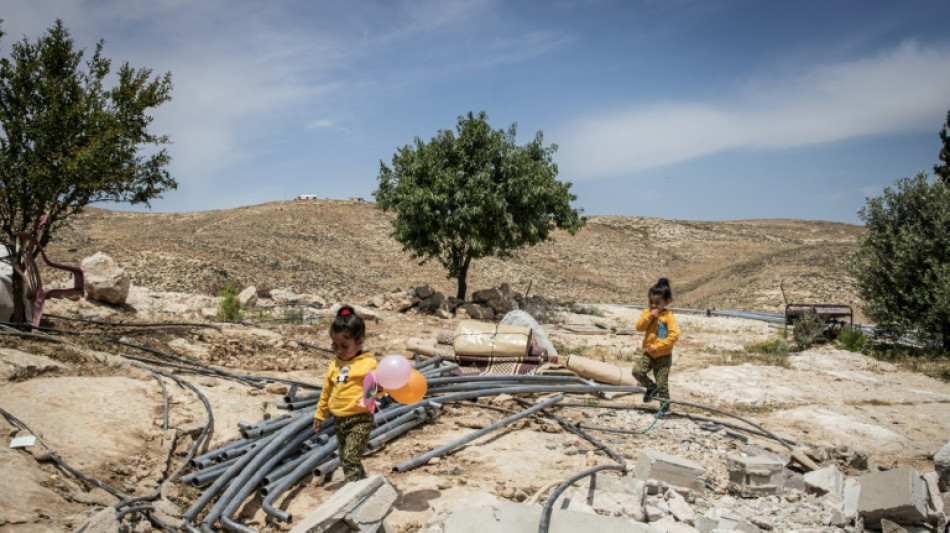
Palestinians in razed West Bank hamlet vow to stay / Photo: © AFP

 WADA pledges vigilance on Russian athletes ahead of 2028 Olympics

 NASA satellite rescue mission fails

 Cobolli halts Jodar to reach Cincinnati quarter-finals

 As election looms, Netanyahu puts Turkey in Israel's crosshairs

 McIlroy questions LIV stars 'value' as talk of PGA return builds
 'Breakthrough' mRNA cancer drug curbs melanoma in large trial

 Many US Fed policymakers back interest rate hikes if inflation stays high

 Robinson and Tongue star as Pakistan collapse in England opener
 All Blacks must get 'everything right' to beat Springboks, says legend Fitzpatrick

 Robinson and Tongue star as Pakistan all out for 171 in England opener

 Lake Zurich sees water level hit record low amid drought

 Merck and Moderna's tailored cancer drug curbs melanoma recurrence in trial

 Referees chief Webb wants clamp-down on Premier League set-piece grappling

 Robinson makes history as Pakistan collapse against England

 Alvarez can win back Atletico fans in two games: club chief

 Oldest human brain cells grown in lab 'recorded passage of time'

 7,300 excess deaths and counting in France's historically hot summer
 Ukraine MPs approve new defence minister after divisive reshuffle
 North Korea leader's sister says 'unaware' of reported Kim-Trump communication
 Russia, Ukraine exchange 103 captured soldiers each

 Sainz signs new contract with F1 team Williams

 Playing at Real Madrid 'not for everyone': Bernardo Silva
 As election nears, Israelis fear polarisation could spark violence

 Bayern's Hoeness 'speechless' after second Musiala collapse

 Reijnders leaves Man City for Saudi's Al Qadsiah: source

Standing in the rubble of used to be his home, Palestinian farmer Haitham Dababseh cleared stones to make space for a tent after Israeli army bulldozers destroyed his village in the occupied West Bank.
Residents of Khallet al-Dabaa and other hamlets in the West Bank's Masafer Yatta region have for years contended with violence from Israeli settlers and repeated demolitions.
But the bulldozers that descended on Khallet al-Dabaa on Monday carried out "the biggest demolition we've ever had", said Dababseh, razing to the ground the hamlet that is home to about 100 Palestinians.
Israeli forces "came here in the past, they demolished three times, four times", the 34-year-old farmer told AFP, but never entirely destroyed a hamlet this size in Masafer Yatta.
"I just have my clothes. Everything I have is under the rubble."
Behind him, his 86-year-old father struggled to move the house's former door out of the way so that they can set up their shelter.
Khallet al-Dabaa is one of several villages featured at length in the Oscar-winning documentary "No Other Land", recounting the struggles of the Palestinian residents of the area in the West Bank's south, a frequent target of settler violence and army activities.
Several of the communities shown in the documentary have experienced settler attacks or army demolitions since it won an Academy Award in March.
- No protection -
Several years after occupying the West Bank in 1967, the Israeli army had declared Masafer Yatta a restricted firing zone.
Israeli forces regularly demolish structures that the military authorities say were built illegally in the area, where about 1,100 Palestinians live across several hamlets.
"Enforcement authorities of the Civil Administration dismantled a number of illegal structures that were built in a closed military zone in the South Hebron Hills," the Israeli military told AFP in a statement on the Khallet al-Dabaa demolition.
"The enforcement actions were carried out after the completion of all required administrative procedures and in accordance with the enforcement priority framework previously presented to the Supreme Court," it added.
Some residents, and many of their ancestors, once lived in caves in the rocky terrain to escape the area's stifling summer heat, and built houses with stone and other materials after the Israeli firing zone designation in the 1970s.
Dababseh said he was the first member of his family to be born in a hospital and not a cave.
He lamented that the army had blocked the entry to the cave near the family home where his father and grandfather were born.
In the middle of Khallet al-Dabaa, what served as a health and community centre is now a pile of broken concrete with no walls.
A torn logbook that an aid organisation used to record residents' medical check-ups lay under dust.
On the outside wall of the only structure left standing, a painted mural read "Let me live".
Mohammed Rabaa, head of the nearby Tuwani village council which has jurisdiction over Khallet al-Dabaa, told AFP that the foreign aid his community received was useless if the world "can't protect it".
- 'I'm not leaving' -
According to Rabaa, "nine settler outposts were established in the Masafer Yatta area" since October 2023, when war began in the separate Palestinian territory of the Gaza Strip.
The West Bank is home to about three million Palestinians, but also some 500,000 Israelis living in settlements that are illegal under international law.
Settlement outposts, built without the authorities' prior approval, are considered illegal under Israeli law too although enforcement is relatively rare.
The settlers who live in the nearby outposts "attack homes, burn property, destroy and vandalise" with full impunity and often under army protection, said Rabaa.
To him, they aim to force Palestinians to leave and "do not want any Palestinian presence".
The day after Khallet al-Dabaa was razed, Israel's Finance Minister Bezalel Smotrich, a far-right politician who lives in a settlement, expressed his hope that the government would formally annex the territory soon.
Umm Ibrahim Dababseh, a 76-year-old woman who has lived in Khallet al-Dabaa for six decades, said she would not leave under any circumstances.
"I told them, 'make my grave right here'," she said of the Israeli soldiers, adding that they had to drag her out of her now ruined house.
"I didn't even get to wear my clothes properly," she said, sitting with her granddaughters on a rock under the shade of an olive tree.
Haitham Dababseh, a distant relative of Umm Ibrahim, said that hardships would not make him leave either.
"Last night, I slept there," he said, pointing to a bed exposed to the elements on the hilltop.
"I have a bed, okay, I will cover myself with the sky, but I'm not leaving."
H.Kuenzler--VB