
-
 Macron hosts Saudi crown prince for visit ranging from esports to Mideast
-
Swiss forward Embolo joins Atlanta United
-
 Jamieson gets Trump call after ending 14-year golf title drought
-
Former cricket captains appeal to Pakistan over Khan health care
-
 Norwegian King Harald's health has 'deteriorated': palace
-
Latest 'Spider-Man' tops American box office for 4th weekend

-
 Man City snatch late win in Maresca debut, Iraola's Liverpool rescue dramatic draw
-
Szoboszlai's last-gasp leveller rescues Liverpool in Newcastle draw

-
 Trump takes starring role at Washington's IndyCar debut
-
Landfill collapse kills 30 in Guinea
-
 Villa boss Emery says it's down to Watkins to explain absence
-
'Unbelievable' Cherki proves his point to Man City boss Maresca
-
 Duplantis labours to 'super difficult' pole vault win at Silesia Diamond League
-
10-man Atletico snatch Villarreal draw as Alvarez returns

-
 Max smash at zany Zandvoort: Three stories from the Dutch GP
-
Seville, Jefferson-Wooden roar to 100m wins at Silesia Diamond League

-
 Brennan sprints to Vuelta stage two victory, Pogacar keeps red
-
VW chief warns carmaker's situation 'more than critical'

-
 Duplantis conquers pole vault at Silesia Diamond League
-
England cricketer Carse under investigation after 'nightclub incident'

-
 France's badminton gold winners set for obscurity back home
-
McLaren's Norris wins Dutch GP after Verstappen crash
-
 Brighton start Premier League season with rout of 10-man Villa
-
Giroud scores as Lille give Davide Ancelotti winning start

-
 Maresca makes winning start with Man City after dramatic fightback
-
Kejelcha smashes half-marathon world record in Buenos Aires
-
 Mo'unga returns for All Blacks against Johannesburg Lions
-
Trump admin predicts US trade war 'devastating' for Canada
-
 Belgian sprinter Philipsen wins Renewi Tour
-
Trump set for starring role at Washington's debut IndyCar race
-
 'A day for French badminton' as Lanier triumph gives them golden double at world champs
-
Kane voted player of the year in Germany

-
 Kane voted German footballer of the year
-
Padikkal hundred helps India to 300-5 against Sri Lanka
-
 'New season, new trim': Man City star Haaland chops off flowing locks
-
Man City agree deal for Lille star Bouaddi

-
 Lanier clinches badminton world title in France's golden double
-
Humanoids break records at Beijing Robot Games
-
 After Wildberries, Ukraine launches drone campaign on Russia's Ozon
-
Zelensky rejects rival's call for vote, says would 'split' Ukraine
-
 Padikkal, Gill half-centuries take India to 187-3 at tea
-
Zelensky rejects wartime elections, says would 'split' Ukraine
-
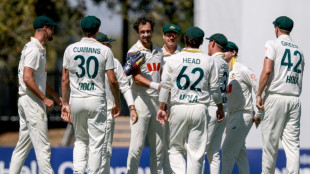
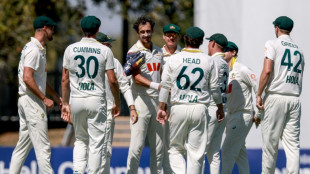
 Cummins hails 'sharp' Australia as they get back to winning ways
-
'Keep up the spirit': Indonesian teenage 'Superman' joins wildfire fight
-
 Bangladesh eye more Australia Tests to hit next level
-
Starc bags 10 as Australia thrash Bangladesh in second Test
-
 Thousands expected at Sweden climate demo as election looms
-
Starc heroics see Australia thrash Bangladesh in second Test
-
 Starc heroics put Australia on brink of victory over Bangladesh
-
Pegula dethrones Swiatek to book Cincy final against Gauff
Buchenwald camp survivor recounts liberation, 80 years on
Jacques Moalic, a 102-year-old former Agence France-Presse journalist, remembers vividly the liberation of Buchenwald concentration camp by American troops 80 years ago.
In an interview with AFP, where he worked for 40 years after World War II, the Buchenwald survivor spoke of his last months in captivity and the arrival of American troops on April 11, 1945.
He recounted his ordeal once again, speaking ahead of the 80th anniversary of the camp's liberation. Around 56,000 Jews, Roma and Soviet prisoners died there between 1937 and 1945.
In 1943, Moalic, then a young Resistance fighter, was arrested and eventually forced to board a train.
He tried to flee, jumping from the train, but was caught.
In December 1943, he was brought to Buchenwald, which stood on a hill near the German town of Weimar.
He was placed in Block 34. In the hell that was Buchenwald, prisoners pinned their hopes on Allied forces, who landed on the beaches of Normandy on June 6, 1944.
- Transfer to Ohrdruf -
The liberation of Paris in August 1944 boosted their spirits.
"In the camps, people regained their courage," Moalic, former head of general news at AFP, said in his Paris apartment.
"They said to themselves, we will be free by Christmas. I didn't really believe it. I was right."
When the Allied troops had not arrived by the end of the year, many began to lose hope.
In January 1945, Moalic was moved to the Ohrdruf death camp.
"In January, on the 8th I believe, there was an unexpected gathering," he said. "The SS officer passed between the rows noting down the numbers. Eight hundred to 900 of us were to leave for a camp nobody knew about."
He was advised to try to get himself taken off the list if he wanted to live.
"But I was on it, and there was no escaping. We ended up in Ohrdruf."
The prisoners there were forced to dig underground tunnels.
"Guys worked day and night digging into the mountain," Moalic said.
He thought he would die.
"I said to myself: being woken up at four or five in the morning, going home at 10 at night, I'll last a fortnight. For the first time, I thought that maybe I wouldn't come back."
Instead, he was recruited as an electrician. The job saved his life.
"I slept in former Wehrmacht (German military) accommodations," he said. Other prisoners were exposed to temperatures of minus 15 degrees Celsius. Many died.
- Death march -
"Of course, we had known for some time that Russians and the Allies were advancing. But there's a big difference between 'they're advancing' and 'they're here'!" he said.
"One day at roll call, we heard a sound we had never heard before -- artillery, cannon," he said. They realised the Allies were within striking distance.
"We looked at each other and there was an extraordinary silence."
In 1945, Easter fell on April 1. They did not work that day. Then they were told they were being evacuated.
They were ordered to march, in columns of 1,000 people. They did not know their final destination.
They marched through mountainous countryside.
"It drizzled," he said. "We marched like that for three or four days."
Ohrdruf had been worse than Buchenwald, and the prisoners were exhausted.
Anyone who fell along the way was shot.
Many were killed during the death march, said Moalic.
"Some of the guys were already half dead when they started out," he said.
"We arrived at Weimar train station and then we started climbing towards Buchenwald."
It was a trek of around six or seven kilometres, he said.
"There were 72 corpses."
- Liberation -
When the prisoners arrived back at Buchenwald, it was dark.
"There were 3,000 to 4,000 of us on the roll call square," he said.
One man recognised him and took him back to Block 34. "I was covered in lice."
The Americans were getting closer.
"On April 11, there was a lot of excitement in the camp," Moalic said.
The prisoners did not know whether they would be liberated or massacred.
"The SS began to empty the camp, block by block, and each group was sent to Weimar station, where filthy wagons were awaiting."
The remaining prisoners were preparing for a possible fight.
"Then all of a sudden, an American unit arrived," he said.
"The SS did not engage in combat. They preferred to get the hell out of there," he said.
"A few minutes later, we were outside."
When Moalic finally returned to Paris, he was questioned by authorities at the iconic Lutetia hotel, which was turned into a welcome centre for concentration camp survivors.
He looked so haggard women gave up their seats for him in the metro.
"I still remember a pale spring sun," he wrote in an account published in 1985.
"Wednesday April 11, 1945 was a beautiful day for the inmates of Buchenwald concentration camp, the first beautiful day since July 1937, when Heinrich Himmler inaugurated and named it."
C.Stoecklin--VB