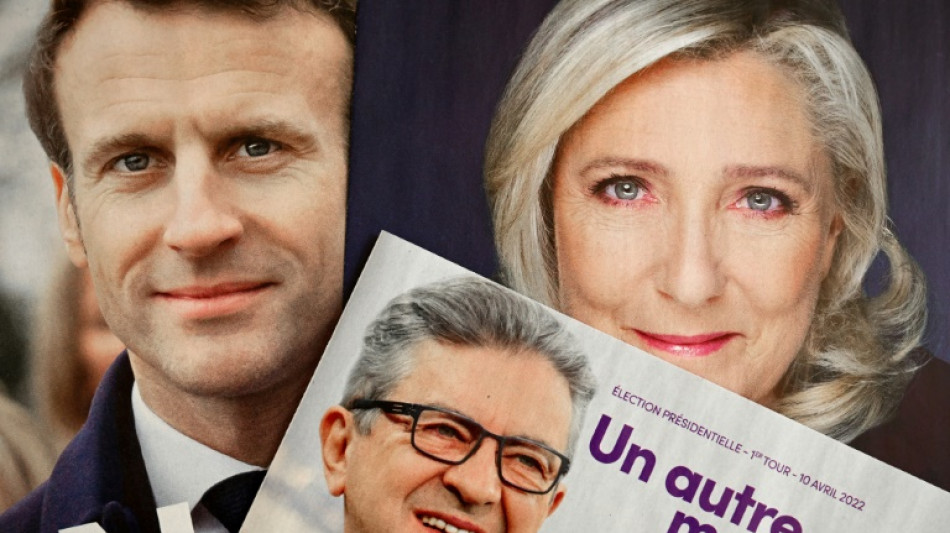
In new shake-up, French politics fragments into three blocs / Photo: ©

 Arizona Superintendent Tom Horne to Leave Office, Plans Law Practice and Charter School

 Japan and Peru Mark 150 Years of Diplomatic Ties Amidst Trade and Investment Talks

 Ian Jackson Scores Game-High 22 Points After Rick Pitino's Prank Suspension

 Khan Welcomes Milburn’s Youth Employment Reforms Amid High NEET Rates

 Shinde Clarifies Torn Photo Controversy Amid Sonia Gandhi Book Protest

 BMW i3 vs Mercedes C-Class Electric vs Hyundai Ioniq 6: The Ultimate Premium EV Showdown

France's political landscape is now fragmented into three blocs -- the centre, far-right and radical left -- after the abysmal performance of traditional parties in the presidential election.
Power alternated for decades until the 2010s between the two main parties -- the Socialists and Republicans -- before Emmanuel Macron took power in 2017 with a centrist platform.
His meteoric emergence -- and pillaging of key traditional right and left figures for his own centrist movement -- pushed the political centre of gravity on the left and right to the extremes.
Now, the traditional parties struggle to get even five percent of the vote, a situation that creates not just political but also financial problems for them under the French system.
"The first round of this presidential election confirms the three-way split of the electorate and the creation of three blocs with pretty much equal weight," said political scientist Gael Brustier.
It's the "cornerstone of the new world of French politics", he wrote in a Slate column.
Marine Le Pen, who will go head-to-head with Macron on April 24 in the second round of the election, and her National Rally (RN) party embody the far-right bloc.
Macron represents the centre while Jean-Luc Melenchon and his France Unbowed (LFI) party are the focus of the far left, taking a strong third place in Sunday's polls.
"The French political landscape has redefined itself around three political forces: a bloc which unites the centre-left and centre-right, embodied by Macron, the radical left, and far-right," Bernard Poignant, a former Socialist mayor who now supports Macron, told the Ouest France newspaper.
- 'Season 2' -
Socialist Party candidate Anne Hidalgo and the Republicans hopeful Valerie Pecresse were crushed on Sunday, winning only 1.75 percent and 4.78 percent of the vote respectively.
They now find themselves in dire financial straits since they finished below the five percent threshold for having campaign spending largely reimbursed by the state.
Financial woes are familiar to the Socialists. The party was forced to sell its historical headquarters in late 2017 to try to salvage its finances.
And Pecresse has launched a humiliating appeal for donations to try to save the party as it faces a 7.0-million-euro ($7.6 million) hole in its finances.
"The breakdown and reshaping of French political life began in 2017 with the advent of Macronism and the collapse of the Socialist Party," political scientist Jerome Fourquet told France Inter radio.
"And we watched season two yesterday (Sunday)..., the confirmation of the obliteration of the Socialists, the second historical pillar in the French political landscape, and the Republicans have been devastated as well," Fourquet said.
The last Socialist president was Francois Hollande, a deeply unpopular leader who never ran for a second term.
"What is the Socialists' reason for existing? What is the Republicans' reason for existing in a political system where you have a radical left, a central bloc that goes from the centre left to the right, and a far-right bloc?" asked Brice Teinturier, head of Ipsos polling company, told AFP.
"It's extremely difficult to find," he said.
- 'Elitist bloc?' -
However, unity within the extreme blocs is more fragile because of their diverse social make-up, rendering them more difficult to structure.
"I reject the idea of three blocs, left, centre and right," said pollster and political scientist Jerome Sainte-Marie at PollingVox. He sees a clash between an "elitist bloc" including the wealthy behind Macron, and a double "popular bloc".
Sainte-Marie pointed to "an alignment of managers and the retired" supporting Macron in the elitist bloc that unites individuals from a higher social class.
The popular bloc is "more mixed", with private-sector workers supporting Le Pen, while public sector workers and immigrant populations usually opt for Melenchon.
Melenchon benefitted from the support of other leftist formations, like the ecologists.
In addition to his base, he has "new reinforcements" with quite significant increases in... voters of immigrant origin", political scientist Fourquet said, adding that Melenchon had captured "even more of the culturally left-wing, teachers, students".
K.Thomson--BTB