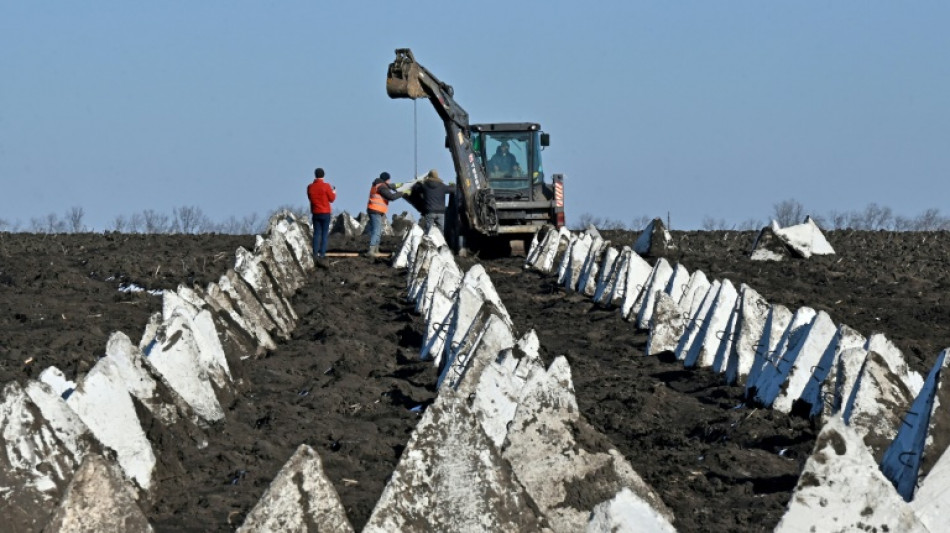
Ukraine digs in for drawn-out defensive fight / Photo: © AFP

 Australian lawmaker hurt in car attack underwent surgery overnight: PM

 Japan launches rocket for potential world first Mars moon mission

 Ethiopia PM warns Eritrea of 'severe consequences' if supports enemies

 Boland grabs opportunity for Australia as South Africa struggle in second Test

 Ronaldo handed 30-day suspension: Portuguese federation
 France announces curfews as government grapples with unrest

 Boland sets pace as South Africa struggle
 Ukraine on back foot as Kremlin moots US, China meeting
 'Stay home!': Tourists find themselves in a France convulsed by protests
 Kenyan cult leader guilty on all charges over 191 starvation deaths

 Eagles star Hurts to miss rest of NFL season: reports

 Oil-rich Alberta votes on Canada breakup

 Israel announces arrests after West Bank settler attacks on Westerners
 Guehi insists players have 'trust and belief' in Man City after charges
 UN climate panel head wants swift end to deadlock over key scientific report
 PM calls for curfews in France as govt grapples with unrest
 Man City's Semenyo out for up to eight weeks

 Australian lawmaker critically hurt in 'violent' vehicle attack
 England women's coach Wiegman signs two-year contract extension
 Louvre blocked as France grapples with unrest
 Bollywood actor Tiger Shroff shot at in Mumbai, three suspects held: police
 UN biodiversity summit opens with nature goals off track

 'Physical hell': Hong Kong hosts gruelling underwater hockey tournament
 Police 'lost control' during French protests, says interior minister
 Australia's new Ghost Shark submarines grow some 'teeth'
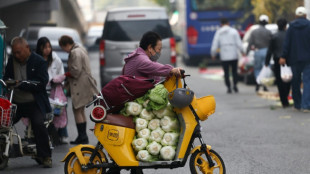
Ukrainian forces facing a lack of munitions and manpower are digging in to resist Russian attack, mirroring the invaders' strategy and showing Kyiv expects a drawn-out war.
President Volodymyr Zelensky said last week that Kyiv's troops were in an "ongoing process" of building around 2,000 kilometres of defensive lines.
Britain's defence ministry said the works included "anti-tank dragon's teeth and ditches, infantry trenches, minefields and fortified defensive positions" in a post on X, formerly Twitter.
"The establishment of major defensive positions is indicative of the attritional character of the conflict... any attempt to conduct breaching operations will likely be accompanied with high losses," the ministry added.
Built in 2023, Russia's so-called "Surovikin Line" on occupied Ukrainian soil stalled Kyiv's counteroffensive with its three-layered defence in depth.
Such barriers are designed both to wear down enemy forces and prevent them holding ground even if they succeed in breaking through.
Ukraine's version may be less elaborate and deep, but is needed to compensate for its ammunition shortage.
"Already, Ukrainian officials say that time is the key factor preventing them from building something resembling the... Surovikin line," said Ivan Klyszcz, a researcher at Estonia's International Centre for Defence and Security (ICDS).
"Ammunition scarcity and diminishing morale have placed Ukraine squarely on the defensive," he added.
- 'Maximise the cost' -
Ukraine's counter-offensive in the second half of 2023, planned with backing from allies including the US, left Kyiv with minimal territorial gains and heavy losses.
As the war has dragged on, defenders' advantage over attackers has become starker than in many previous conflicts.
Both sides now hope to inflict the heaviest possible losses on their enemy over the long term.
Zelensky's lines "are designed to maximise the cost of casualties and fatalities for the Russians," said Seth Jones, vice-president of US-based think-tank CSIS.
"These kinds of fortifications have been effective in slowing down offensive forces" in the past, he added.
Russian observers contacted by AFP were unmoved by Zelensky's announcement.
It was "proof that Ukraine has realised its offensive failed," said Alexander Khramchikhin, a Russian military expert.
"Their success will depend on their quality" and on how much the construction effort is hobbled by Ukraine's still-endemic corruption, he added.
"Do they have the manpower to build and defend them?" asked Vasily Kashin, of Moscow's Higher School of Economics.
"Russia's army has already broken through stronger Ukrainian fortifications at Avdiivka," he added, referring to the frontline town in eastern region of Donetsk that fell to the Russians in mid-February.
- Years to go? -
Kyiv may be bowing to the present realities of the conflict, but its objective remains liberating its territory in the eastern Donbass region and the Crimean peninsula, which Russia took in 2014.
"The Ukrainians have relied on fortifications since spring 2022. The real difference... is that now, they will not only focus on fortifying the immediate vicinity of the front line" but also shore up their rear areas, said analysts from British private intelligence firm Janes.
Like the Russian defences, Kyiv's aim is to prevent attackers from securing any short-term gains they may make.
Ukrainian leaders hope that as the war wears on, Western sanctions will hobble Russia's ability to sustain the effort.
Meanwhile in Moscow, the hope is that Western military and financial aid to Ukraine will dry up.
Both sides' conjectures point to the same strategy for now: holding ground.
"The balance of power is shifting and Ukraine aims to extend the conflict at least into 2025," Russian analyst Kashin said.
While front lines may appear fixed, fighting is "less at an impasse than in a phase of 'reloading'", the French Institute for International Relations (IFRI) said in a report published last week.
Ukraine and Russia are "racing to rebuild the combat potential that would allow them to win in 2025 or 2026," it added.
Neither side is capable of winning the war for now -- nor have they given up on eventually prevailing.
"It's possible these lines would become de-facto borders," CSIS' Jones said -- although the possibility of negotiations remains relatively distant.
"There is going to be another year or two before both sides will be willing to talk," Jones added.
T.Egger--VB