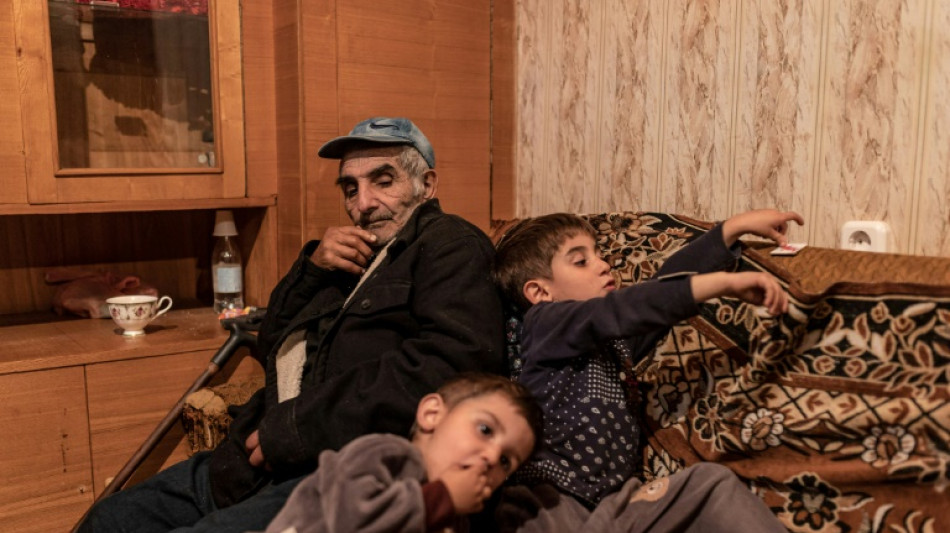
Is the Karabakh conflict about religion, Armenians wonder / Photo: © AFP

 South African election results renew debate over identity-based voting

 South African voters report smoother local election but declining IEC trust

 Dolly Parton museum and Nashville hotel open after singer’s death

 George and Amal Clooney attend New York political-comedy reading

 British buyers pay substantial premiums for period-home appearance

 Thomas Markle released to house arrest after child-abuse-image charge

 Dawn of War 4 developers chose Adeptus Mechanicus for tactical variety

 Italy face unbeaten South Africa in Turin Nations Championship match

 ChatGPT interactive interface feature tested across six custom tools

 Freshways milk-price cut deepens pressure on UK dairy farms

 Labour and National remain virtually tied as New Zealand vote count advances

 The Good Daughter adapts Karin Slaughter thriller with Rose Byrne and Meghann Fahy

 Heavy-lift drone evacuates wounded Ukrainian soldier from frontline kill zone

 Morrison says West Brom recovered after pressure from successive derby losses

 Britain considers 2027 state visit for Ukraine’s Zelensky

 Arizona Democrats Secure Historic Trifecta with New Legislative Leadership

 Carney Welcomes U.S. Trade Reversal After Democratic Midterm Victory
With its manicured lawns and ancient cross-stones, the church of Saint Gregory in Goris is a haven of peace in the chaos of a city full of Armenians fleeing Nagorno-Karabakh.
Anush Minassian, Bible in hand, came to ask Father Vardapet Hakobyan, a priest from the Armenian Apostolic Church diocese of Syunik, to bless her two daughters.
They just arrived to Armenia from Stepanakert, the capital of the self-proclaimed republic of Nagorno-Karabakh, which is set to disappear at the end of the year.
Minassian had no news of her husband, who was reported missing when a petrol station near Stepanakert exploded on September 25, killing early 200 people.
She had scant hope of finding him alive.
This was not the only fear eating away at the 41-year-old worshipper.
In September, mainly Muslim Azerbaijan seized Nagorno-Karabakh, which was populated by Christian ethnic Armenians.
More than 100,000 of its 120,000-strong population have fled the territory, where there has been a Christian presence for more than a millennium and which is home to numerous Armenian holy sites.
"Everything is threatened. Our Christianity is threatened," she said. "We'll have to fight to salvage what's left."
- 'Rewriting history' -
Since the collapse of the Soviet Union and a war between Armenia and Azerbaijan in the 1990s that killed 30,000, Yerevan has accused Baku of rewriting history to stake its claim to Nagorno-Karabakh and say Armenians shouldn't be there.
Armenians have dark memories of the bombing in 2020 of the Shusha cathedral in Karabakh, a symbol of Armenian religious identity.
Nor have they forgotten the destruction two decades ago of the medieval Armenian cemetery in Julfa.
The graveyard in the Azerbaijani exclave of Nakhichevan once contained thousands of intricately carved memorial cross-stones, or khachkars.
Father Hakobyan gives short shrift to Azerbaijan's pledge to respect Armenian rights and culture.
He is convinced Baku is out to eradicate all traces of Christianity from this part of the Caucasus.
"The Christian world must stand up to this genocide," he said. "Otherwise everything is lost."
In the Armenian capital, Yerevan, 200 kilometres (125 miles) to the northwest, the Saint Sarkis cathedral was packed for the "national day of prayer for Artsakh", the Armenian name for Nagorno-Karabakh.
A relic of the military saint -- his right hand coated in silver -- was brought in for the occasion from the cathedral in Echmiatsin, the seat of the Armenian Apostolic Church.
Azerbaijan's lightning takeover of Karabakh on September 20 has disrupted the Church's calendar.
It postponed the ceremony planned for October 1 to bless Saint Myron, a religious event that takes place every seven years and brings together Armenian Apostolic Churches from around the world.
- Iran-Armenia alliance? -
But not everyone sees the Nagorno-Karabakh conflict as a religious one.
"It's a war for territory, that's all," Saint Sarkis priest Shahe Hayrapetyan, who has a soft voice and sparkling eyes, told AFP.
He offered an example: Shiite Muslim Iran, which shares a 50-kilometre border with Armenia, is home to several thousand Armenians who are free to practise their Orthodox faith.
Many Armenians feel let down by Russia, their historic Orthodox backer, and have little faith in the comforting noises coming from Western capitals.
Instead, they consider Iran to be the only remaining ally they can trust.
The government in Tehran has warned its Azerbaijani counterpart against any attempt to create a land corridor through Armenian territory to link Azerbaijan proper to Nakhichevan and Turkey.
Iran has both commercial and political motives for opposing the Zangezur Corridor project.
It wants to keep a foothold in the Caucasus and prevent Azerbaijan creating a land link to its ally Turkey, a member of the US-led NATO military alliance.
"I don't believe this conflict has have religious origins," says 35-year-old Edmon Harutiuniyan, a worshipper at Saint Sarkis.
"Look: in recent months, Iran has helped Armenia more than any other country."
The tourist guide, who prays with fervour, clasping his clenched fist to his chest, says Armenians "don't have a problem with Islam".
He points out that there are politicians of Armenian origin in many Muslim-majority territories, from Lebanon and Syria in the Middle East through Central Asia and the region of Tartarstan in European Russia.
"Our conflict with the Turks and the Azerbaijanis is about our very existence," he says.
"They're the ones trying to turn it into a religious conflict."
D.Bachmann--VB