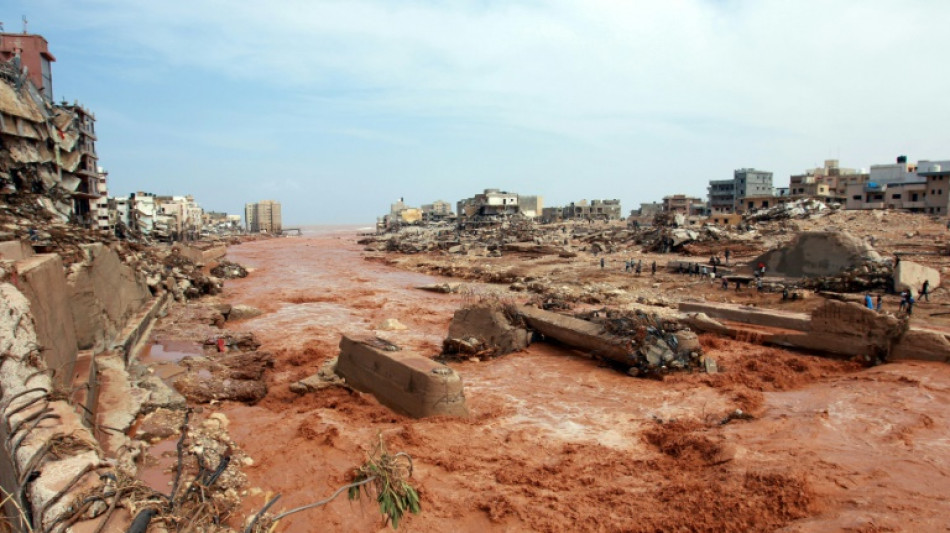
Libya flood relief hampered by 'turf wars' and division / Photo: © AFP/File

 South African election results renew debate over identity-based voting

 South African voters report smoother local election but declining IEC trust

 Dolly Parton museum and Nashville hotel open after singer’s death

 George and Amal Clooney attend New York political-comedy reading

 British buyers pay substantial premiums for period-home appearance

 Thomas Markle released to house arrest after child-abuse-image charge

 Dawn of War 4 developers chose Adeptus Mechanicus for tactical variety

 Italy face unbeaten South Africa in Turin Nations Championship match

 ChatGPT interactive interface feature tested across six custom tools

 Freshways milk-price cut deepens pressure on UK dairy farms

 Labour and National remain virtually tied as New Zealand vote count advances

 The Good Daughter adapts Karin Slaughter thriller with Rose Byrne and Meghann Fahy

 Heavy-lift drone evacuates wounded Ukrainian soldier from frontline kill zone

 Morrison says West Brom recovered after pressure from successive derby losses

 Britain considers 2027 state visit for Ukraine’s Zelensky

 Arizona Democrats Secure Historic Trifecta with New Legislative Leadership

More than three weeks after Libya's deadly flood disaster, the divided country's two rival administrations remain bitterly at odds on how to manage the massive aid and reconstruction effort.
The aftermath of the disaster on September 10-11 has seen the rival camps in the east and west of the war-scarred country both announce their own plans for a reconstruction conference.
The United Nations, Western governments and international observers warn that Libya's dysfunctional politics are hampering efforts to help the tens of thousands of displaced survivors rebuild their lives.
The UN mission chief in Libya, Abdoulaye Bathily, stressed Monday that the competing efforts "are counterproductive, deepen the existing divisions in the country (and) impede reconstruction efforts".
The United States, Britain, France, Germany and Italy backed his call for "a unified Libyan national mechanism" coordinated with international partners "to deliver transparent and accountable relief".
Claudia Gazzini of think-tank the International Crisis Group warned that Libya's two rival administrations might "use this crisis in opportunistic ways", including by possibly diverting funds.
"There are already signs of turf wars (and corresponding disinformation campaigns) between the rivals over who should take charge of reconstruction efforts," she warned.
The humanitarian needs are enormous in the devastated eastern city of Derna, where a huge flash flood broke through two upstream dams and swept entire neighbourhoods into the Mediterranean, leaving behind an apocalyptic wasteland.
Local authorities have declared a death toll of 3,845, but have yet to release an official figure of how many people remain missing -- a number international aid groups put at around 10,000 in the first days after the disaster.
The scale of the destruction was blamed on the sheer volume of the rains brought by hurricane-strength Storm Daniel, and on the impact Libya's years of chaos have had on critical infrastructure, early-warning systems and emergency response.
- Years of chaos -
The oil-rich North African nation has been in turmoil ever since a 2011 NATO-backed popular uprising led to the overthrow and killing of longtime dictator Moamer Kadhafi.
Years of fighting followed involving myriad tribal militia, jihadists and foreign mercenaries as the country also became a gateway for Europe-bound irregular migrants, many of whom have suffered severe human rights abuses in Libya.
Libya now remains split between two former battlefield enemies: a UN-backed government based in the capital Tripoli in the west, and the disaster-hit east, backed by military strongman Khalifa Haftar.
Haftar is close to Russia and its Wagner mercenary group and to the oil-rich United Arab Emirates, which led the early disaster relief effort.
After the flood, the eastern government was quick to invite the "international community" for a donor conference scheduled for October 10, an announcement met with scepticism abroad.
It has since postponed the meeting until November 1.
Eastern officials have also distributed cheques for aid and compensation to mayors of flood-hit municipalities, an effort documented in photos published online.
The Libyan parliament, based in the major eastern city of Benghazi, meanwhile announced it had allocated 1.9 billion euros for reconstruction, without specifying how it would be spent.
Illustrating the institutional chaos, it was Libya's western-based government that announced around 18 million euros in aid for flood-damaged schools in the east.
- 'Breaking the stalemate' -
US ambassador Richard Norland cautioned that "the Libyans must establish the structures that bring authorities from across the country together to agree on priority expenditures and ensure funds are efficiently and properly allocated".
"We urge Libyan authorities now to form such unified structures -– rather than launching separate efforts -– that represent the Libyan people without delay."
The UN's Bathily said that "the Libyan people have expressed their concerns about arbitrary cost estimates and unilateral reconstruction initiatives announced without transparency and buy-in from all relevant authorities and stakeholders".
He urged "a unified national mechanism" to steer a speedy reconstruction effort "based on a credible, independent and objective assessment of the damage and needs, professionally determined cost estimates, and transparent contracting and procurement processes."
More broadly, Bathily called for renewed efforts toward national unity and elections, stressing that "the impact of Storm Daniel also underscores the imperative to expedite negotiations on breaking the political stalemate".
B.Wyler--VB