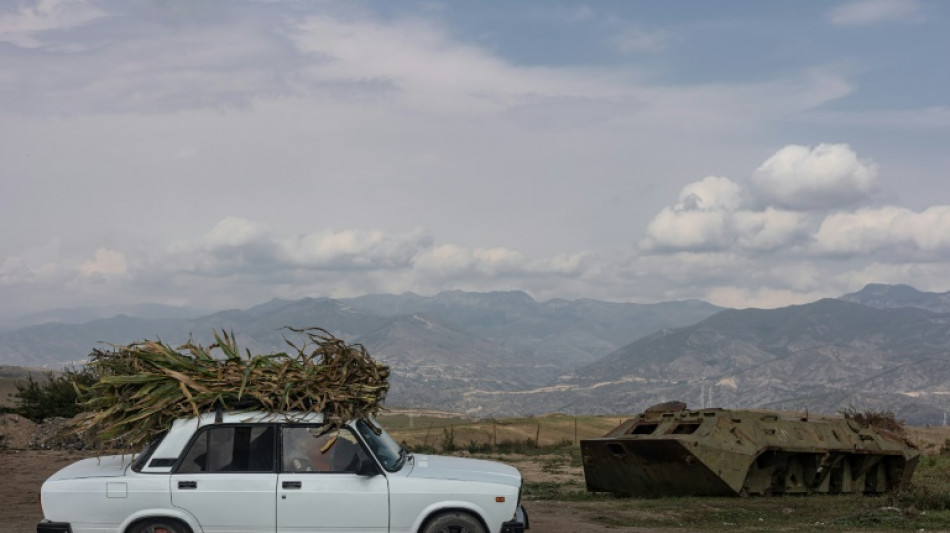
Armenia ratifies ICC founding treaty, angering Russia / Photo: © AFP

 South African election results renew debate over identity-based voting

 South African voters report smoother local election but declining IEC trust

 Dolly Parton museum and Nashville hotel open after singer’s death

 George and Amal Clooney attend New York political-comedy reading

 British buyers pay substantial premiums for period-home appearance

 Thomas Markle released to house arrest after child-abuse-image charge

 Dawn of War 4 developers chose Adeptus Mechanicus for tactical variety

 Italy face unbeaten South Africa in Turin Nations Championship match

 ChatGPT interactive interface feature tested across six custom tools

 Freshways milk-price cut deepens pressure on UK dairy farms

 Labour and National remain virtually tied as New Zealand vote count advances

 The Good Daughter adapts Karin Slaughter thriller with Rose Byrne and Meghann Fahy

 Heavy-lift drone evacuates wounded Ukrainian soldier from frontline kill zone

 Morrison says West Brom recovered after pressure from successive derby losses

 Britain considers 2027 state visit for Ukraine’s Zelensky

 Arizona Democrats Secure Historic Trifecta with New Legislative Leadership

Armenian lawmakers approved a key step towards joining the International Criminal Court (ICC) on Tuesday, a move that is expected to escalate tensions with the ex-Soviet country's historic ally Moscow.
Russia had warned Armenia against voting to ratify the founding treaty of the ICC, after the international court in March issued an arrest warrant for President Vladimir Putin over the war in Ukraine and the illegal deportation of children to Russia.
ICC members are expected to make the arrest if the Russian leader steps foot on their territory.
The vote illustrated a growing chasm between Moscow and Yerevan, which has grown angry with the Kremlin over its perceived inaction over Armenia's long-standing confrontation with Azerbaijan.
Azerbaijani forces last month swept through the breakaway region of Nagorno-Karabakh -- where Russian peacekeepers are deployed -- and secured the surrender of Armenian separatist forces that had controlled the mountainous region for decades.
A broadcast online from the Armenian parliamentary session showed 60 deputies voting in favour of the proposal, with 22 -- mainly opposition lawmakers -- voting against joining the ICC.
The Kremlin had said a decision in Armenia to join The Hague-based court would be viewed in Moscow as "extremely hostile."
Tensions have also been rising between Yerevan and Moscow over the role of Russian peacekeepers in the Karabakh region of Azerbaijan, which announced its dissolution last week following the lightning military operation by Baku.
- 'External security risks' -
Armenian's Prime Minister Nikol Pashinyan last week sought to assuage Kremlin fears, saying the initiative was not "directed against" Russia.
"It comes from the interests of the country's external security, and taking such a decision is our sovereign right," he said.
On Tuesday, Armenia's representative on international legal matters, told parliament that the decision was focused on the country's security concerns.
"We are creating additional guarantees for Armenia" in the face of the threat to the country's territorial integrity from arch-foe Azerbaijan, said Eghishe Kirakosyan.
It was an apparent reference to May 2021, when Azerbaijani forces occupied a small pocket of land inside Armenia, near the countries' shared border.
The arch foes have been locked in a decades-long rivalry and fought two wars over Karabakh, in the 1990s and 2020.
Kirakosyan said that Yerevan had proposed signing a bilateral agreement with Moscow to alleviate Russia's concerns over the ratification of the Rome Statute.
Armenia signed the Rome Statute in 1999, but did not ratify it, citing contradictions with the country's constitution.
The constitutional court said in March those obstacles were removed after Armenia's adoption of a new constitution in 2015.
- One-day offensive -
After the offensive in September, most of the Armenian population fled the self-proclaimed republic of Karabakh, whose authorities announced that it would be dissolved by 1 January 2024.
After the fall of the Russian Empire, the mountainous region, populated mainly by Armenians who regard it as part of their ancestral land, has been part of Azerbaijan.
It unilaterally proclaimed its independence with the support of Armenia when the Soviet Union collapsed in 1991.
Karabakh separatists resisted Baku with the support of Yerevan for three decades, notably during the first Karabakh war from 1988 to 1994 and the second in 2020.
That six-week war ended in a deal brokered by Russia that saw the 2,000-strong peacekeeping contingent deployed.
The international community never recognised the self-proclaimed republic.
G.Frei--VB