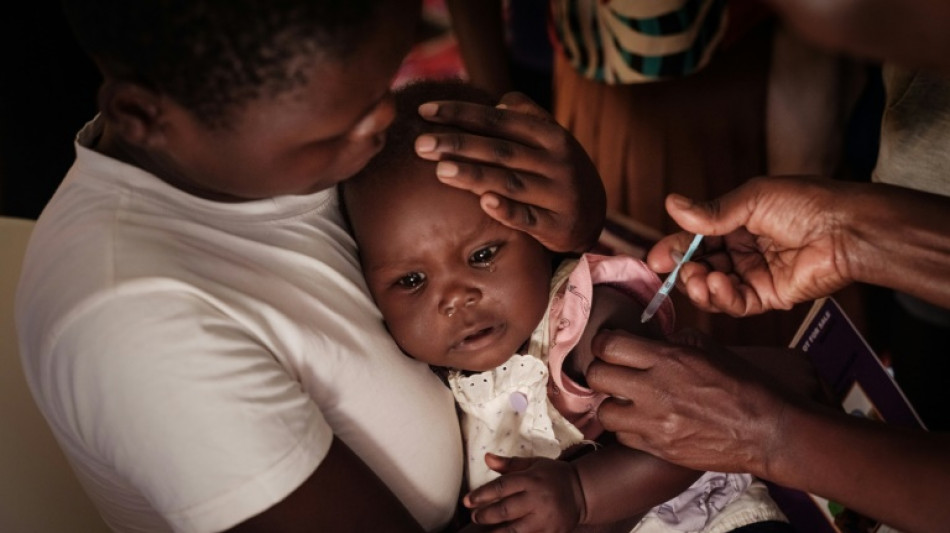
WHO recommends second malaria vaccine for children / Photo: © AFP

 South African election results renew debate over identity-based voting

 South African voters report smoother local election but declining IEC trust

 Dolly Parton museum and Nashville hotel open after singer’s death

 George and Amal Clooney attend New York political-comedy reading

 British buyers pay substantial premiums for period-home appearance

 Thomas Markle released to house arrest after child-abuse-image charge

 Dawn of War 4 developers chose Adeptus Mechanicus for tactical variety

 Italy face unbeaten South Africa in Turin Nations Championship match

 ChatGPT interactive interface feature tested across six custom tools

 Freshways milk-price cut deepens pressure on UK dairy farms

 Labour and National remain virtually tied as New Zealand vote count advances

 The Good Daughter adapts Karin Slaughter thriller with Rose Byrne and Meghann Fahy

 Heavy-lift drone evacuates wounded Ukrainian soldier from frontline kill zone

 Morrison says West Brom recovered after pressure from successive derby losses

 Britain considers 2027 state visit for Ukraine’s Zelensky

 Arizona Democrats Secure Historic Trifecta with New Legislative Leadership

The UN's health agency on Monday recommended a second malaria vaccine for children, which could save hundreds of thousands of lives by plugging a huge supply and demand gap.
Nearly half a million children in the African region die every year from the disease, which is caused by a parasite carried by mosquitoes.
"As a malaria researcher, I used to dream of the day we would have a safe and effective vaccine against malaria. Now we have two," said World Health Organization chief Tedros Adhanom Ghebreyesus.
The new R21/Matrix-M vaccine, developed by Britain's Oxford University and manufactured by the Serum Institute of India, has already been approved for use in Burkina Faso, Ghana and Nigeria.
In 2021, the RTS,S vaccine, produced by British pharmaceutical giant GSK, became the first to be recommended by the WHO to prevent malaria in children in areas with moderate to high malaria transmission.
"Demand for the RTS,S vaccine far exceeds supply, so this second vaccine is a vital additional tool to protect more children faster, and to bring us closer to our vision of a malaria-free future," Tedros said.
- Deadly disease -
Almost half the world's population lives in a malaria high-risk area, with the vast majority of cases and deaths occurring in Africa.
The WHO's regional director for Africa, Dr Matshidiso Moeti, said the new vaccine held great potential for the continent by helping to close the huge demand-and-supply gap.
"Delivered to scale and rolled out widely, the two vaccines can help bolster malaria prevention and control efforts and save hundreds of thousands of young lives in Africa from this deadly disease," she said.
Pilot programmes to introduce the RTS,S vaccine in three countries -- Ghana, Kenya and Malawi -- have enabled 1.7 million children to receive at least one dose since 2019.
These programmes have led to a substantial reduction in severe and fatal forms of malaria, and a drop in child mortality.
At least 28 African countries plan to introduce a WHO-recommended malaria vaccine as part of their national immunisation programmes, the WHO said.
It added that the RTS,S vaccine will be introduced in some African countries in early 2024, and the R21 vaccine is expected to be available in mid-2024.
The two vaccines have similar efficacy rates of around 75 percent when administered under the same conditions.
The cost-effectiveness of the new vaccine would be comparable to other childhood vaccines, with a dose of R21/Matrix-M costing between $2 and $4, the WHO said.
The organisation and its partners expect requests for up to 60 million doses a year by 2026, Gavi, the Vaccine Alliance said in a statement.
This figure is expected to rise to up to 100 million doses by 2030.
-Dengue, meningitis, Covid-
Beyond malaria, the WHO recommended a new dengue vaccine, Qdenga, for six to 16 year olds in areas where the disease is a major public health problem.
Its experts also recommended a new meningitis vaccine, Men5CV, which protects against five species of disease-causing bacteria.
The health agency also said that in the fight against Covid-19, a single dose of most vaccines is now sufficient for primary immunisation against the disease, given that most people have already been infected at least once.
T.Suter--VB