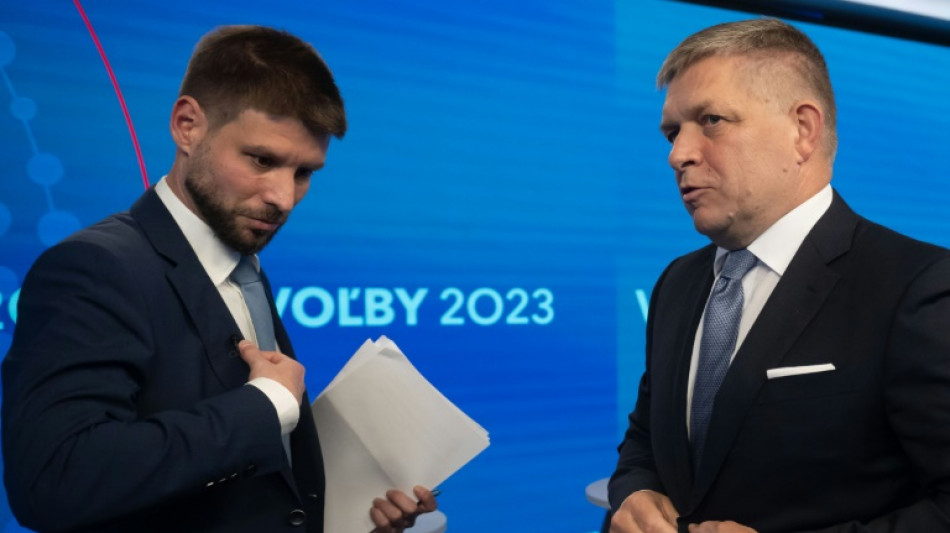
Slovaks vote in tight polls key for foreign policy, Ukraine aid / Photo: © AFP

 South African election results renew debate over identity-based voting

 South African voters report smoother local election but declining IEC trust

 Dolly Parton museum and Nashville hotel open after singer’s death

 George and Amal Clooney attend New York political-comedy reading

 British buyers pay substantial premiums for period-home appearance

 Thomas Markle released to house arrest after child-abuse-image charge

 Dawn of War 4 developers chose Adeptus Mechanicus for tactical variety

 Italy face unbeaten South Africa in Turin Nations Championship match

 ChatGPT interactive interface feature tested across six custom tools

 Freshways milk-price cut deepens pressure on UK dairy farms

 Labour and National remain virtually tied as New Zealand vote count advances

 The Good Daughter adapts Karin Slaughter thriller with Rose Byrne and Meghann Fahy

 Heavy-lift drone evacuates wounded Ukrainian soldier from frontline kill zone

 Morrison says West Brom recovered after pressure from successive derby losses

 Britain considers 2027 state visit for Ukraine’s Zelensky

Slovaks voted on Saturday in a tight early election seen as key to whether the country will keep supporting neighbouring Ukraine after a campaign marked by disinformation.
Polling stations across the EU and NATO member of 5.4 million people will close at 2000 GMT, with exit polls expected shortly afterwards and the final results due on Sunday morning.
"Things should move forward a bit here... we have to vote to choose the best possible government to orchestrate this process," Stefan, 53, told AFP at a polling station in Bratislava, giving only his first name.
Pensioner Emilia Divilekova, also voting in the capital, said her son had left Slovakia dismayed with the "gang of mafia, thieves and murderers" ruling the country.
"He now lives 900 kilometres away from home and I would like him to be able to come back."
Two parties were neck-and-neck in the final opinion polls -- the left-wing Smer-SD of populist former premier Robert Fico and the centrist Progressive Slovakia of European Parliament vice-speaker Michal Simecka.
Both parties scored around 20 percent backing, which means the likely election winner will need help from smaller parties to form a majority coalition in the 150-seat parliament.
The new government will replace a wobbly centre-right coalition in power since 2020, which has seen three cabinets installed over the period.
In the heated election campaign involving several brawls between candidates, Fico has taken aim at the EU and NATO as well as the LGBTQ+ minority.
He has also rejected providing any further military aid to Ukraine, which has been battling a Russian invasion since February 2022.
Simecka has vowed to rid Slovakia of "the past", referring to Fico's three terms as prime minister in 2006-2010 and 2012-2018, and is urging Slovaks to "elect the future".
"These elections, I think they are deciding about the future orientation of our country in foreign policy, defence and security policy, but also about... the future of democracy," independent political analyst Grigorij Meseznikov told AFP.
- 'Fear factor' -
The campaign was marked by disinformation affecting half of the nation, according to analyses.
Even during the two-day campaign moratorium ahead of the vote, Simecka was targeted by a fake video.
Slovakia emerged as an independent country in 1993, following a peaceful split with the Czech Republic after Czechoslovakia shed a totalitarian communist rule of four decades in 1989.
Slovak President Zuzana Caputova told AFP she would tap the election winner to form the next cabinet.
The choice of coalition partners is fairly broad, with 11 parties expected to win parliamentary seats.
Although many Slovak voters have experience with the Moscow-steered communist regime, many are expected to vote for populists like Fico who are vowing to stop military aid to Ukraine.
"The fear factor might play a role since we are Ukraine's neighbour, and people are longing for peace, which is what we will all agree on," said Caputova.
"But some think peace can be achieved by stopping any aid to Ukraine, and that's where I disagree," added the 50-year-old former lawyer, whose five-year term expires next year.
- 'More or less equal' -
Fico is likely to woo Smer-SD's spin-off Hlas-SD, led by former Smer-SD vice-chairman Peter Pellegrini.
Pellegrini replaced Fico as premier in 2018 after Fico had to step down amid nationwide protests following the murder of journalist Jan Kuciak and his fiancee.
Kuciak uncovered links between the Italian mafia and Fico's government in his last article published posthumously.
Fico's other potential partners are the newly formed far-right Republic and the Slovak National Party (SNS), with whom he had already ruled twice.
Progressive Slovakia will in turn be looking at the parties of the outgoing centre-right coalition -- Freedom and Solidarity, OLaNO, We Are Family and For People.
"Today, the positions of both groupings, national populist and pro-democratic, are more or less equal concerning the support of these parties," said Meseznikov.
T.Germann--VB