Foragers and popsicle sellers: a micro-economy among US migrants / Photo: © AFP

 Indonesia central bank chief steps down early: govt
 Gaza teen triumphs despite war, loss and displacement

 Whales at risk, hungry pelicans: Marine heat wave hits California

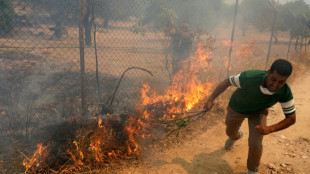
 With minutes to flee, Spain fire evacuees grab what they can

 Ioane, Holland back for All Blacks' blockbuster South Africa tour

 Beltran, Kent and Jones join Baseball Hall of Fame
 New pro Koivun holds off Scheffler to win PGA 3M Open

 Masood leads Pakistan to 199-3 against West Indies

 UK's Burnham to welcome Zelensky in first foreign leader visit

 Pogacar looking to enjoy 'small things' after 5th Tour de France win
 Ramsay-Peaty hatches 'battle plan' to bounce back from Commonwealth Games tears

 Lucas Museum to display unseen 'Star Wars' pieces, curator says

 Del Toro, Seixas show glimpse into Tour de France future

 Tour stage win 'not from my toes', says Van der Poel

 Honduran ex-president returns home after Trump pardon
 Pogacar wins record-equalling fifth Tour de France

 Verstappen grumbles as he roars to second in 'undriveable' car
 France, Spain battle 'unpredictable' wildfires as 325,000 evacuated

 Norris heaps praise on McLaren for updated car and victory

 Hearn says Fury-Joshua must take place in UK under current deal

 Scotland's Ward wins Commonwealth gymnastics title, Ramsay-Peaty bounces back in the pool

 French firefighters face 'pyrocumulonimbus' for first time
 Urgent search for suspect after deadly 'Islamist terror' attack near Berlin Pride

 Spain football coach De la Fuente visits Madrid wildfire evacuees

 Malaysia steps in to host Bahrain F1 GP in October

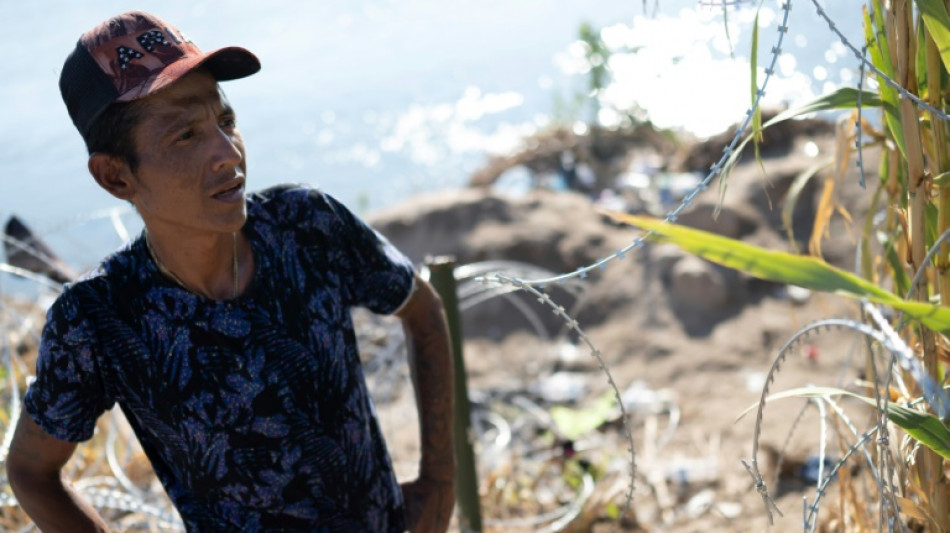
Marco Gonzalez used to fish the river between Mexico and Texas, but now he has a more lucrative harvest -- possessions abandoned by the thousands of migrants crossing the border from the south.
Crowds of people reach the border every day, after long, dangerous and difficult journeys from Africa, Asia or South America.
Their discarded backpacks, clothes or blankets sustain a cottage industry of foragers, part of a micro-economy that feeds off the stream of humanity desperate to get into the United States.
"Once, when I was fishing, I found $100 in a bag, and so I started coming here," 37-year-old Gonzalez told AFP on the banks of the Rio Grande.
"And since now there's a ton of clothes here all over... I thought, I'm staying."
- 1.8 million -
In the last 11 months, at least 1.8 million people have reached the southern US border, many of them searching for safety and economic opportunity they could not find in their own countries.
The soaring numbers are a political headache for President Joe Biden, whose Republican opponents are hammering the issue, a year out from an election.
Thousands enter the country illegally every day, some swimming across the perilous waters of the Rio Grande. As they do, they often abandon possessions that weigh them down.
"I only kept my papers and some shoes," Venezuelan Francis Ibarra told AFP.
"I left the clothes from the river there because they were all wet."
For officers patrolling the US side of the banks and islands on the Rio Grande, the scavenging is now just part of the daily landscape.
"It's become a way of life for people who live on the border," one Texas National Guardsman told AFP, on condition of anonymity because he was not authorized to speak to the media.
"You see them in cities -- they come to look for things to sell or exchange. Some make a living from it; others do it to help migrants."
Clothes and bags dot the island that lies halfway between the Mexican city of Piedras Negras and Eagle Pass in Texas, cast off by people who stopped to rest after their first dash into the current.
As an AFP team watched, a man and two children picked through the detritus, looking for anything worth having.
Even more accumulates on the US side of the river, where migrants believe they will be ordered to leave their possessions if they meet Customs and Border Protection officers on the other side of the razor wire.
For Gonzalez, it is here that offers the richest pickings.
What he gathers, he can give to an NGO that helps migrants in Piedras Negras.
"The woman there, since she already knows me, gives me a good meal, rice, beans, oil, and toilet paper," he said.
More enterprising still is Sixto Gomez, who used to sell popsicles in Piedras Negras, but now plies his trade on the river.
"I sell more here than in the city, and no one bothers me, who is going to come here?" he asks.
On the island in the middle of the river he asks 15 pesos (85 US cents) for a popsicle, but on Sunday when a logjam formed at the razor wire, he crossed to the US bank to peddle his wares -- and raised his price to 20 pesos.
"Here it is more expensive," he told AFP. "This is America."
L.Wyss--VB