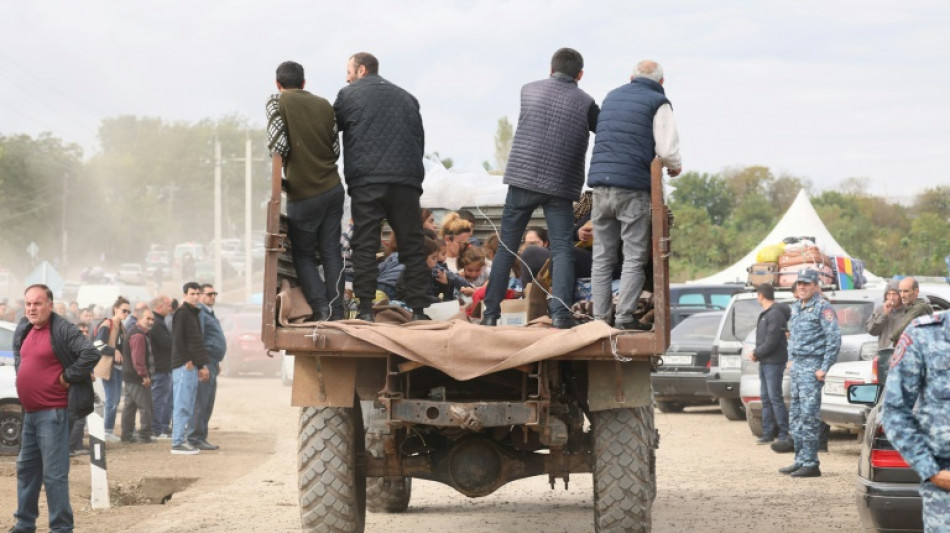
Karabakh exodus grows after offensive, as fuel blast kills 20 / Photo: © AFP

 Dana White Confirms Flight to Washington for Trump Meeting on Press Secretary Role

 Dengue Fever Expands Into High Himalayas as Climate Change Warms Nepal

 IoT Refrigerator Hacks Disrupt Blood Labs and Supermarkets Across Europe and US

 Post-election pressures complicate US and Israeli decisions on Iran

 UN members approve talks on treaty protocol against environmental crime

 Family-run West Sussex beach café prepares for first winter season

 CT scans reveal health and burial clues from Egypt’s Braided Lady mummy

 Oxford faces complaints over lecturer’s classroom attire

 Kyren Wilson and John Higgins reach International Championship snooker final

 New Zealand and Tonga meet for place in Rugby League World Cup final

 Reports of unsafe AI-toy responses renew calls for child-safety rules

 Juneau food network combines difficult supply routes with deep sharing traditions

 India climbs green-transition ranking after first emissions decline in 25 years

 Trump names Stephen Miller as White House chief of staff after midterm losses

 Restored Albanian tower houses anchor new rural tourism trail

 Sonia Gandhi reflects on family tragedy and reluctant political career

 Pope Leo begins three-country South American tour in Uruguay

 Khawaja says entire Australia camp knew of 2018 ball-tampering plan
Thousands more Armenian refugees fled Nagorno-Karabakh on Tuesday as officials in Azerbaijan's war-scarred separatist statelet raised the death toll from a fuel blast to 20.
The number of deaths from Monday's disaster threatened to grow much higher because dozens were being treated in critical condition and many remained unaccounted for.
Most of the victims were stocking up on fuel for the trip down the so-called Lachin Corridor connecting the impoverished and historically disputed region with Armenia.
Yerevan has warned of possible "ethnic cleansing" by Azerbaijan -- a close ally of Armenia's arch-nemesis Turkey -- after Baku claimed full control of the region in a lightning offensive last week.
Armenians, mostly Christian, and Azerbaijanis, mostly Muslim, have fought two wars over the mountainous territory since the Soviet Union's 1991 collapse that has claimed tens of thousands of lives.
The area is now populated by up to 120,000 ethnic Armenians but is internationally recognised as part Azerbaijan.
Armenia said on Tuesday that more than 13,000 refugees had fled since the first group arrived in the country on Sunday.
An AFP team along the Lachin Corridor saw hundreds of cars piled high with belongings moving slowly along the jam-packed road.
Some of the vehicles crept along on flat tyres and many people simply walked past the last Azerbaijani checkpoint.
"They expelled us," one man said as he walked past the Azerbaijani soldiers.
The influx overwhelmed the border town of Goris -- the first port of call for most families.
"We lived through terrible days," said Anabel Ghulasyan, 41, from the village of Rev, known as Shalva in Azeri.
Many slept in their cars, emerging on Tuesday with red-rimmed eyes and forming long queues outside shops to buy phone cards.
- Fears of higher toll -
Adding to the humanitarian drama, the separatist government on Tuesday said 13 bodies were found at the scene of a fuel depot blast on Monday and seven more people had died of their injuries.
It said 290 people had been hospitalised and "dozens of patients remain in critical condition".
Armenia's health ministry said it had sent a team of doctors to the rebel stronghold of Stepanakert by helicopter.
The Azerbaijani presidency said Baku had also sent medicine to help the wounded.
But treatment was being complicated because local hospitals had run low on medications after a nine-month blockade Azerbaijan had imposed to bring the region to heel.
Azerbaijan turned on the electricity of the rebel stronghold Stepanakert on Sunday, switching it to its own power grid as part of a "reintegration" drive.
Envoys from Baku and Yerevan were in Brussels on Tuesday to pave the way for the first meeting between their leaders since last week's offensive on October 5.
Tuesday's talks between national security advisers of the two countries and European heavyweights Germany and France will be chaired by the chief diplomatic adviser to European Council president Charles Michel.
- Chaos -
Azerbaijan's operation on September 19 to seize control of the territory forced the separatists to lay down their arms under the terms of a ceasefire agreed the following day.
The separatists have said 200 people were killed in last week's fighting.
Azerbaijan's state media on Monday said officials held a second round of peace talks with Nagorno-Karabakh's ethnic Armenian community aimed at "reintegrating" them.
The question of staying or leaving is now tormenting many Armenian families.
Some say that they cannot live under the authority of Azerbaijanis, while others argue that leaving now means that Armenians might never be able to return, losing the region for good.
"If I do have a chance to come back, I will," said Khachatur Aydinyan, a 62-year-old shepherd.
"I am sad to leave my sheep behind."
Those who do decide to go often run the risk of losing contact with friends or family members waiting for them on the other side of the border in the chaotic sea of people.
"They left Stepanakert yesterday, but I have heard nothing since because there is no cell phone service."
burs-zak/yad
U.Maertens--VB